
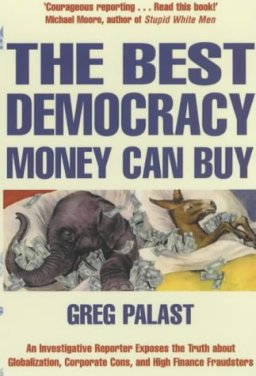
Greg Palast
London: Robinson, 2003,
£7.99, p/b
As the war on Iraq has reminded us, journalism can be a dangerous vocation: the nearer a reporter, photographer or filmmaker gets to the action, the greater the risks run. Away from the shooting, the hazards are different, though only a little less potent, and Greg Palast experienced quite a few of them when he brought his brand of clever, witty and vigorous exposure to bear on the Blair government in 1998. For detailing the corruption at the heart of New Labour in his Lobbygate reports in The Observer (see Lobsters 36 and 38), Palast was branded a liar on the front page of the then Blair-backing Daily Mirror. He was then set up to appear as a sex pest at Labour Party conference. This is not treatment the pliant press lobby around No. 10 are ever likely to suffer.
Palast is now back in his native USA where his latest revelation is the Congressional decision to export the flawed Florida election system which took George W Bush into the White House to the rest of the country.
This book – like Michael Moore’s Stupid White Men, little loved by the political and journalistic establishment – is happily proving a big seller, and with good reason. For Palast brings together globalisation, corporate corruption and the politics of energy and high finance not as some fringe, abstruse theoretical work, but as news stories – the stuff real people listen to, watch and read because it touches their lives.
That’s why the Blair machine tried to destroy him. For although his Lobbygate exposure of No 10 adviser Roger Liddle and the corrupt New Labour apparatchiks who sold their address books for fat fees first appeared in a nervous Observer then edited – badly by most accounts – by Will Hutton, its significance could not be ignored by the tabloids. That none managed to force out Liddle or even prompt complacent Parliamentarians to investigate the serious issues he raised prompts Palast to characterise British attitudes as ‘kissing the whip’.
In pulling together the worlds of Enron, New Democrats and little sister New Labour, Wall Street, the IMF, the WTO, the Third Way, privatised schools and prisons, election manipulation and a cringing press, Palast sets out the ground on which a new radical politics is being built. Along the way he doesn’t just upset the Blairs of this world: he rumbles some well-heeled ‘lefties’ from less challenging climes, not least Christopher Hitchens.
Hitchens attacked a Palast piece on British censorship for being marked by ‘ignorance and pettiness’. Palast answers his accuser and then mocks him – and this is years before Hitchens becomes known as a supporter of the George W’s war on Iraq – as ‘a British transplant in America, whose posh accent and carefully hedged nastiness made him New York’s favourite cocktail party revolutionary’. Punctured pomposity is one of the flesh wounds of writing. Palast’s is the journalism that deserves a medal.