
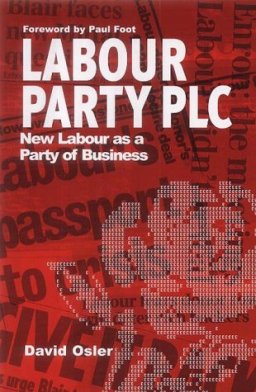
Labour Party PLC
David Osler
Edinburgh: Mainstream Publishing, £15.99, 2002
Colin Challen MP
Having written a history of Conservative Party funding, (1) I had been wondering when somebody would get round to doing a similar job on Labour. However, Labour Party plc is more than a simple history of party financing, it seeks to show that Labour, or should we say New Labour has become a slave to the private sector, thus turning its back on its roots. All the well-trodden paths are examined Mittal, Ecclestone, Maxwell, Hinduja brothers et al. As such, Labour Party plc is a useful compendium of all the dubious episodes of Labour/business interaction which demonstrate what we always feared: the American model of business politics has achieved a much greater purchase on the British scene than most people would think healthy. The US model, to recap, is more concerned with personality than partisanship. It’s all about the freedom conferred by the ‘What’s right is what works’ philosophy as expressed, e.g. by Dick Morris, a former senior Clinton aide who said:
‘That’s why the centre is so viable, and that’s my idea of triangulation: take the best of each and merge them. That’s not political immorality, it’s an act of political sagacity and a recognition of the notion of Hegelian triangle the thesis, the antithesis, and the synthesis which Hegel posits and which Marx and I agree is how history moves forward.’ (2)
So when a senior Labour politician was challenged about the immorality or otherwise of taking a large donation from Richard Desmond, the pornographer, we were told morality wasn’t at issue. No wonder that grassroots political party structures are on the wane in the UK! The Conservatives may still claim to be the largest party with 370,000 members to Labour’s 260,000, but the Tories used to claim 3 million. Pragmatism is not the world’s greatest recruiting sergeant it would seem.
In each U.S. state there are unlikely to be more than one or two full-time party employees and very few activists. During election periods this is compensated for by the temporary recruitment of consultants, whose role is chiefly to manage mass-media advertising, divided between television and direct mail. Permanent grass roots activity barely exists. So, too, the drop in British grass roots activity is compensated for with huge centralised budgets: hence the demand for large scale donors. The background of these donors may have been Conservative in some cases but that doesn’t matter: every pound that comes Labour’s way is a pound less for the Tories, and the bigger the ‘turncoat’ the better, since it all goes to enhance Labour’s dominance of the Hegelian triangle.
Reducing the position of trade unions
In great measure Labour’s dalliance with rich people was designed to broaden its financial base and reduce the preeminent position of trade unions. A party that could appeal equally to trade unions and business would truly be ‘one nation’, the natural party of government and so on. According to the most recent opinion polls, this strategy has held good, with Labour still bouncing along 11 points ahead of the Conservatives. So, unless somebody actually provides hard evidence of cash for favours (and Osler doesn’t get beyond what has already been alleged in newspapers), there may never be that Ian Greer or Neil Hamilton-like sleaze moment sufficient to the task of killing Labour’s popularity. Perhaps we are aping that other American trait most vividly witnessed during the Lewinsky affair, where the electorate becomes so inured to the nature of their leadership that they don’t give a damn – so long as the economy’s ticking over. The public, judging by the drop in election turnouts, is losing its faith in party politics and is more than ever buying into the ‘whatever works’ message. Here lies the greatest danger for political parties.
In my view it was quite clear after the Major sleaze years that the accusers as well as the perpetrators were both left tarnished by the Tories’ behaviour. The public’s view became even stronger: that’s what all politicians do. Despite Labour’s change in the law, which forced many improvements in party financial accountability, the horse had already bolted. Even that law has added momentum, with stories appearing in October 2002 of various Scottish Labour constituency parties allegedly not declaring donations under the new rules. Now even poor old volunteer party treasurers can be drawn into the net.
Sleaze is one thing. But of course Osler’s main thrust is to show that Labour has sold its soul to the devil. This isn’t something that merely goes back to Clause 4. Most members who joined the Labour Party never saw Clause 4 as anything other than an historical relic of an early twentieth century stitch-up. Those that didn’t were in a minority, and they probably couldn’t stomach any Labour leader for very long anyway. Blair has probably grasped that nettle somewhat better than did Harold Wilson, whose efforts to keep everybody on board probably damaged his health.
Do far cats call the tune?
Only the misty-eyed romantics would believe for one moment that millionaires etc. don’t flutter around the governing party like moths around a light bulb; or that such fair weather friends don’t get invited in. But do these fat cats call the tune? I’m not so sure. If one looks at the growth in PFI, for example, those in the centre would argue that this has more to do with reducing current public debt, perhaps with an eye on Euro membership, than it has with a few sleazy donations. Gordon Brown would argue that it means getting an immediate surge in public investment without a return to ‘boom and bust’.
But specific one-off cases, like the Ecclestone bung, cannot be explained away so easily. This episode, coming so soon into the new government’s period of office, left as bitter a taste in the mouths of party supporters as would a spoonful of tobacco tar. The return of the money was an admission of guilt of sorts. In an age when public perception is deemed to be political reality, it is hard to understand how a party so revered and reviled for its public relations could innocently assume that Ecclestone’s gift and the relaxation of the advertising ban that followed would not have been linked. The evidence of the link was never more than circumstantial, but it remains very hard to believe this was simply a coincidence.
What we need is a far more robust approach to financing our politics which makes all this subterfuge unnecessary. Such robustness would mean a return to the grass roots approach; a less capital intensive appeal to the electorate. It would mean a huge reduction in general election spend; much less, or better still, no billboard advertising, for example. The value of political advertising is debatable. The Conservatives didn’t earn any extra votes in 1997 with their billboard advertising, they merely reminded voters what tossers they were.
We have the freedom to set these rules, a freedom which is not available in the United States, since they have a constitutional right to free speech and giving money is an expression of free speech, it seems. We should consider how to reduce political expenditure, and the possibility of more state funding for the balance that remains. Osler rejects state funding, largely on the grounds that no-one’s pocket should be press-ganged into supporting causes they abhor, and because it would destroy the trade union link. Neither of these objections are particularly compelling. I abhor nuclear weapons, but in our democratic system I am still forced to pay for them. As for opposition parties, they already get millions of pounds worth of ‘Short’ money to aid their parliamentary efforts. It is true that money plays a considerable role in the trade union-Labour link, but this is not to say that all future links between the party and the trade unions must be predicated on money. The relationship is stronger than that, surely.
Osler concludes that ‘New Labour is institutionally corrupt, in the same sense that the Metropolitan Police is institutionally racist’. I’m not sure exactly what he means by this statement, although it has to be considered in the context of his wish:
‘…that the best answer of all would be the rise in England and Wales of a new socialist political force along the lines of the left and red-green parties that are now a fixture in most European polities, exemplified by the alternative the Scots already have in the form of the Scottish Socialist Party.’
These alternatives are presumably all institutionally incorruptible, although I wonder if that dream would stand up to close examination. (3)
‘New’ Labour is as yet only a state of mind the Labour Party remains the Labour Party, warts and all. It is right that these warts be exposed, for the slow pace of reform may eventually cauterise them. It is demonstrably the case that this is already happening, since an unintended consequence of the Political Parties, Elections and Referendums Act 2000 has been to bring about a considerable drop in large political donations to all parties potential donors fear suggestions that they will be labelled corrupt.
Despite Osler’s animus towards the Labour Party, the party would do well to heed the content of Labour Party plc, and go much further down the road of making the exercise of political power more transparent, including meeting the 2002 party conference demand that PFI should be subjected to a thorough and independent review.
As regards Labour’s embrace of capitalism, the overarching theme of this book, Environment Minister Michael Meacher’s comment that Labour is not capitalist (4) is a welcome retort to Mandelson’s ‘we are all Thatcherites now’. At least there are a few people left who think this subject merits debate.
Notes
1 Colin Challen, Price of Power: the secret funding of the Tory Party, (London: Vision, 1998)
2 Jules Witcover, No Way to Pick a President: How money and hired guns have debased American elections, (New York: Routledge, 2001) p. 34
3 For example, see the comment of the erstwhile chair of the Socialist Alliance, Liz Davis quoted in Tribune, 1st November 2002 on the occasion of her resignation: ‘I feel strongly that minimum standards of accountability and probity have not been upheld by some leading officers and members of the executive.’ According to the Tribune article, Ms Davis was referring to ‘allegations of financial malpractice’.
4 Any Questions, BBC Radio 4, 25 October 2002