
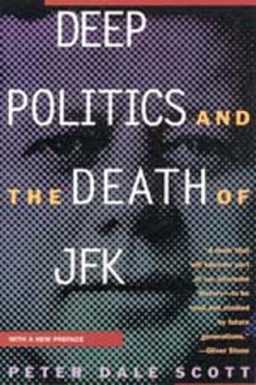
Peter Dale Scott
University of California Press
(paperback edition, with new preface)
1996, $14.95
‘The key to understanding Deep Politics is the distinction I propose between traditional conspiracy theory, looking at conscious secret collaborations towards shared ends, and deep political analysis, defined as “the study of all those political practices and arrangements, deliberate or not, which are usually repressed rather than acknowledged”.'(1)
Peter Dale Scott’s new paperback edition of Deep Politics begins to develop conspiracy theory away from its one dimensional past, towards a more authentic understanding of what is wrong with Western political culture. The preface is perhaps more important than the rest of the book which contains the usual immaculate research from Scott, but is written in a fashion that defies all but the most dogged reader. What Scott is beginning to articulate about politics is interesting and new, and may represent the long awaited maturing of conspiracy theory beyond a complex form of real-world Cluedo, into a genuinely useful forum for political analysis.
His thesis is a development from two other books of his: Cocaine Politics: Drugs, Armies and the CIA in Central America;(2) and The Iran-Contra Connection: Secret Teams and Covert Operations in the Reagan Era.(3) Scott effectively had the story documented three years before the recent ‘revelations’ by a San José newspaper that clients of the CIA had been allowed to introduce crack cocaine into black neighbourhoods in California. These are ‘revelations’ which make the FBI’s COINTELPRO look like hi-jinks, and it is Scott’s hope that by bringing them to the surface we can illuminate aspects of our political culture which we will want to change. Scott’s evolving position represents an analysis of his own progress in trying to understand the relationship between the procedural democracy, the criminal establishment and the secret state. Specifically his questions are: what are we going to do about the fact of their close interaction? And why is our civil society unable to respond to this fact? His work spans many countries, over three decades, though his chief focus is the United States. His conclusions are a major confrontation to pluralist political theory, researchers in parapolitics, and ordinary citizens about the state of their democracy.
His reflection stems from an appreciation of, and a discomfort with, the consensus that has emerged about the activities of the leading Western States – what has been termed ‘covert operations’ or ‘parapolitics’. Scott is concerned with both the inadequacy of our analysis of the information that has been gathered, and the psychological denial that is the frequent response to such information.
‘Today virtually everyone concedes that there is something profoundly wrong with American society. Psychological denial cannot repress this fundamental perception. Try, however, suggesting that the Kennedy assassination is a symptom of something structurally wrong in American society, and you will see this suggestion rejected, energetically, by intellectuals from the right, center, and left of the American politicial spectrum……What is going on here?'(4)
In short, and this is true in Britain and America, we lack a basis for belief in a system to which we feel there is no alternative. As the detritus of the secret state is unveiled we are becoming divided between the critical community and the electorate, a group who are, by definition under this analysis, in denial. This cleaving of public understanding is broadening so that two distinct and separate world views have emerged.
Scott is proposing a way of understanding that cuts through the post-modern idea of total disconnection, fragmentation and chaos. In our rejection of the grand meta-narratives we have become embroiled in the detail to the detriment of our broader understanding. Fleeing from macro deterministic theories of power we have perhaps been blinded to some basic realities. But events of the Cold War era, followed by the revelations, research and concealments of the thaw, have opened our eyes to some harsh truths. Scott attempts to take stock of these realities, and rather than go further into the minutiae, he asks us to stand back and reflect on what these issues mean for our political system as a whole.
Scott is moving away from this previous definition of parapolitics, ‘a system or practice of politics in which accountability is consciously diminished’. Scott still sees value in this definition, but, ‘as thus defined [it] is itself too narrowly conscious and intentional to describe the deeper irrational movements which culminated collectively in the murder of the President’.(5) For Scott then, parapolitics is ‘only one manifestation of deep politics, all those political practices and arrangements, deliberate or not, which are usually repressed rather than acknowledged.’
Scott admits that ‘the line between the two is not always easy to draw’ but argues that ‘[a] deep political system or process is one which habitually resorts to decision-making and enforcement procedures outside as well as inside those publicly sanctioned by law and society. In popular terms, collusive secrecy and law-breaking are part of how the deep political system works.'(6) Nobody who has witnessed Watergate, Irangate, Kincora, the Rainbow Warrior murders, Stalker, Colin Wallace, or any of the other significant exposes of the secret state activities of the past 25 years could really dispute this. Which is to say nothing of Scott’s main subject, the Kennedy assassination.
But there is a difficulty in that the general public has grown weary of such scandal; it has in fact become a norm. Scott approaches this anomaly by examining two issues: the role of the ‘establishment left’, which for Scott means magazines like The Nation and writers like Alexander Cockburn and William Domhoff, and the role of academia and public opinion management. Parapolitics, the argument goes, has not been effective, because it has been working within too narrow a self-understanding, and because it has been disassociated from politics itself. But as Scott points out, the isolation of parapolitics is partly a reflection on the failure of ‘the establishment left’ to take account of what has been said.
The Establishment Left
Conspiracy theory, for Alexander Cockburn, undermines ‘any sensible analysis of institutions, economic trends and pressures, continuities in corporate and class interest and all the other elements constituting the open secrets and agendas of American capitalism.'(7) Scott takes this view to be indicative of a general ‘establishment left’ view of conspiracy theory (which in itself is now an almost wholly unworkable term.)
Similarly, G. William Domhoff, the sociologist and author of the 1967 Who Rules America?: ‘[Because] we all have a tremendous tendency to want to get caught up in believing that there’s some secret evil cause for all of the obvious ills of the world [conspiracy theories] encourage a belief that if we get rid of a few bad people, everything would be well in the world’.(8) This tendency is clearly prevalent, and it surely does hold some comfort, but the accusation is unfair with regard to Scott. It is worth quoting Scott in full:
‘I should make it clear that I propose deep political analysis of the Kennedy assassination not as a substitute or alternative to the structural analysis desired by Cockburn and Domhoff but as an extension of it. I have always believed, and argued, that a true understanding of the Kennedy assassination will lead, not to ‘a few bad people’, but to the institutional and parapolitical arrangements which constitute the way we are systematically governed, The conspiracies I see as operative, in other words, are part of the political structure, not exceptions to it.'(9)
Scott could not provide a more unequivocal explanation of his position, which clearly demarcates him from the paranoid tradition of American politics, in which exterior forces are seen to be undermining the fabric of the ‘honest core’.(10) After analysing the left’s own involvement in discounting the parapolitical and therefore denying the potential of deep politics, Scott examines some of the other forces which have contained this analysis, namely the pro-active repression of a wider dialogue by the influencing of the media and academic community.
‘Responsible’ Elites and Public Opinion Management
Though Scott and Chomsky clashed over the motivations behind Kennedy’s assassination(11) and the escalation of U.S. aggression in Vietnam, there are points of convergence regarding academia and the ‘responsible elites’ – a key point for Scott’s deep politics. After analysing the ownership of publishing and the coverage of the Kennedy assassination, Scott turns to the academic world:
‘Among the ‘deep’ or repressed sociological features of our universities and cultural life are the following facts published by the Church Committee in 1976:
The Central Intelligence Agency is now using several hundred academics, who, in addition to providing leads and occasionally making introductions for intelligence purposes, occasionally write books and other materials used for propaganda purposes abroad…these academics are located in over 100 American universities.
Prior to 1967, the Central Intelligence Agency sponsored, subsidized, or produced 1,000 books… For example, a book written for an English speaking audience by one CIA operative was reviewed favourably by another CIA agent in the New York Times. Until February 1976, when it announced a new policy towards U.S. media personnel, the CIA maintained covert relationships with about 50 American journalists or employees of U.S. media organizations. They are part of several hundred foreign journalists around the world who provide intelligence for the CIA and a times attempt to influence foreign opinion through the use of covert propaganda.(12)
Conspiracy Theory versus Deep Politics
Both the corporate domination of education and the secret state’s efforts at propaganda are not to be discounted. But they pale in actual effectiveness next to the general culture of commodification which surrounds us. This has the result that the predominant impact on a student or academic’s work is the need for his or her research to have some market value or benefit for his or her cv rather than any intrinsic worth. Or, this is the commodification that manages to, for example, re-sell back to conspiracy devotees the X-Files, in which the secret state re-emerges as the critical-democrat. In this sense the departure from both the culture and understanding of ‘conspiracy theory’ is long overdue. All of which compliments the deep political analysis offered by Scott, not by suggesting that the X-Files was created as a means of clouding the issues, but rather that it is an example of how the phenomenon of conspiracy theory has outgrown its usefulness. Deep political analysis has to be taken in context, and that should include an examination of the role of the wider political culture and social norms which underlie the specific political assumptions.
As we draw to a bewildering consensus over such important issues as the Kennedy assassination, we are immobilised by our understanding. Scott states, ‘Some of the major findings of the first official investigation, the Warren Commission in 1964, have now been authoritatively demolished by the second, the House Select Committee on Assassinations in 1979.'(13) Sceptics are left with a choice between an obviously flawed and deceptive investigation and one that had access to more material, a broader remit, and was less flawed, if not less deceptive. The failure of either investigation, or the hordes of Kennedy buffs, to find any real answer to the question of who killed Kennedy is accepted by Scott. He explains the failure thus:
‘I believe this failure to be have been an unncesessary one, caused by the tunnel vision of most critics and their opponents. They have been too fixated on the least answerable question: Who really killed the President? And they have paid too little attention to the contextual question, both more important and paradoxially more easy to answer: What were the structural defects in governance and society that allowed this huge crime to be so badly investigated (or, in other terms, to go unpunished)?'(14)
Scott’s self-reflection throws down a gauntlet to others which can be heard reverberating throughout this book. Deep Politics and the Death of JFK has the potential to revolutionise both the means and the method of parapolitical research, and should be required reading for anyone interested in democracy rather than Cluedo.
Notes
- Deep Politics p. xi
- Peter Dale Scott and Jonathan Marshall, University of California Press, 1991
- Peter Dale Scott, Jonathan Marshall and Jane Hunter, South End Press, Boston, 1987.
- Scott, Deep Politics (1996) p.6
- Ibid. p. 6.
- Ibid. p. xii
- The Nation, January 6/13 1992 p. 6
- Jonathan Vankin, Conspiracies, Cover-ups and Crimes (Dell, New York, 1992) p. 149
- Deep Politics p. 10
- This tradition can be traced back to the Puritans, but its history certainly includes anti-Catholicism, anti-semitism, anti-communism, anti-homosexuality, anti-feminism, anti-liberalism, anti-clericalism, and is manifested today in the foaming at the mouth of the religious right.
- See Chomsky’s Rethinking Camelot:JFK, the Vietnam War and US Political Culture, Verso, London 1993, versus Scott’s Epilogue to Chapter 2 of Deep Politics.
- It is worth comparing this earlier research by the Church Committee with more contemporary accounts, such as Laurence C. Soley’s Leasing the Ivory Tower; the Corporate Takeover of America (South End Press, Boston, 1995) which deals with the 1990s equivalent of the CIA involvement – state intervention by inaction. It traces the highly partisan funding of think tanks, research centres, institutes and the sponsorship of corporate ‘Chairs’, allowing businesses permanent bases within the highest institutions of education.
- Deep Politics p. 3
- Ibid. p. 4