
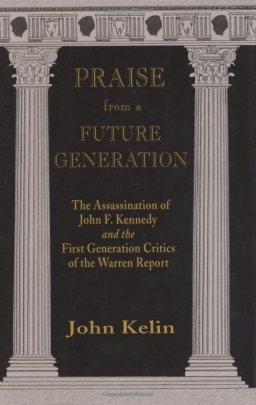
Let us now praise famous researchers
Praise from a Future Generation:
The Assassination of John F. Kennedy and the first generation critics of the Warren Report
John Kelin
San Antonio, Texas: Wings Press, 2007. xviii + 585pps.
Bibliography, Notes, Sources, etc. Illustrated. $29.95.
Reviewed by
Anthony Frewin
While the literature critical of the Warren Commission’s findings is vast I can only think of two works offhand that are autobiographical accounts of what it actually meant to be a critic: Mark Lane’s A Citizen’s Dissent (1968) and Gaeton Fonzi’s The Last Investigation (1993), the former describing the early days of the critical community and the latter the background to working on the House Select Committee. One could perhaps also include here David Lifton’s Quest for Corvo-style Best Evidence (1980) which is as much a first-hand account of uncovering the evidence as it is of the evidence itself.
I’ve often thought it would be entertaining to read a lengthy article, say 20 to 30,000 words on the emergence of the critical community, but what we have here instead is nearly 600 pages. John Kelin has provided in exhaustive detail a history of the first generation of critics in the 1960s, namely Harold Feldman, Penn Jones Jr, Raymond Marcus, Sylvia Meagher, Vincent J. Salandria, Leo Sauvage, Harold Weisberg, and several others. If you want to know what Raymond said in his telephone call to Sylvia at 3.30 pm and what he then said that evening to Leo and Vincent then this is the book for you.
There’s precious little here about Mark Lane and whether you love him or loathe him he was a vitally important part of the mix, and virtually nothing about Sylvan Fox, the author of the first critical study of the Warren Commission’s findings put out by a mainstream publisher, The Unanswered Questions about President Kennedy’s Assassination (New York: Award Books, 1965). Actually, it was preceded by Thomas G. Buchanan’s Who Killed Kennedy? (London: Secker & Warburg, 1964) which was published before the Warren Report came out. Buchanan was criticising the ‘findings’ that had been leaked out by the FBI and others and putting the ‘lone mad nut’ thesis into (American) historical perspective. And what was David Lifton up to back then? And whither Thomas G. Buchanan?
These are small cavils though and Kelin has done a remarkable job of research and writing. It’s a good read, but at the back of my mind I keep thinking, shouldn’t he have been out investigating the case now, and wouldn’t 20 to 30,000 words have been enough?