
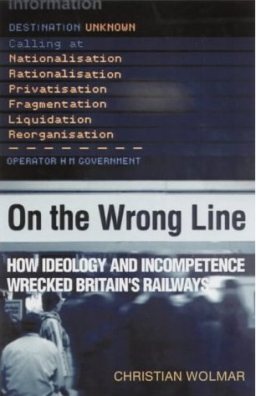
On the Wrong Line: How Ideology and Incompetence Wrecked Britain’s Railways
Christian Wolmar
(London: Aurum Press, 2005), 373pps.
Reviewed by Anthony Frewin.
A couple of months ago I was at St Albans mainline station with Rachel waiting for someone to arrive from London. The train was delayed for half an hour and in that time we’d only seen a non-stopping express and a local service. I said to Rachel, ‘You never see any goods trains now, do you?’(1) She looked at me rather quizzically and replied, ‘What’s a goods train?’ Well, Rachel was born in 1983 and what was she to know of goods trains? Fifty years ago I was a trainspotter down the line at Elstree and Boreham Wood station. Goods trains used to roll by every ten or fifteen minutes. Great long trains that sometimes we’d think would never end: 80, 90, 100 or more wagons hauled by Stanier Class 5s or even a ‘Britannia’ Pacific. And where are all those wagons now? They’re on the roads while the vast rail infrastructure remains largely empty.(2)
The Railway Age was born in Britain and exported all around the world and one of its implicit messages was that railways should be run as a single unitary authority; but John Major knew better (with his rushed through privatisation) and New Labour, despite pre-election undertakings to re-nationalise the industry, just went belly-up on the proposal. Remember Tony Blair in opposition saying he wanted to see ‘a publicly accountable, publicly owned railway’?
Christian Wolmar is a canny and perceptive writer on the politics and economy of the railways and it’s an area he has largely made his own. He’s also immensely readable which does help when the story he has to tell is so unfailingly depressing. The thrust of the book is neatly encapsulated by its subtitle. Here, from pages 256-57, is the bottom line:
‘Remember, reducing the financial burden of the railways on the Treasury was the core purpose of the whole privatisation exercise. The private sector was supposed to be more efficient than the public sector and the two main sets of contracts were drawn up on that basis: train operators were on a downward curve in terms of franchise payments and the maintenance companies also received less year on year in Railtrack’s original contracts.
But all this was wishful thinking. The decline in franchise payments proved to be an unattainable target and, while Railtrack did initially bear down on costs, this was only achieved by allowing the state of the network to deteriorate [emphasis added]. Then, after Hatfield, costs soared to an unprecedented level. The annual subsidy is now running at several times the highest amount that BR ever received. All aspects of running a railway have become far more expensive…’
Why should this be? First, of course, privatisation itself was a costly exercise. At a conservative estimate, the total cost of the process, including the amounts paid out by bidders, was reported to be at least £1bn. For the taxpayer, the direct cost was at least £600m,(3) which only covers the obvious spending such as fees for consultants and lawyers……..
The sorry story of privatisation is, amongst other things, the story of safety being compromised and this is brought out particularly vividly in the chapters on the accidents at Southall, Ladbroke Grove, Hatfield and Potter’s Bar, each a model of its kind, with even the forensic detail being presented accessibly. Yes, safety was a poor relative to profit.
Yet it gets even worse. The ideologues who foisted this on the public believed that their cronies and professional managers (a.k.a. ‘consultants’(4) from outside the railway could run the show better than those with knowledge and experience from within the industry, better because they were ‘private’ not ‘public’ and this is what the ideology decreed.
The fucking-over of the railways is, of course, nothing new. It was started big time right after the war, and by a Labour government.(5)
The ideology and the incompetence, it’s all here, and there’s no better guide than Wolmar in this volume.
Anthony Frewin is a novelist and screen writer. His latest novel is The Reich Stuff.
Notes
- I dated myself by referring to goods trains. The nomenclature since I waved good-bye to my trainspotting days is for the term freight, originally American usage, as in the Freightliner service for containers inaugurated by BR in 1965. And, remember, that 1957 skiffle hit record was Freight Train, not Goods Train.
- Yes, it’s still vast as can be seen on any contemporary rail map. But consider how vast it once was, even as late as 1948, when, in the fifty years prior, there had been many line and station closures. See the maps in Alan Jowett’s Nationalised Railway Atlas of Great Britain and Ireland (Penryn: Atlantic Publishers, 2000).
- They don’t learn, do they? The legal and consultancy fees for the Metronet PPP were £500m, and that sum could have refurbished a London underground railway station or two, and some. The Commons Transport Select Committee noted that ‘the private sector will never expose itself to risk unless it is proportionately, if not generously rewarded. Ultimately the taxpayer pays the price.’ Metronet, only there for the profits, went bust and the taxpayer is left to pick up the £2bn debt. So, £2.5bn down the drain that could have been spent on restructuring London’s underground railways. Nice example of prudence, eh, Gordon?
- Where would we be without consultants? I’ve always liked NASA’s definition of a consultant/ expert: ‘An ordinary guy a long way from home.’
- A good study of the period from the end of the war to privatisation is David Henshaw’s The Great Railway Conspiracy (Hawes: Leading Edge, 1991).