
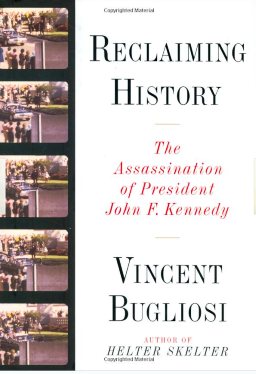
Reclaiming History: The Assassination of President John F. Kennedy
Vincent Bugliosi
New York & London: W. W. Norton, 2007
xlvi + 1612 pps. + CD-ROM End Notes and Source Notes (958 + 170 pps.). Illustrations, bibliography, index, $49.95.
‘Reclaiming History is important not just because it’s correct, though it is. It’s significant not just because it is comprehensive – surely, no one will deny that. It is essential, first and foremost because it is conclusive. From this point forward, no reasonable person can argue that Lee Harvey Oswald was innocent….He establishes that Oswald fired three shots from the window of the Texas School Book Depository…. No shots – not hits or misses – were fired from the grassy knoll or any other place around Dallas’ Dealey Plaza….Oswald killed Kennedy and he acted alone….But no serious scholar of the president’s assassination will ever write again on the subject without citing Bugliosi….With this work, Bugliosi has definitively explained the murder that recalibrated America. It is a book for the ages.’
‘Bugliosi is refreshing because he doesn’t just pick apart the conspiracy theorists. He ridicules them, and by name, writing that “most of them are as kooky as a $3 bill”….What Bugliosi has done is a public service; these people should be ridiculed, even shunned. It’s time we marginalized Kennedy conspiracy theorists the way we’ve marginalized smokers; next time one of your co-workers starts in about Oswald and the C.I.A., make him stand in the rain with the other outcasts….It’s in the arguing that Bugliosi, as a former prosecutor, truly shines.’
‘Lee Harvey Oswald, acting alone, killed John F. Kennedy. Absent a trial proving his guilt, Bugliosi…. has offered the next best thing: a prosecutor’s air-tight brief that leaves no reasonable doubt….Bugliosi is right that this case is, and ought to be, closed. And I share his distaste for the wild finger-pointing and often paranoid reasoning of the Warren Report’s critics …….’
Bugliosi’s book, which denies all conspiracies, has the ring of truth – scrupulous, irrefutable truth – and I predict it will be the line that historians 100 years from now will take on this story….threatens to torpedo the most popular parlour game of them all by providing the defin-itive proof that Lee Harvey Oswald killed the 35th presi-dent with no help from anyone else….His technique….is to expose the double-think and distortions of the conspiracy theorists.’
Pretty fine paragraphs the above four, eh? Read them again and savour them. The first para is composed of extracts from Jim Newton’s review in the Los Angeles Times,(1) the second from Bryan Burrough in The New York Times,(2) the third from Alan Wolfe in The Washington Post,(3) and, lastly, David Walton in the Cleveland Plain Dealer.(4)
It’s worth quoting the boosters at length as a reminder that the mainstream media sure won’t let go of Earl Warren’s conclusions. They are wedded (or is it welded?) to them no matter what comes over the transom. Warren was right, has to be right. The alternative is just too disturbing to be imagined.
There’s a pretty hefty gulf between these writers and their readers. Despite the mainstream’s championing of the lone mad nut thesis, some 75 per cent of the American public now believe there was a conspiracy,(5) that Oswald didn’t act alone if, indeed, he acted at all. So, this is encouraging: the critical community has achieved something. And this is what Bugliosi will never forgive the critics for: had it not been for them this 75% would believe everything Earl Warren told them. These feckless souls have been led astray, have had ideas put into their heads. Why, they’ve even started questioning an official body!
But, really, how can these journalists write this guff? There are one of two reasons: either they’ve never read any works critical of the Warren Commission and its conclusions and therefore exist in a state of blissful ignorance; or they have a hidden agenda. It’s one or the other.
If these quotes have an aura of déjà vu it is because we have read them before. Remember the egregious Gerald Posner (another proven lawyer) and Case Closed, his defence of the Warren Commission back in 1993? They were saying the same things then about his book. Here, for example, is David Wise: ‘At last the voice of sanity….a long-awaited, much needed antidote to the conspiracy theorists, Case Closed is brilliantly researched, utterly convincing and compelling. If you read only one book on the assassination let it be this.’(6)
And it’s not over yet. Max Holland is putting the finishing touches to another Warren defence. Expect to read similar benedictions from the usual suspects when that appears.
Another treat in store is the proposed TV mini-series of Reclaiming History. The Hollywood trade paper Variety(7) announced that HBO in collaboration with Tom Hanks’ Playtone production company will make a ‘ten-parter’ that ‘will debunk long-held conspiracy theories and establish that assassin Lee Harvey Oswald acted alone.’ Accompanying this will be ‘a companion documentary special, with Bugliosi addressing myriad conspiracy theories, including those involving the Mafia, the KGB or Fidel Castro in JFK’s assassination.’
One hopes that Bugliosi is doing all this on a pro bono publico basis and eschewing what he terms the ‘lucrative JFK conspiracy industry’ (see below).
Who he?
‘I can assure the conspiracy theorists who have very effectively savaged [Gerald] Posner in their books that they’re going to have a much, more difficult time with me. As a trial lawyer in front of a jury and an author of true-crime books, credibility has always meant every-thing to me.’(8)
So, who is the man who can give such a self-effacing undertaking?
Vincent Bugliosi was born in Minnesota in 1934. He first made the front pages when, as the LA County Deputy DA, he successfully prosecuted Charles Manson and other members of his ‘family’ for the 1969 murders of Sharon Tate and others, and then wrote a book about the case, Helter Skelter (1974).(9) He had a very successful career as a prosecutor prior to his retirement. Amongst his more recent works is Outrage: The Five Reasons Why O. J. Simpson Got Away With Murder.(10) His interest in the JFK assassination largely arises from a ‘trial’ of Lee Harvey Oswald produced by Channel 4 TV in London in 1986. He prosecuted and Gerry Spence defended in front of a real judge and a jury.(11)
Bugliosi has his own website up and running for Reclaiming History and regularly updates it.(12)
Small may be beautiful but…
….big has the grandeur of size. One can imagine Bugliosi having this rendered in pokerwork above his study desk.
The volume is enormous. It weighs 5.53 lbs/2.51 kilos with a larger than normal trimmed page size for a book of this kind, 9.75 x 6.75ins/250 x 175mm, and with a smaller than normal type size (10pt?). Its word count is, I estimate, in excess of 1.4 million words, which easily dwarfs the Warren Report itself.
Bugliosi is going to rescue the ‘lone mad nut’ thesis, the Magic Bullet, Jack Ruby as ‘accidental slayer’ and all the rest of the Warren Commission gospel from, to borrow a phrase of H. L. Mencken’s, the ‘Sheol of shattered illusions.’ OK?
And a lectern is highly recommended.
Years ago, when the New Statesman was worth reading, it used to run a little feature entitled ‘This England’ that reprinted amusing newspaper and magazine clippings readers had sent in. An item that always stuck in my mind was from a book review in The Observer: ‘If for no other reason than sheer bulk this book has to be taken seriously.’(13) Was this the thinking of Bugliosi when he set sail on his twenty year odyssey of writing Reclaiming History? Well, this may impress the rubes (amongst whom I would include the four shills quoted at the beginning), but it shouldn’t impress anyone else. The fact is that his editor at Norton, Starling [sic] Lawrence, could easily have taken a blue pencil to the typescript and reduced it by 50%, if not more. Bugliosi’s prose is overblown and prolix and the book is littered throughout with irrelevant and extraneous material, pages and pages of what one might term ‘bulking material.’(14) And, yes, big has the grandeur of size.
A volume like this, needs be, must be fitted out with commensurate claims. We know the publisher wants to shift as many copies as possible, but how’s this from the front flap?
‘….Bugliosi is perhaps the only man in America capable of writing the definitive [sic] book on the Kennedy assassination. This is an achievement that has for years seemed beyond reach. No one imagined that such a book would ever be written: a single volume that once and for all resolves, beyond any reasonable doubt, every lingering question as to what happened in Dallas and who was responsible….Every detail and nuance are accounted for, every conspiracy theory revealed as a fraud on the American public. Bugliosi’s irresistible logic, command of the evidence, and ability to draw startling inferences shed fresh light on this American nightmare. At last it all makes sense.’
To do what is claimed here, certainly to satisfy the uneducated and uninformed, isn’t that difficult a trick; and the trick is inadvertently revealed by Alan Wolfe, as quoted above in The Washington Post, when he writes that Bugliosi has produced ‘a prosecutor’s air-tight brief.’ That’s it. It’s that simple. A prosecutor’s brief wherein you cherry-pick. You concentrate only on what supports your case and ignore everything else. You are selective in your presentation of ‘evidence.’ You accept self-serving statements at face value.(15) You rubbish the ‘unfriendly’ witnesses with ad hominem attacks, ridicule them, and misrepresent what they say. You employ hearsay, gossip, tittle-tattle.(16)It’s tunnel vision all the way down the line and no hostages are taken. Thus this ‘achievement’ of Bugliosi’s is no achievement at all; but then he’s a lawyer not an historian. What do you expect? He thinks you can ‘argue’ history in the same way you argue a case in a court of law.
Smears
Bugliosi’s language is intemperate and emotive throughout. He uses sarcasm, sneers and smears whenever anyone questions his thesis or presents an embarrassing fact. Anyone who criticises the Warren Report in any way is a ‘conspiracy theorist’, a phrase he uses constantly, drumming it home that such people cannot be trusted, much less actually listened to. Here he is on Doug Horne of the Assassination Records Review Board: ‘obscenely irresponsible….insane….crazy……an aberration……an unaccounted for loose cannon……avowed conspiracy theorist…..conspiracy theorist extraordinaire.’(17)Are these the words of a courtroom slugger or those of a responsible writer?
A solicitor once defined evidence/proof to me as ‘whatever you can get a jury to believe’ and I suspect Bugliosi concurs. Truth? What’s that got to do with anything?
One wonders not at whom this book is aimed, but who will actually buy it? And of those who buy it who will actually read it? My feeling is it’s going to end up rubbing shoulders and gathering dust on the shelf with all those other purchased-but-never-read volumes (you know: Stephen Hawking, Salman Rushdie, Booker Prize winners, etc).
If Bugliosi does succeed in reducing the 75% who believe there was a conspiracy it will be at one remove. It will be through positive book reviews and features in newspapers and magazines, and the whole panoply of mainstream television. Even in the best case scenario it will, however, be slight. Too much has gone on since 1963. The public knows the government lies to them, knows there are conspiracies.
Bugliosi is, to use one of Slim Pickens’ favourite sayings, a day late and a dollar short.
*
The first 969 pages of the book detail Oswald, Dealey Plaza and the aftermath, and conclude that Earl Warren got it right on every count: that Oswald was a lone mad nut and so on. As Bugliosi apparently proves this to his own satisfaction beyond a reasonable doubt, why then does he devote the following six hundred pages to attacking any alternative theories and just about anyone who has ever raised a query about the official version? Lawyer’s vanity or a sneaking feeling that the ground supporting his conclusions might not be that solid?
Let’s look at how Bugliosi deals with several prominent critics. First off, Mark Lane:
‘….the Pied Piper of conspiracy theorists….“almost single-handedly invented the lucrative [sic] JFK conspiracy industry”(18)……Lane was the slickest and most voluble of the early left-wing group of writers, and the KGB even contributed two thousand dollars…to Lane’s efforts…. He was welcomed into Left-leaning European intellectual circles….German Communist Joachim Joesten dedicated his 1964 book, Oswald: Assassin or Fall Guy?, to Lane ….Lane.…has become an embarrassment to the Left ….“the left’s leading hearse chaser”….a “huckster”…. Lane was a fraud.’(19)
Getting the message? How about this on Thomas Buchanan:
‘….an expatriate American Communist living in Paris…. “In 1949 Buchanan was fired from the staff of a Washington newspaper [Washington Evening Star] for being a Communist party member, and is now a frequent contributor to left-wing newspapers and periodicals.” ’(20)
Joachim Joesten next, author of Oswald: Assassin or Fall Guy? (1964):
‘….Joesten was a “German Communist Party member. Joesten’s book was published in this country [USA] by the recently defunct publishing firm of Marzani and Munsell….one of the foremost publishers of Communist and extreme left literature in America”….Joesten had been a member of the Communist Party of Germany since 1932.’(21)
And now Harold Weisberg, and more Mark Lane:
‘…..Whitewash and Rush to Judgment….were not written by Communists, but by…. “leftists sympathetic to Marxist ideology”….Weisberg was earlier, in 1938, discharged from his investigator post on the La Follette Civil Liberties Committee “for giving confidential matter to the Daily Worker, the leading Communist newspaper in the country.” In the summer of 1947, Weisberg was fired from his post with the U.S. Department of State along with nine others for known association with agents of the Soviet Union…..Lane has a long and curious involvement with a host of extreme left-wing causes and is a well-established spokesman for leftist ideology….Lane is a former executive secretary and national board member of the National Lawyer’s Guild, a cited Communist front ….This past year [1967?] he was a member of the Committee of Sponsors for a Veterans of the Abraham Lincoln Brigade(22) dinner. The brigade is also a cited Communist front.’(23)
What on earth does any of this background have to do with proving the Warren Commission’s findings true or false? What should and doesn’t concern Bugliosi is these and other writers’ valid criticisms and findings (I use the word valid to mean substantive questions and facts that have stood the test of time) and nothing else. But in the meantime, he’ll smear them.
It may be that many will see these associations as badges of honour, but there are many who won’t: Oswald was a Commie, only Commies defend him; ipso facto……
Now let’s see an example of the Bugliosi ‘critical’ modus operandi.
John Armstrong
Armstrong has done much important and significant work on the ‘Two Oswalds,’ not just the (multiple?) impostors in the immediate run-up to the assassination, but the two ‘legends’ that go back to the early 1950s, ‘Harvey’ and ‘Lee.’(24) Bugliosi is having none of this:
‘John Armstrong….carries his fantasy about a double Oswald to such absurd lengths that not only doesn’t it deserved to be dignified in the main text of my book, but I resent even having to waste a word on it in this endnote.’(25)
But, nonetheless, he will, which is very gracious of him. He describes Armstrong’s book as a ‘long tribute to absurdity’ with a premise that is ‘prodigiously ridiculous.’ Of Armstrong himself, ‘What could possibly have launched an otherwise intelligent person like Armstrong into such a deranged and irretrievable orbit?’(26) And, ‘Armstrong’s theory is so loony it even completely confuses him.’(27)
In his discussion of Armstrong Bugliosi zeros in on the 1953 case of ‘Harvey’ in Stanley, North Dakota. Armstrong writes how in that summer William Timmer, aged 12, was living with his grandmother in Stanley.
‘During summer vacation in 1953, Timmer and some friends….were riding their bicycles in the park near the courthouse. Another boy, about the same age, was also riding a bike in the park. Timmer noticed the young boy because of his shabbily dressed appearance and his bike, which had no fenders or chain guard. Timmer judged the boy to be about 14 years old and thought he was too old to be riding a bike. The new boy joined Timmer’s group and introduced himself as Harv or Harvey Oswald. Harvey told the boys that he had been the member of a gang in New York City, and talked of gang fights where members used weapons with razor blades stuck in potatoes…. Harvey talked about communism and carried a communist pamphlet in his back pocket.’(28)
Timmer spent much of the summer with Oswald until he was forbidden to continue the friendship by his mother who was disturbed by Harvey saying, ‘Someday I am going to kill the President and that will show them.’
‘At the time of the assassination Timmer was ill and staying at the New Haven Motel in Spokane, Washington. After the assassination Timmer’s mother sent him some newspaper photos from the Yuma, Arizona, Sun. One of the photos showed Lee Harvey Oswald as he was led from the Dallas jail, and another photo showed Oswald when he was shot by Jack Ruby. Timmer’s mother wrote beneath the photos, ‘Was he around Stanley? Seems like you knew him.’(29)
Timmer looked at the photos and was certain that Oswald was the same person he had met in 1953. Later Timmer’s mother wrote a letter (11 December, 1963) to President Johnson saying that her son had known Oswald when he was in Stanley, North Dakota. The letter was given by the Secret Service to the FBI who sent agents to interview both Timmer and his mother but, as Armstrong notes, there is no evidence that any of this investigation was ever passed on to the Warren Commission.
How does Bugliosi respond to this? Easy. It’s all rubbish. How come? Easy again – the FBI checked it all out and they say it is rubbish (truth, of course, being their only client). Further, he includes the gratuitous information that Timmer’s mother allegedly had a ‘mental condition’ and attempted suicide by ‘drinking Lysol.’ Like mother, like son? You get the drift.
Bugliosi also uses the interview Oswald gave in Moscow in 1959 to Aline Mosby, an American journalist, to disprove the Stanley connection. He states that her typewritten notes of the interview show ‘NO’ (New Orleans) instead of ‘ND’ (North Dak-ota) as the location Oswald said he and his mother moved to after leaving New York. What Bugliosi doesn’t vouchsafe is that these notes were typewritten five years after the interview (at the request of the Warren Commission) whereas her contemporaneous handwritten notes show clearly that it was ‘ND’.
In his End Notes on the CD-ROM Bugliosi dances around several of Armstrong’s other contentions regarding Harvey and Lee but does so in such a confused and confusing manner it is difficult to actually work out what he, Bugliosi, is saying. The impression he gives and wants to give is that Armstrong is wrong on every count (and is probably a bit loony too). At one point he even accuses Armstrong of ‘gross and deliberate misrepresentation’ which is pretty rich.
Bugliosi, here as elsewhere, carefully avoids substantive questions fearing where they may lead. For instance, Armstrong’s discussion of Warren Commission Exhibit 1413 where we have two contradictory school records, one showing that ‘Oswald’ attended Beauregard school in New Orleans for 89 days in the Fall term of 1953, while the other shows him attending a New York school at the same time for 62 days. Bugliosi is silent on this as indeed he is on much else.(30) There are problems in places with Armstrong’s thesis, but Bugliosi is not the person to resolve them.
Oswald: the question of motive
This was a problem for the Warren Commission and it’s an ongoing problem for its supporters. Here we have a lone mad nut who allegedly wants to claim a place in History (cap H!) by shooting the president yet he denies the charge when arrested. If only he had stomped around the Dallas PD holding a fist in the air and shouting, ‘I killed JFK!’ If only.
Bugliosi’s first confronts the problem when detailing the Warren Commission and the delivering of its Report to President Johnson. I say ‘confronts’ whereas he merely repeats the official findings:
‘The Commission could not make any definitive determination of Oswald’s motive but cited his deep-rooted resentment of all authority, his inability to enter into meaningful relationships with people, his urge to find a place in history and his despair at times over his failures, his capacity for violence as evinced by his attempt to kill General Edwin Walker, and his avowed commitment to Marxism and Communism as factors that contributed to his character and might have influenced his decision to assassinate the president.’(31)
Nearly six hundred pages later Bugliosi returns to the subject with a chapter tersely entitled ‘Motive’.(32) After an opening discussion of the legal meanings of motive and intent he holds his hands up.
‘Even if Oswald were alive and wanted to tell us, though he could tell us much, he might not be able to convey all the psychic and subconscious dynamics swirling about in his fevered mind that led up to his monstrous act of murder. Even on a conscious level, his demented mind may have been confused as to the main reason or reasons why he pulled the trigger.’(33)
He adds that, ‘If the Warren Commission and HSCA [The House Select Committee on Assassinations] conceded that they could not nail down for sure why Oswald killed Kennedy, I surely am not so presumptuous as to believe I can.’(334)However, this isn’t going to prevent our attorney from venturing forth with upwards of ten thousand words on the subject.
What Bugliosi does throughout this chapter, as indeed he does throughout the book, is call upon material (I nearly said evidence) from the Warren Commission or HSCA or the federal agencies as though it was independent verification of what he himself is arguing, when his Genesis 1:1 is that very selfsame material. In other words, he’s filling a hole with the earth he dug out.
Bugliosi poses the question as to why, if Oswald wanted credit for the assassination, did he deny it, and argues that this is a ‘non sequitur predicated on the belief that his wanting to become famous and his denying guilt right after the assassination are mutually exclusive states of mind.’(35) And there’s more to come:
‘His conduct after the shooting clearly showed that he wanted to survive, see another day. More importantly, just because he wanted to be famous for his deed doesn’t necessarily mean he wanted this to happen immediately, thus ensuring his apprehension and likely execution. It is much more reasonable to assume that he wanted to disclose his identity on his own terms and at a time and place he, not the authorities, chose, such as in Cuba or Russia.’(36)
So, the idea here, the very special pleading of the attorney from Los Angeles, is that Oswald’s plan is to flee the scene of the crime and arrive in Cuba or Russian and then announce he’s the assassin? Huh?! Oswald may have shot the president of the United States but he’d then be about as welcome in either country as the previous deposed dictator/party leader. There’s enough flack flying around without harbouring a criminal like this. Oswald would be bound and trussed and on the next flight back to the Republic from wherever. But the question we have to ask ourselves is this: does Bugliosi really believe Oswald believed this?
Yeah, but hold on. Oswald was arrested. The game was up.
Does Bugliosi think Oswald believed he’d eventually get released and be allowed to emigrate to Cuba or Russia and then claim responsibility? Surely not. So, why when he was in police custody and he realised the game was over did he not ’fess up? Bugliosi shirks this question throughout the rest of the chapter and the book.
Oswald was arrested not for the assassination of JFK but for the alleged murder of Tippit. The first Oswald knew of his being centre frame for the assassination was shortly before midnight on 22 November when he was being moved to the basement of the Dallas PD for a press conference a reporter asked, ‘Did you kill the President?’ Oswald replied:
‘No. I have not been charged with that. In fact nobody has said that to me yet. The first thing I heard about it was when the newspaper reporters in the hall asked me that question.’(37)
Would this not have been a good opportunity to claim responsibility with all those journalists present and live TV feeds? Or was Oswald waiting for a court room appearance? How do you plead, Mr Oswald? Why was Oswald silent?
But Norman Mailer, in full blown ‘Let me through! I’m a novelist!’ mode, has an answer to this conundrum, an answer only a novelist could come up with, and it is this: an assassin of a president could be considered a ‘hero,’ whereas the murderer of a policeman is merely a punk. Oswald had compromised his position on 10th Street and Patton by shooting Tippit, he was now just a low-life, a punk, and thus could not claim hero status. Shame had overcome him.(38)
The remainder of the chapter is a stew of tittle-tattle, irrelevant circumstantial detail, hearsay and unreliable testimony that Bugliosi calls in to shore up the Warren Commission’s findings. But motive? You’ll not find it here.
Bugliosi in his own write
Did Earl Warren have enough time and resources to fully investigate the assassination? Ever wondered about this? Wonder no more.
‘The [Warren] Commission had nine months, far more than enough time to reach a conclusion that was obvious to nearly everyone involved in the investigation within days – that a nut had killed Kennedy, and he himself had been killed by another nut, with the possibility of a conspiracy being highly implausible.(39)
Did Bugliosi really write this or is it an errant paragraph from a Paul Krassner piss-take that mistakenly ended up in the wrong file? Read this again, it’s worth repeating:…….. more than enough time to reach a conclusion that was obvious to nearly everyone involved in the investigation within days – that a nut had killed Kennedy, and he himself had been killed by another nut, with the possibility of a conspiracy being highly implausible.
LBJ could have saved himself the trouble of setting up a commission and saved the Republic a serious amount of dollars by simply parachuting in über-attorney Bugliosi. By the Monday after the assassination it could all have been done and dusted and normal service would have been resumed. We could all, to use a phrase that Bugliosi frequently hurls at critics, get a life (again).
As we now know, the ‘investigation’ was done and dusted within a day or two of Dealey Plaza. On the evening of 22 November, within hours of the assassination, President Johnson put Hoover in charge of the investigation and subsequently told him he wanted a full report on his desk by Tuesday. What would the report conclude? An FBI document authored by Inspector James R. Malley states that the president ‘approved the idea that [the FBI] make a report showing the evidence conclusively tying Oswald in as the assailant of President Kennedy.’ Thus the official solution and, as Gerald D. McKnight has proven in minute detail, Earl Warren and company simply fell in behind it: they were presented with conclusions they had to substantiate.(40)
Like many lawyers, particularly trial lawyers, Bugliosi will say or write something that doesn’t actually mean what it appears to mean on first blush. Try this:
‘It has to be noted that after the FBI became the chief investigative agency of the Warren Commission, no fair and sensible person could ever accuse the bureau of conducting a superficial investigation.’(41)
There’s a wrong and inappropriate word here and that word is superficial. Now try substituting the word honest or even the word thorough which are the words Bugliosi should have used but whose meanings he wishes to convey by the use of superficial. The average reader will have been sold a dummy. (Incidentally, I’m not aware of anyone in the critical community who has ever accused the FBI, in overall terms, of a superficial investigation. Sure, the Bureau neglected to pursue all leads and covered up others, but this was dereliction and corruption not superficiality.)
One has to doff one’s cap to Bugliosi’s industry in producing this book. But the question one keeps returning to is Why? Was this some puckish intellectual endeavour to show the world he could prove black was white and vice versa, an ambition spurred by vanity? Did an idée fixe become lodged in his brain, a maggot eating away at his reason? Or, and this is the most disturbing, does he really believe the Warren Report? Surely not? More respect would be due him if he threw up his hands and said, ‘Look, give me a break! I wanted to cosy up to the power elite and make some serious bucks at the same time.’
When I’ve felt charitable towards Bugliosi I’ve recalled one of La Rochefoucauld’s maxims: ‘The more subtle the wisdom, the more subtle the folly.’ Perhaps that’s the answer, but it’s all a mystery, right? Just like Oswald’s motive (!).
When reading Reclaiming History one frequently feels that one has entered some parallel alternate universe, some world conjured up by Philip K. Dick, where Everything is Answered; because Bugliosi has an explanation for just about every question that has been asked, and if he doesn’t have an answer it is only because a particular question has no relevance or meaning whatsoever.
‘Shame on a former member of the American bar for sinking to such a depth of ignominy,’ says Bugliosi of Barr McClellan’s book fingering Lyndon Johnson in the assassination.(42)These words should come back to haunt Bugliosi himself….down all his days.
Notes
- 13 May, 2007.
- 20 May, 2007.
- 27 May, 2007.
- 20 May, 2007.
- Gallup Poll, November 2003, quoted in Reclaiming History, p.xv.
- The quote comes from the dust wrapper’s front flap of the hardback: Case Closed: Lee Harvey Oswald and the Assassination of JFK (New York: Random House, 1993). Further hosannas were on the back cover from William Styron (no less), Stephen Ambrose and Tom Wicker. The actual publisher’s blurb claims, ‘Case Closed finally succeeds where hundreds of other books and investigations have failed – it resolves the greatest murder mystery of our time, the assassination of JFK’ and that’s not all: it ‘also demolishes the leading conspiracy theories, putting to rest once and for all speculation about the involvement of the CIA, FBI and the mafia, and the supposed links between Lee Harvey Oswald and Jack Ruby.’ And there’s more, ‘Case Closed answers all [sic] lingering questions about the assassination.’ Harold Evans, aka Mr Tina Brown, was editor-in-chief of Random House at the time and, according to Posner, Evans himself actually wrote all this hyperbole. What a sad descent for someone who once edited The Sunday Times (when it was worth reading)! Posner is quoted by Judy Bachrach in her very readable Tina and Harry Come to America (New York: The Free Press, 2001), p.203, a book that no British publisher seems willing to take on. I wonder why?You would think that Bugliosi would embrace a fellow true believer like Posner, but no. Posner comes in for some heavy criticism, much of which is shared by the critical community. Indeed, Bugliosi even brackets Posner with ‘conspiracy theorists’ at one point (p.xxxviii).
- 7 June 2007.
- Reclaiming History, pps.xxxviii-xxxix.
- He actually had a co-writer (Curt Gentry) as indeed he did with his two subsequent books. Helter Skelter is a court room book, nothing more, nothing less, and rather tedious and not very informative about Manson. The book on Manson still remains Ed Sanders’ The Family: The Story of Charles Manson’s Dune Buggy Attack Battalion (New York: E. P. Dutton, 1971).
- London & New York: W. W. Norton, 1996.
- A whole host of actual witnesses was called, running from Buell Wesley Frazier and Lyndal L. Shaneyfelt for the prosecution, to Cyril Wecht and Bill Newman for the defence. The TV jury found for Bugliosi whereas a telephone poll of viewers conducted by Showtime Cable TV in the States showed an overwhelming 85% finding for Spence: that is, Oswald not guilty. See further, Reclaiming History, p.xvi et seq. Also, Anthony Frewin, The Assassination of John F. Kennedy: An Annotated Film, TV, and Videography, 1963-1992 (Westport, CT: Greenwood Press, 1993), pp. 51-3.
- <http://www.reclaiminghistory.com/> The publisher’s website is: <http://www.norton.com/catalog/spring07/004525.htm>
- Included in Michael Bateman, editor, This England: Selections from the New Statesman Column 1934-1968 (Harmondsworth: Penguin Books, 1969), p.33. One of the most amusing books ever published.
- Some of this can be attributed to the fact that Bugliosi largely dictated the book. See Reclaiming History, p. 1514.
- Try this, Reclaiming History, p.xx: ‘Adding a touch of humor to it all, as Commission member Gerald Ford said, “The thought that Earl Warren and I would conspire on anything is preposterous.”’ This from Gerry the Commission snitch!
- For instance, Bugliosi quotes Jeremy Gunn of the Assassinations Record Review Board on Doug Horne (see below), ‘Anything that Horne said about any conversation I had with him I would not consider reliable’ and ‘I try to avoid reading anything written by Douglas Horne.’ (Reclaiming History, p. 444). Without getting in to the details of why Gunn is making such statements and merely repeating them consigns the remarks to….tittle-tattle.
- Bugliosi is discussing Doug Horne’s paper, ‘Questions Regarding Supplementary Brain Examination(s) Following the Autopsy on President John F. Kennedy.’ Reclaiming History, pps .434-47, End Notes pps. 226-8.
- Of which Bugliosi will claim his part with a first printing of 135,000 copies. Source: http://www.fye.com/
- Reclaiming History, pps. 1000-1011, the chapter ‘Mark Lane.’
- Reclaiming History, p. 990. Buchanan’s short prescient book, Who Killed Kennedy? (London: Secker & Warburg, 1964), is still worth reading, not least of which for its examination of previous American presidential assassinations and attempts that demonstrates the jiggery-pokery surrounding Oswald and the misleading claims made by the government were nothing new in this area.
- Reclaiming History, p. 990.
- The American volunteer contingent of the International Brigades in the Spanish Civil War.
- Reclaiming History, p.991.
- John Armstrong, Harvey and Lee: How the CIA framed Oswald (Arlington TX: Quasar, 2003). Running to just over a thousand pages and with a CD-ROM it is, like Bugliosi’s volume, too big for its own good. It would have been better for Armstrong to produce several smaller volumes exploring particular aspects of the case rather than producing this massive book that attempts to deal with everything .<http://home.wi.rr.com/harveyandlee/> is a good website for readers new to Armstrong’s work. It contains the ‘Harvey and Lee’ essay with full supporting documentation.
Bugliosi gleefully pounces on the most inconsequential inaccuracy of the critics and holds it up and asks, how can we trust him on anything else? So let’s play him at his own game. He writes that Harvey and Lee is a ‘983-page book’, Reclaiming History, End Notes p. 565. It isn’t. It’s 1016 pages.
- Reclaiming History, End Notes, p. 565.
- Reclaiming History, End Notes, pp. 567, 569.
- Reclaiming History, End Notes, p. 575.
- Harvey and Lee, p. 70.
- Harvey and Lee, p. 70.
- He must have in mind that famous remark of Warren Commission attorney, Wesley Liebeler: ‘At this stage, we are supposed to be closing doors, not opening them.’
- Reclaiming History, p. 359.
- Reclaiming History, pp. 935-50.
- Reclaiming History, p. 936. Note the emotive language here: fevered mind, monstrous act, demented mind.
- Reclaiming History, p. 936.
- Reclaiming History, p. 939.
- Reclaiming History, p. 939.
- The Warren Report (Washington DC: US Government Printing Office, 1964), p. 201.
- Mailer filmed interview in Robert Stone’s 85 minute documentary, Oswald’s Ghost. Most recently shown on BBC Four on 5 June 2007. Bugliosi seems not to be aware of this novelettish silliness. And on the subject of Mailer, did anyone ever get beyond the first few pages of Oswald’s Tale: An American Mystery (New York: Random House,1995)?The idea a novelist can bring an understanding to the case that a mere critic or researcher cannot was given an outing by many mainstream critics when Don DeLillo’s novel about Oswald, Libra (New York: Viking, 1988), was published. It’s that old contagious nineteenth-century Romanticism again! You just can’t get away from it.
- Reclaiming History, p.xxx.
- Gerald D. McKnight, Breach of Trust: How the Warren Commission Failed the Nation and Why (Lawrence, KS: University Press of Kansas, 2005). The FBI memo is discussed p.19. A key work for understanding the Warren Commission and related matters. Needless to say, Bugliosi rubbishes the good professor but side-steps discussing any substantive issues he raises.
- Reclaiming History, p.xxxii.
- Reclaiming History, p.925. McClellan’s book is Blood, Money & Power: How LBJ killed JFK (New York: Hannover House, 2004).