
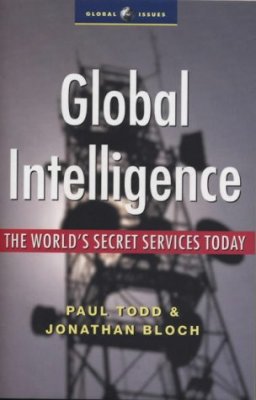
Global Intelligence: the World’s Secret Services Today
Paul Todd and Jonathan Bloch,
London and New York, Zed Books, 2003
h/back £32.95/ $55.00
p/back £9.99/ $17.50
‘We lacked specific information on many key aspects of Iraq’s WMD program’ Vice chairman of the National Intelligence Council, Stuart Cohen, December 2003
With the spectacular failure of the ‘Allied’ intelligence services before during and after the second Gulf War, the time was right for some real political insight into what happened. This isn’t it. Instead, it’s a wide-ranging reappraisal of the intelligence communities in the post-9/11 world.
The book wrestles with these key questions: how is it that the super-rationalist West, with all of the massive resources of the CIA, TIARA (Tactical Intelligence and Related Activities) and SIS, were completely unable to stop a few guys with Stanley knives flying jet planes into the World Trade Centre? How have the security and intelligence forces managed to repackage themselves in the ‘new world’ of post-Cold War era of globalisation and cultural-religious conflict? And who is benefiting from this hyper-technological world, those struggling to overturn or to impose a world government of the powerful?
Todd and Bloch’s recurring themes are the anti-civil liberty implications of terrorist legislation, and the supreme failure of the UK and US intelligence forces amidst the ‘new surveillance culture’ of the modern world. This broader culture is formed from three compelling factors: what the authors call the ‘Washington consensus’ on economic organisation (whereby everything should be quantified and expressed in numerical measures of value), the deepening digital revolution and, finally, the process of globalisation. The book’s subplot is clearly the language of US imperialist hegemony, the self-deception of Blair’s duplicitous regime and the increasingly strident tones of Dubya’s Christian Fundamentalism.
Ultimately, if the authors findings are naïvely disappointing (there’s a checklist of reforms that would curtail the excesses of the word’s secret services, things like ‘independence from the executive’, ‘extensive access to information’ and so on, as if the ‘rogue elements’ of secret services are an aberration from rather than an expression of state power), it is an antidote to mind-numbing media banality. Their chapter on ‘Terrorism The Dark Side of Globalisation’ asks all the right questions: ‘What of state terrorism? What are the prospects of winning the anti-terrorist war? Will the victory prove elusive, its aims diffused in ever more open-ended licence to pursue the struggle?’; and, amidst insightful analysis, of how, say, ‘heterarchy’ (authority determined by knowledge or function rather than position), has guided groups such as Al-Qaida, there is much of use.
Bloch and Todd are clear that this year’s ‘rogue states’ were last year’s recipients of massive US funding, and are precise on the hypocrisy of the relationship between the US and the Saudi regime. They also pick out such gems as the State Department’s April 2001 report on Patterns of Global Terrorism that stated that approximately 47% of all terrorist incidents world-wide were committed against the US citizens or property, and conclude rightly:
‘Leaving aside the highly contested definition of the term itself, it is easy to see how terrorism has seamlessly replaced communism in the face of a self-proclaimed rival universal creed fundamentalist Islam.’
The authors certainly hit home when they look at the long-term effect of the insularity of US and Western culture. It’s become a cliché that modern warfare is something done at arm’s length. Professional soldiers, in jets or ships miles away from ‘the action’, or unmanned aerial vehicles (UAVS) such as the ‘Predator’ or the ‘Hawk’, unleash death and destruction on a target far away. The structure, they point out, is similar in terms of intelligence. The authors draw attention to ex-CIA operative Reuel Marc Gerecht’s article of July 2001, in which he stated: ‘America’s counter-terrorism programme in the Middle East and its environs is a myth.'(1) A couple of months before the Twin Towers attack, Gerecht pointed out the reluctance of the CIA to conduct operations under ‘non-official cover’, their refusal to engage in local events and culture beyond the business/embassy circuit and the ‘total absence of staff trained in local languages’ a cultural and operational nightmare that conjures up images of men in black suits approaching the Mujahidin saying; ‘Gee, you seen an Arab dude with a towel round his head?’ And it gives a little insight into exactly why they still haven’t found Osama.
Similarly, the authors, now warming to their theme, point out that this surveillance from afar has also been pretty useless in ‘financial intelligence’. Despite the fact that by April 2002 some $104 million in suspected terrorist assets had been blocked or seized in more than 140 countries, this was likely to have been a broad but ineffective trawl. Despite Bush’s Executive Order 13324 which froze the assets and gave the US Treasury unprecedented powers to impose sanctions on any bank not seen to be co-operating, very little of this would be effective as most of the Middle East and the wider Islamic world’s money traffic is done through hawala money brokers a thought apparently impenetrable to CIA spooks holed up in the embassy with a laptop and a scotch.
In a quick overview of the relations between the US and other ex-enemies, (now comrades-in-arms), we get a glance at Yemen, Sudan, Iran, North Korea and Pakistan. If there’s a criticism of this book it is too broad and too thin, constantly throwing up nuggets of detail that cry out for more in-depth coverage.
Technologies of Surveillance
‘One of the first things we noticed when we got on the Internet was that it’s one of the most fabulous surveillance systems ever invented.’ John Young, Cryptome
The strongest suit in the book, Bloch and Todd’s chapter on technology, privacy and liberties, is cogent and revealing importantly so: ‘For the populations of advanced industrialised countries in particular, the twenty-first century is an age of surveillance unparalleled in history.’ The epidemic of surveillance, which appeared at first as a ludicrous orgy of interference for well-equipped spooks, has turned into a more complex situation. For Todd and Bloch, in the areas of fibre optics, encryption and general techno-literacy, the people are at least presently and as far as we know ahead of the game. According to these guys, it’s the hacker-kid, the switched on activist and the ‘wired’ citizen or netizen (sic) who is probably getting more out of the digital revolution than the world’s secret services. America’s struggle with this dualism between supreme technological advance and almost total cultural isolation continues to be a burden for the world’s de facto American government.
As America struggles to get a hold on its role, it does what it does best, and throws money at the problem. An official budgetary figure for US intelligence was published for the first time in 1997. At some $26 billion this was close to the figure which had first emerged in 1994. Where Bloch and Todd shine is in the revisiting how the growing military budget of the Cold War was quickly repositioned and ‘economic intelligence’ was replaced with the military aim of ‘full spectrum dominance’. Repeatedly they assert that what we have witnessed is the failure of policy not of intelligence.
Unpicking the threads of US-Iraqi relations is a highlight of this book. The origins of the situation that now sees almost 10,000 dead Iraqi civilians and similar US military casualties and injured are examined. (2)As the authors remind us, at one time Hussein was a dear friend, such that:
‘The burgeoning intelligence intimacy between Langley and Saddam would come to encompass communications intercepts, weapons data, high definition photography or Iranian targets, and near real-time troop movement data gathered from US-manned AWACS based in Saudi Arabia.’
It is an economic relationship that has held America and Iraq in each others arms. This relationship goes way back: $400 million guarantees by the US Commodity Credit Corporation in 1983, which rose to some $3.8 billion by 1988. By the early 1990s the US was taking a quarter of Iraqi’s total oil exports.
Equally it was the disastrous policy and strategic decisions made at the end of Gulf War 1, that led directly to the present catastrophe. In its determination to complete the 100 hour war on schedule for Bush’s re-election, the administration called an arbitrary halt to hostilities on 27 February 1991. On 1 March mass uprisings in the Shi’ite Southern areas of Iraq and the Kurdish North took place in response to Bush’s urging to ‘put Saddam aside’. But mirroring his own domestic world view, Daddy Bush’s exhortation had been aimed not at popular insurgency but at inspiring a dissident Iraqi generals. It was in this way that the main forces (now sabotaging the American military in Iraq) were left in place. And all this despite the fact that ‘a rebellion of genuinely broad-based opposition forces at one stage had seized control of 16 of Iraq’s 18 provinces.’
In the end, there is a tension in the authors’ analysis. On the one hand they argue:
‘The growth of the surveillance state is nothing but a classic example of the power of marketing. It might also be understood as the intensification of a long-present sociological trend, identified by C Wright Mills in the late 1960s, for a ‘power elite’ to emerge in the now normal passage from government to consultancy to corporation and back again.’
But then quickly afterwards they argue that the removal of the Gough Whitlam government in a ‘constitutional coup’ in Australia in 1975 led to commendable reform. Even their term ‘legal authoritarianism’ betrays a sort of mild shock-horror at the extent of the unfolding policies.
Despite this, the book’s main strengths the tracking of the growth of the intelligence services to dominate policy budgets in recent years and transform ‘social democrat’ governments into authoritarian ones is a persistent if unrealised force. Despite this unfulfilled potential, Bloch and Todd lay pockets of brilliant, if chilling research and analysis.
Accidentally, perhaps, the book is an indictment of the ‘Coalition of Two’. It shows clearly that, beyond the fluff and the media flap, the failure of the intelligence services has largely been a political failure: ie. the state’s almost totally bankrupt efforts to present information in a way likely to con the general public. The exposé of how the state and its clandestine operatives work has been blown open in the events that led up to the Hutton Inquiry, cascading cynicism onto an already sceptical anti-war British public. A useful side-effect has been a generational haemorrhaging of respect for the political classes, so that an older audience, perhaps still suffering under lingering misapprehensions of deference, can join a younger generation in the global anti-capitalist movement.
Notes
1 <www.theatlantic.com/issues/2001/07/gerecht.htm>
2 Channel 4 News reported in February that more than 11,000 injured had been through Andrews air force base in the previous nine months and the real figure was probably higher than that. <www.channel4.com/news/2004/02/ week_2/10_iraq2.html >
Mike Small is one of an editorial group running Indymedia Scotland <http://scotland.indymedia.org/> and is writing a book on ‘Blairusconi: the New Labour Project and the Italian Right’.