
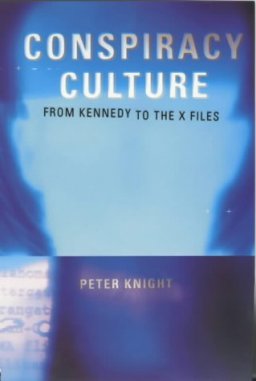
‘Let me through! I’m an academic conspiracy expert.’
Peter Knight
London and New York: Routledge, 2000
p/b £16.99, h/b £60
Page one of this book or, rather more accurately, page ix, the first page of text, saw my heart sinking. There, above the preface, was a quote from Don DeLillo’s novel about Lee Harvey Oswald, Libra (1988). I do not know anyone in the critical community who has ever taken this novel seriously. However, it is a work much loved by literary critics, academics, Guardian reviewers and others with little or scant knowledge of the Kennedy assassination. Their argument goes that the novelist’s imagination can bring an understanding to Oswald that is beyond the grasp of a mere researcher or historian. Oh, yeah? It’s more than a little disturbing that a Romantic view like this is still widely abroad.
Anyway, let’s go straight to chapter 2, ‘Plotting the Kennedy Assassination.’ Uh-huh! It opens with yet another quote from Libra, but we’ll pass on that.
Knight gives us a quick once over on the importance of the Kennedy assassination:
‘From official government enquiries to amateur web sites, and from Hollywood films to literary novels, those seven seconds of mayhem in Dealey Plaza have been relentlessly examined for clues not just to a plot to kill the President, but to the hidden agenda of the last four decades of American history.’
A cute phrase, that: ‘seven seconds of mayhem.’ But, mayhem? I can think of many words to describe the assassination, but that surely isn’t one of them. Whatever else it was, it wasn’t mayhem. Kennedy was assassinated and the assassins got away. Does that sound like mayhem?
The second page of the chapter has a quote from D. M. Thomas’s assassination novel, Flying to Love (1992). So, don’t get scared; we never stray too far away from literary texts, our bulwarks in the shifting sands of the real, historical world. And a few lines on, another literary quote, from Thomas Pynchon’s The Crying of Lot 49 (1966); but the problem here is that the assassination is never mentioned in the book, not that we are going to let that cheat us, for Kennedy’s death, divines Knight, ‘always seems to be hovering just out of reach’ in its pages. What else could be hovering just out of reach? This week’s lottery numbers?
Knight writes that there are two explanations for the ‘popularity’ of conspiracy theories in regard to Kennedy’s assassination. 1) That conspiracy theories provide a ‘consoling sense of closure’, and 2) Something about a ‘wide-spread loss of faith’. Well, one thing conspiracy theories do not provide is, to use this awful word that has wandered in from the counselling trades, closure. Au contraire. And as to ‘loss of faith’, the sense here eludes me.
However, forget about these popular theories; our Lecturer in American Studies at the University of Manchester,
‘…will argue that the turn to conspiracy theory in the Kennedy case is far more complicated ….conspiracy theories have highlighted and fed into an anxiety about the irredeemable strangeness of reality in post-modern times.’
Post-modern? Beyond ideology? The Third Way? The end of History? I’m none too sure what all this means, but Knight, like many other academics operating in this neck of the woods, shies away from what we might term hard history. The contradictions and unanswered questions about the assassination tumbled out of Dallas within forty-eight hours. Something was going on there and we were not being given the full story. There was not some sort of ‘conspiracy miasma’ floating about in the ether awaiting to alight arbitrarily upon a particular event. The puzzles of Dealey Plaza were not ‘socio-cultural’ artefacts. They were forensic.
Knight continues in a similar vein surveying selected developments in the case and one suddenly realises that he isn’t actually very interested in what really happened; and if he is, he’ll go along with the Warren Commission’s lone, mad, nut theory (after all, this is the official theory!). Anyway, this is all prologue to wait for it! discussing Don DeLillo! You can hear his sigh of relief as he washes up on the beaches of Libra. Made it! Back to the lit crit, the stuff that really matters.
I must single out the treatment of John Armstrong’s work on ‘Lee’ and ‘Harvey’. Knight notes Armstrong’s ‘enormously detailed’ presentation at the 1997 ‘November in Dallas’ convention on the ‘multiple inconsistencies’ of Oswald’s life and then writes that, ‘Many perhaps all of these anomalies can be explained away.’
Many? He cites one small item from Armstrong’s evidence where he appears to be in error, an item that does not invalidate in any way the main thrust of this researcher’s argument. But many of these anomalies cannot be explained and this is why the case has resolutely refused to go away.
Perhaps all? Here’s hoping, eh, Peter?
What else is in the book? Well, he seems to have watched every episode of The X-Files ever made and discusses the show endlessly. Is it really that important? There’s also stuff on feminism and ‘black paranoia’ paranoia amongst American blacks. And what else? An introductory chapter, some notes useful for their references, and an index.
There is a need for a study examining the cultural impact of the Kennedy assassination and the way it has affected the popular imagination, much along the lines of what Paul Fussell did for 1914-18 in The Great War and Modern Memory (1975), but Knight is no Fussell. A hardworking, industrious academic maybe, but bereft of that commanding depth of understanding and compassion that turns a critic into a Critic.
So, who will buy this book? Other academics. The people whose books are referenced in the end notes.