
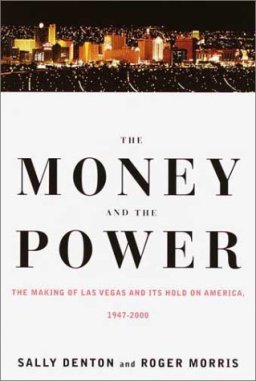
The Money and the Power: The Making of Las Vegas and Its Hold on America 1947-2000
Sally Denton and Roger Morris
London: Pimlico, 2002, pb, £15
John Burnes
It’s hardly news that Las Vegas was a city run by the Mob. Or that it was fuelled by financial corruption. Or that both of these situations were enabled by the fact that Nevada used to be the one state in the US where gambling was legal. What is still news, however, is the scale of that corruption and how it reached into every nook-and-cranny of post-war American life.
Denton and Morris put forward the thesis that Vegas was in fact the ‘shadow capital’ of the US in the last half of the twentieth century, growing inexorably in power and influence as its expansion paralleled the world-wide expansion of political power in Washington. They trace the ubiquitous but subterranean connections between these two cities. In effect, they have written the early history of those various connections between the US political machines, federal agencies and organised crime that anyone with an interest in parapolitics has come to increasingly accept as the norm.
The book is as much the history of a state, Nevada, as it is the history of a city. After a brief mining boom in the nineteenth century it seemed that Nevada was destined to return to the backwater it had always been, geographically isolated and politically and financially insignificant. Both Vegas and Nevada had gone bust before the rest of America in the 1920s. By 1921 Vegas had a population of 3,000 and the whole of Nevada mustered a population of less than 78,000. By 1960 the city had a population of 64,000. This rose to 164,000 by 1980 and by 1995 had grown further to 368,000. The population is expected to reach the 2 million mark by 2005. It’s growing at the rate of 7% per year.
What happened to explain this transition from desert watering hole to the world’s fastest growing city, a city where land prices were $1.25 per acre in the late forties and are now as high as anywhere outside of Manhattan? Well, the Mob happened, in the persons of Bugsy Siegal and Meyer Lansky – as did the Pentagon, courtesy of the US atomic testing programme. Both these influxes of outside talent, people with ‘juice’ to use the Vegas parlance, were presaged by three events in 1931. Gambling was legalised, quickie divorces were licensed and the construction of the Hoover Dam began. This combining of out-of-state attractions for a still largely puritanical America with a group of males with money to spend formed the essential mix in the cocktail that achieved its final blend in the late forties – sun, sex and sin on the permanent building-site cum brothel/casino/hotel that Las Vegas became. The Mob headed west, followed by the politicians.
One other series of events, Prohibition and its aftermath, contributed to this growth. Local politics had always been more or less corrupt in the US. Before Prohibition, the politicians used to hire the local gangsters to enforce the desired electoral outcome. After Prohibition, the gangs were wealthy enough to hire the politicians. Alcohol might now be legal but the enormous profits that Prohibition had generated were used to institutionalise other equally lucrative but illegal enterprises, mainly gambling, prostitution and narcotics.
The grand junction
Denton and Morris trace the way that Vegas became the grand junction where the profits from these activities were laundered and invested. Not only were they used to build and finance the casinos, the casinos themselves generated enormous profits. With the tax on gambling never rising much above 6%, they could hardly avoid doing so. With profits of 30-50%, double the profit of even the most successful business, Vegas became a cash-cow like no other. Every President from Truman to Reagan either visited Vegas to raise campaign funds or was politically and financially indebted to the people who ran Vegas. Paul Laxalt, one of only two republican Senate gains in the year after Watergate, had been a long-time defender of casino interests in the state. He was the first to form a Citizens for Reagan Committee, later becoming one of Reagan’s key advisors in the White House. He was too tainted to run for the Presidency himself.
In tracing this increasingly symbiotic relationship between politics and organised crime in the US, Denton and Morris not only connect afresh what we had already vaguely known, but also knock a few myths on the head. It wasn’t just the Mafia, the Italian mob, that was involved in creating organised crime in the US. After Meyer Lansky, who was Jewish, had formed his partnership with Lucky Luciano, who was Italian, in 1920’s New York, organised crime became a completely multi-ethnic enterprise. The Mafia soon came to an understanding with the gangs which had originated in other ethnic groups. Everyone, Poles, Irish, Jews, and Italians got their piece of the pie. These understandings were transferred to Vegas.
Kefauver
This corruption wasn’t inevitable, an irresistible social and political force. In chapters devoted to Estes Kefauver and his eponymous committee, Denton and Morris describe and analyse a key moment in the US’s post-war history. Kefauver’s televised questioning of various mobsters had made him, hitherto an obscure senator from Tennessee, into a national political figure, as well-known at the time as another junior senator – the one from Wisconsin, Joe McCarthy. The Kefauver committee was the first – and last – of its kind. Given a sweeping mandate to investigate interstate organised crime, something which Hoover, then head of the FBI, denied existed, it looked for a time in the early fifties as if it might not only break the power of the Mob but also propel Kefauver into the White House in 1952 on a populist reform ticket. Instead, we got the Age of Ike.
Kefauver made three errors. First, he mistook the Mafia, the Italian mob, for the whole of organised crime in the US. He completely missed the Syndicate, the national organisation of which the Mafia was only a part. Second, he failed to appreciate the growth of narcotics as a major Mob interest, concentrating his attention almost wholly on gambling. This was largely due to the fact that the Federal Bureau of Narcotics had placed a mole on the Committee. He was George White.
Presented to Kefauver by the FBN as an expert on the Mafia, White was hardly the ideal figure to shape the committee’s enquiry. He had served in the OSS during the war, working closely with James Angleton. He had also worked with Meyer Lansky on Operation Underworld, the Mob’s first contact with the US intelligence community. Peter Dale Scott describes White in Deep Politics and the Death of JFK as ‘part of the “inner circle”‘, one of those who liaised between organised crime and the US bureaucracy in the post-war world. He also acted as liaison in the early days of MKUltra and its predecessors. It seems likely that White’s actual job was to steer the committee away not only from the Mob’s involvement in narcotics but also away from any connection between them and US intelligence, particularly in connection with narcotics. He was later a key figure in covering up Chiang Kai-sheck’s involvement in the heroin traffic from Asia to the US, publicly blaming the Communist Chinese instead. (He also recruited Jack Ruby as an informant in Chicago in the late forties before Ruby moved to Dallas.)
Kefauver’s third mistake, his key political mistake, was to get up the nose of Harry Truman. Of the nineteen bills that stemmed directly from the hearings, and the further two hundred that arose from the Committee’s official report, not one made it past Congress. Kefauver had beaten Truman in the New Hampshire primary and went on to win fourteen out of the sixteen Democratic primaries in 1952. He looked certain to be the Democratic candidate for the presidency. He led Eisenhower in some of the polls.
Fixing the convention
The only solution the Democratic party machine could come up with was to fix the Convention. On the eve of the Convention, Kefauver could still only be assured of less than half of the 500 votes from the Democratic states he had swept in the primaries. Ironically, Kefauver rejected an offer from the Texas Democrats led by Governor Shivers and Lyndon Johnson, with their financial backers, Carlos Marcello and Benny Binyon, a Texas/Las Vegas cowboy-gangster, to swing Texas his way. The price would have been a deal with the Texas oil barons regarding their virtual monopoly of offshore oil in the gulf states. Kefauver’s refusal lost him nearly 10% of the available votes. The Chicago machine swung into action against him, blocking physical access to the convention to Kefauver’s supporters. Sam Rayburn refused to recognise either him or his supporters from the platform. Finally, Kefauver was dumped by the party’s northern liberals, led by Hubert Humphrey. Humphrey had first come to public prominence as a gang-busting mayor. Only many years later would it be known how many contributions Meyer Lansky had made to Humphrey’s various campaigns. (When Humphrey later took his oath as vice president of the US in 1965 under LBJ, the Bible he swore on was held for him by one of his old patrons, Minneapolis vice lord Fred Gates.) Adlai Stevenson won the nomination and was hammered by Eisenhower the following November. Truman had even vetoed Stevenson’s suggestion that Kefauver be placed on the ticket as vice-presidential candidate. Kefauver’s reform aspirations died with his political ones.
It’s arguable that the Democratic Party never recovered from this convention. The only Democratic candidate who looked even to be in a position to take on the Mob, Robert Kennedy, was shot within minutes of winning the California primary in 1968. At the time, he looked likely to beat the emerging Republican candidate, one Richard Nixon. The only other Democratic president, with the exception of Lyndon Johnson, between 1952 and 1976, John F Kennedy, had owed his win to the support of Sam Giancana, the mob boss in Chicago in 1960.
As mentioned above, Binyon was one of Johnson’s sponsors. Although he could hardly read or write, he had worked his way up from a gambler-cum-enforcer in early twentieth-century Texas to become a land and casino owner in Nevada worth some $100 million on his death. On the way, he’d killed people who offended him, including ‘a nigger’ he’d caught stealing whiskey. When he casually confessed to this at a hearing to renew his gambling license, the committee agreed with him that this didn’t really count. He once physically ejected a black, disabled war veteran from one of his casinos, throwing both him and his wheelchair into the street.
Las Vegas was as racist as it was corrupt, but the racism wasn’t always expressed as crudely as this. It was often hidden beneath a subtle blend of public relations and backstage negotiations. When the black singer, Lena Horn, played Vegas in the fifties, a deal was negotiated whereby, unlike other black performers, she could sleep in the hotel she was singing in. The only condition imposed was that the hotel would burn the sheets from her bed rather than send them to the laundry. Ms. Horn had taken her children with her for the week. One afternoon they attempted to cool-off in the hotel swimming pool. They were thrown out.
The book contains one extraordinary photograph taken in the fifties and which encapsulates in a single image the relationship between Vegas/Nevada and the federal government. It’s a daytime snapshot of the Las Vegas Strip. The neon signs are turned off. On the horizon is a large mushroom cloud. It’s from an atomic test. The tests had become a Vegas tourist attraction. There were over a hundred nuclear weapons tested above ground in Nevada in the fifties, sometimes at the rate of four per month. Crowds drove in from LA to hold ‘dawn bomb parties’ on the Strip. The Atomic Energy Commission guaranteed the safety of the experiments. The local press officer who assured visiting journalists of this fact was himself slowly going blind because of the cataracts forming over his eyes. Some casinos displayed notices to the effect that in case any of the explosions caused the roulette balls to bounce, the house-ruling would, as always, be final. Clearly, Stanley Kubrick was not a satirist.
Kodak was one of the few lobbies powerful enough to complain effectively. The radiation from the tests was ruining the film on their production lines. They alone were given advance notice as to when a test was scheduled. Russell, the Governor of Nevada at the time, pointed out to complainants that there was little he could do because 85% of the land in Nevada was owned or controlled by the federal authorities. The rest was owned mostly by the Mob.
The CIA found Vegas as useful for laundering money as the Mob. When Hank Greenspan, the local semi-liberal and ‘crusading’ newspaper editor died – he was as close to an opposition as Las Vegas ever developed – it was discovered that he was not only on the CIA books but those of Mossad as well. His sizeable FBI file revealed not only his various corrupt business relationships, stretching over twenty years with everyone from Siegal to Howard Hughes and Frank Sinatra but also his other career as an arms smuggler. Mossad gave him posthumous recognition. Denton and Morris note that his obituary in the Jerusalem Post was more accurate than any printed by rival newspapers in Vegas itself.
Denton and Morris view Vegas not as a bizarre aberration but as a new norm. If you want to know what the twenty-first century will be like, don’t think of Washington, London or Tokyo, think of Las Vegas.