
Crosland lives!
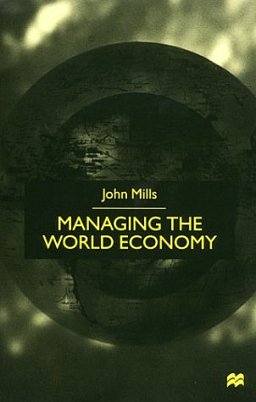
Managing the World Economy
John Mills
MacMillan, London, 2000, £42.50 (hb)
John Mills argues in this book that the central problem facing any economy is that of creating and sustaining growth. This is true not only for the older developed economies of the United States and Europe, including Britain, but also for the Japanese and other Far Eastern economies, the so-called Tiger economies, which experienced spectacular post-war growth but then faced increasing difficulties in sustaining it. Japan’s growth rate, which once led to the Japanese economy being proposed as a new model for the older Western economies, has been sluggish throughout the nineties, and is currently virtually zero.
Mills’ book traces the patterns of the world’s economies over the past two centuries and is, in effect, a history of economic growth since the Industrial Revolution. He attempts to isolate the conditions which have helped or hindered it. Previously, the management of a country’s growth has been more or less a hit-and-miss affair. Those countries which have managed relatively spectacular growth rates for limited periods have not only been unable to sustain them; but, more importantly, perhaps, have also been unable to successfully export their own model for growth – mainly because they have been largely unaware of it, having made the right economic choices haphazardly. A natural consequence of this was that they also remained largely unaware of the reasons for any subsequent slow-down in their growth rate.
In large part, this is a cautionary tale: the damage that is inflicted upon an economy’s capacity for growth by an overvalued exchange rate. He argues that the key factor in managed growth is a managed exchange rate and that supply-side measures alone will never ensure growth. To illustrate this he compares the immediate post-war U.S. economy with the then poor Far Eastern ones. The U.S. outstripped them in every important supply-side factor, in education/training, in productivity, in levels of investment, etc.; but in spite of the post-war boom in the U.S. economy, Japanese growth rates far exceeded those of the U.S.. Productivity per head increases were not alone enough to compete on growth levels. Mills holds that the main advantage held by the Japanese economy was that of a competitive exchange rate, one which stimulated their manufacturing sector and boosted exports. He also draws a similar lesson from the post-war West German economic boom. West Germany was more or less allowed to have a favourable exchange rate, thus ensuring rapid economic recovery and political stability in the emerging climate of the Cold War. This created a thriving manufacturing sector.
The traditional objections to the possible advantages to be gained from a low exchange rate are monetarist ones. It is held that any competitive advantage gained will be purely a temporary one which will be eaten away by a subsequent and inevitable inflation. Mills contests the two basic tenets of monetarist orthodoxy: (a) that an increase in the money supply is the sole (or even major) cause of price inflation; and (b) that devaluation is of necessity inflationary, undermining any temporary international competitive advantage gained through it. Further, he disputes that the main instrument of economic policy should be the control of interest rates in the interest of controlling putative inflationary tendencies. He also contests the notion that there is an iron law of the market governing exchange rates, and that governments are powerless to affect this through policy, because there is an equilibrium exchange rate, a parity, to which the currency will tend to return naturally.
Mills gives many empirical examples. The most convincing is perhaps that of the French devaluation in the late fifties. Subsequent inflation dissipated within months and the French economy became competitive with the West German one. Which was the idea. A more recent example is that of Britain’s forced ejection from the ERM in 1992. Far from being mainly inflationary in its effect, sterling’s release from a deflationary straightjacket blunted the effects of the early nineties recession and set the British economy onto the road of which New Labour is now so proud. The current government front bench were, of course, enthusiastic supporters of British entry into the ERM in 1990, and at the overvalued rate which subsequently forced our exit. No doubt they thought sterling was simply hitching an anti-inflationary piggy-back ride on the German mark.
In essence, Mills holds that it is monetarist doctrine/dogma which is primarily responsible for the low growth rates in the British and European economies since the seventies. And that monetarism itself is the enemy of enterprise, a financial orthodoxy which is the natural correlate of a conservative social and political orthodoxy. With its emphasis on tight money, high interest and exchange rates, conditions which slow down productive enterprise, and make it easier to import and harder to sell abroad, it is a doctrine which not only appeals to the socially conservative but also represents, to a large extent, their real interests. Bankers, pensioners on fixed incomes, and wealth holders benefit from relatively high interest rates. Manufacturers and others engaged in international trade do not. Once established, these conservative tendencies perpetuate themselves. As capital wealth accumulates, slow growth at home causes it to be ‘invested’ abroad and there is even less available for domestic investment.
If Mills is right in his analysis, then the Labour Party switched to its new orthodoxy at precisely the wrong moment – the moment when it began to prove itself wrong for the EU economies. The common European currency with its precursors, the ‘Snake’ and the ERM, both constrained growth in Europe and pushed unemployment to unparalleled post-war levels. He argues that the notion of a common European currency has always been mainly a political project and not an economic one.(1)
British lessons? Blairism is even more traditional than we thought. Mills traces the slowing down of the British growth rate back to the 19th century. The brakes were applied even earlier when Newton was Master of the Mint and was constrained, against his own better judgement, to adopt John Locke’s deflationary economic policies. A similar situation repeated itself after the Napoleonic wars when macro economic policy was devoted to returning the pound to its pre-war level. At all costs. This massive deflation, although successful in its own terms, led not only to political and social unrest, culminating in the Peterloo massacre, but also inaugurated a prolonged post-war recession. The majority opinion of the Currency school, essentially, monetarism avant le lettre, was followed rather than that of the Banking school, even then a minority.
In giving an economic history of the world over the last two centuries, Mills has also provided material for revising what is perhaps still the accepted orthodoxy regarding British economic history in the 1970s. Although monetarism as an academic theory is now rarely promoted as the final word in economic orthodoxy – we no longer wait with baited breath for the quarterly M3 figures – it underlies some still generally accepted pictures of what went wrong economically in the 70s, both globally and nationally. If monetarism is inadequate as an economic theory, then any historical explanation dependent on it is also suspect. Blairism, so heavily dependent on various conventional wisdoms about the history of the 1970s, may turn out to be simply a headless chicken version of Thatcherism: the chicken is still running round the farmyard when the conditions which led to its decapitation have long since ceased to obtain.
This leaves us to decide whether British economic policy in the 70s and 80s was a series of miscalculations, based as much on ignorance as prejudice and dogma, or a deliberate surrender to conservative bankers’ values – that is, to the City.
As Mills shows, the debate is a traditional one; and in the end arises from the paradoxical fact that money, the common measure of value, has itself two values: its exchange value vis-a-vis other currencies; and its interest rate – how much money costs to borrow at a given time. The question as to which of these should be the main lever of economic policy is perhaps the main one facing the British economy – or, rather, its future. Mills has managed to put the question back on the agenda. In so doing – in arguing that there is a possible choice in these matters – he has also raised another old ghost. His subtext is that national economic choices and decisions are also political choices. The book not only addresses contemporary economic problems but perhaps also helps to revive an almost defunct academic subject, political economy.
An important contribution from the centre-left.
Notes
- It would be a major irony of British economic history if the Conservative Party, the traditional guardians of financial orthodoxy, were to be proved correct in viewing the ecu as anathema, though for the wrong reasons.