
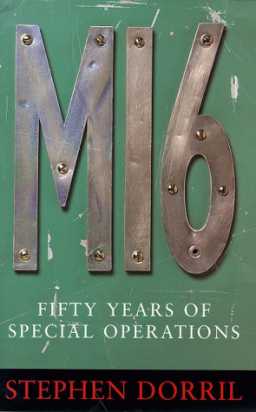
MI6: Fifty Years of Special Operations
Stephen Dorril
Fourth Estate, London, 2000, £25
A Life: A. J. Ayer
Ben Rogers
Chatto and Windus, London, 1999, £20
Many books on intelligence matters simply rehash old ‘facts’, adding a new twist to – a slightly different interpretation of – well-known, if not necessarily well-understood, events. If they contain new information at all, this is often padded-out. What might have been the basis for an interesting article ends up as an inflated, if not pretentious, book. Although it necessarily retreads much familiar ground, Stephen Dorril’s new book isn’t like this at all. At 900 pages, it is a massive and impressive work, one which attempts an overview of the last fifty years of MI6’s operational history. Perforce, the bulk of it is concerned with the Cold War, and then mainly in Europe. This isn’t overly eurocentric on Dorril’s part: his preface states that he intends to publish another volume on the roles of MI6 and MI5 with reference to counter-insurgency in the Third World. This will give more attention to South East Asia and Africa than was possible in the present volume. Fair enough. As the British Empire dissolved in the post-war period, MI6, the foreign intelligence service, often accompanied by the recently created CIA, moved into the newly emergent countries recently vacated by MI5, the service responsible not only for domestic security in the UK but also throughout the Empire; so this aspect needs a separate treatment.
Divided into seven roughly equal parts, this covers in chronological order the period from the end of World War 2 to the present day. Each section has a theme which is itself treated more or less chronologically. These themes are either geopolitical, as in ‘Part Three: The Soviet Empire’, an impressive piece of condensation of both well-known and more obscure sources, which manages both to unify the material and to cast fresh light on it; or temporal, dealing with crucial periods of the Cold War, such as the emergence of the CIA/MI6 psy-ops cultural offensive in the early 50s, exemplified by the Congress for Cultural Freedom. It is Dorril’s use of this formal structure which enables him to master the complexity of the material.
Within this framework, for example, he gives within one short chapter, ‘Yugoslavia: The Golden Priest, Stolen Treasure and the Crusaders’, one of the more concise views yet to
emerge of the connections between the various groups and factions fighting in Yugoslavia towards the end of WW2 and, by implication, the manner in which these conflicting structures contributed to Yugoslavia’s disintegration in the early nineties. He also scotches the notion, persistent on the right, that it was covert Communist influence within SOE (steered by James Klugman) that led the British to begin supporting Tito at the expense of Mihailovic: Tito was simply killing more Germans. There were two wars (at least) happening in Yugoslavia: one brought about by the German-Italian invasion, in the end supported by their Croat allies, which the Serbs as a whole opposed; and another, between Tito and Mihailovic. Tito’s wars were certainly less humane. He had no strategic objection to the German destruction of villages: this resulted in more recruits to the Partisans. In order to save the villages, Mihailovic was committed to a policy of harassment and retreat, combined with periods of semi-truce with the Germans during which he continued to fight the Partisans. This resulted in his post-war execution for collaboration with the enemy. No Communist plot, just differing attitudes to war and country. Each side, of course, took advantage, as best they could, of this basic strategic reality.(1)
Danubia
Equally fascinating is Dorril’s account of the Intermarium movement (chapter 11), concerning what was to become a more central battleground (literally) of the Cold War. This organisation had its origins in mid-thirties Paris and was essentially an anti-Communist Catholic lay organisation. Its aim was to create out of sixteen nations an anti-Soviet cor don sanitaire in Central Europe. Intermarium – literally ‘between the seas’ – as a political reality might have been either a federation or a confederation. Both the British and French intelligence services had a hand in it, in much the same way as MI6 and the CIA had a hand in the post-war European Movement. Indeed, the current European Union might be seen as Intermarium’s post-war realisation, but located further West. It would have been the Austro-Hungarian Empire reborn and extended to the Baltic. Catholic Croatia and Lithuania, the latter once the possessor of an empire stretching nearly to the Balkans, would have formed its Southern and Northern extremes, with Poland at its centre. Dorril records that the impoverished Otto von Habsburg was subsidised to the tune of £50,000 a month by MI6 chief Menzies. The ‘cut-out’ used was probably Kenneth Cohen. Habsburg later left for the United States where he promoted the idea of this state, to be called Danubia. This wasn’t simply pie-in-the-sky politics. In March 1942 the Deputy of British Security Coordination in New York, Charles Ellis, revealed the existence of the secret subsidy to Donovan, head of OSS, with a view to the Americans taking over the funding. Donovan had little faith in Habsburg but was willing to support Count Coudenhove-Kalargi, a rival claimant with his own Pan-Europa project. Churchill supported the latter against the advice of the Foreign Office. The idea was actually broached to Molotov who opposed it as anti-Soviet, and it was formally knocked on the head when the United States swung round to the Soviet view.
The scheme, or a similar one, continued a ghostly, post-war existence for a while. The Vatican supported it. There was an active branch of Intermarium in Rome and senior Vatican priests and bishops became officers of the organisation. Intermarium was one of the first organisations to campaign openly for freedom for Waffen-SS PoWs. Many Intermarium leaders relocated to Rome after the French influence declined in 1946, subsequently transferring their loyalties to the United States, ‘where they found senior positions in CIA-financed and-controlled fronts such as Radio Free Europe, Radio Liberation….’ These became bases for the ‘liberation movements’ sponsored by the CIA and MI6.
The Promethean League
Dorril is equally enlightening in his treatment of the Promethean League, formed in the aftermath of the Bolshevik revolution and representing all the minority nationalities of the former Russian empire, though primarily a vehicle for Ukrainian and Georgian aspirations. A self-acknowledged ‘conspiring underground organisation’, the League developed rapidly and by 1925 was already receiving covert support and financing from Menzies. If its aspirations had been realised, the likeliest result would have been an independent Ukraine guaranteed by Poland. Indeed, it drew much of its inspiration from Coudenhove-Kalergi’s Pan-European Union. Poland would have become a major power-broker in Europe. Again after WW2, its members became part of British Cold War activities. Philby was important here, working from Istanbul. The Soviets of course were kept well-informed of these developments – Philby used Burgess in London to forward the information. The League had, in effect, ceased to operate by 1949 but Dorril traces the ways in which it fed into other anti-Soviet covert groupings, mainly the Belorussians and the Western Ukrainian nationalists operating under the code-name INTEGRAL. As Dorril notes, this name was probably chosen deliberately, looking back to the ideas of ‘integral nationalists’ of thirties Europe. These ideas were generally fascistic, often ultra-fascistic, in outlook. The idea of nation was deified to the point of ultra-nationalism; national feeling was carried by racial blood. In short, members of the same nation would, even if transposed geographically, automatically reproduce their national culture. These bio-mystical ideas were attractive to the younger Galician nationalists who despised the way in which their elders in the Promethean League had compromised with the Poles.
All these currents of federalism and confederalism, under cut by notions of racial autonomy, are deftly charted by Dorril, together with their pre- and post-war analogues. Rarely has so much complex historical material been compressed in so short a space since A. J. P. Taylor managed a coherent account of the Austro-Hungarian empire in a single volume.
Dorril has a general theme, perhaps two, but he doesn’t labour them: the diminution of Britain as a world power, and the way in which covert political operations attempted to oppose this, while at the same time being conditioned by it; and the way in which the Cold War turned the world as a whole into a displaced war-zone, where previously marginal areas, either geographic or operative (spying, say) became crucial battlegrounds. He lets his description of events point their own moral: from the failed Baltic operations, through the Iranian coup, into the hi-jacking of European culture – ‘the Battle for Picasso’s Mind’ – and its recycling as a psy-ops project by the Congress for Cultural Freedom. The notion that Britain could ‘punch above her weight’, due to the combination of the possession of the atomic bomb, with a group of wily Athenians back home running MI6, was tested to destruction.
In his final chapter, ‘The New Agenda’, dealing with MI6’s future, Dorril drops the minor bombshell that the old black propaganda functions of IRD are up-and-running again with MI6. He maintains that a former MI6 officer (Tomlinson?) has alleged that ‘the bread-and-butter work’ of the service’s psychological warfare I/Ops section is in ‘massaging public opinion into accepting controversial foreign policy decisions’. This includes the ‘plethora of media stories about Saddam Hussein’s chemical and biological weapons capability’. So, the British government has a new fibbing-machine that enables us to bomb Iraq whenever it is convenient. (Perhaps also to join a common European currency, or not?)
When the complete history of MI6 in the Cold War is known, it may turn out that MI6 often occupied a similar position with regard to the CIA: supposedly unified against a perceived common Soviet threat, but also engaged in their own internal contest with each other, particularly in parts of the former British Empire. (After all, in the mid-sixties, the CIA did make an attempt to take over MI5 and incorporate it into their London station.) Suez springs to mind, as do Australia and Northern Ireland – the latter is perhaps, depending on one’s politics, the final piece of Empire. In Northern Ireland the scene was complicated by the presence of MI5 and their turf war with MI6. Without rehashing old Lobster history, it is now fairly clear that MI5 thought they could fight the war/conflict with the PIRA to a finish, and that the Americans, excepting bits of Cold War rhetoric from the Reagan era, have always supported at least the possibility of a negotiated settlement, one which would necessarily involve compromise. Without buying into Enoch Powell’s notion that the Americans were happy that the Unionists be abandoned in order to bring a newly united Ireland into NATO, one can understand how the Unionists, at least, saw this as a possible scenario. When the American files are opened to inspection ten or twenty years from now, it won’t be surprising if, together with records of FBI surveillance of NORAID, there are also records of covert meetings between CIA and NORAID ‘representatives’.
The actual mechanisms of the British state
Considering the deposing of Gough Whitlam as Australian PM in the mid-seventies because he had ‘gone soft’ on American ‘bases’ sited in Australia, it is now generally conceded that John Kerr the Governor-General and Crown representative who deposed him, was, if not a CIA asset, at least a man with many CIA contacts. What was MI6’s role here? Certainly the MI6 station traffic increased dramatically during the crucial period. The Privy Council, or some members, would have to have known what was happening. Would this inner circle have included the monarch and the Lord Chancellor, among the senior members of the Council? Apart from continual hints from the late Peter Wright to the effect that the pre-statutory security and intelligence services owed their allegiance to the Crown and not Parliament, nothing is known about the relationship, the actual mechanisms, existing between the Crown and the security and intelligence services. If they exist, these mechanisms would almost certainly go through the Privy Council, as would have the parallel ones between the Australian services and the Crown in Whitlam’s time. Unfortunately very little is known about the workings of the Privy Council. One of the benefits of an unwritten constitution is the amount of room for manoeuvre it allows the executive. One hopes that Dorril’s following work, in which intelligence relationships with Australia will no doubt be dealt with in the sections on the Far East, might throw some light on these matters. Northern Ireland and Australia (even Yugoslavia) played minor, almost marginal roles in the Cold War; but the Cold War itself was fought in and on geographical and political margins; and marginal activity often illuminates the centre.
The books has some minor faults and one glaring omission. There are occasional uncertainties concerning the difference between important and unimportant points and issues. For example, with only the word of an unnamed ex-MI6 officer (Tomlinson?) as evidence, he claims that Nelson Mandela was once an MI6 agent. If true, this is important. It not only changes our perception of Mandela, the most important African politician of this generation, but also of the scope of British post-colonial activity in Southern Africa. Obviously the ANC was targeted, but so was the Soviet Union. No one (outside of LaRouchie land) has as yet suggested that Gorbachev was a British asset. We’d expect a bit of evidence. It doesn’t help Dorril’s case that, when criticised by Anthony Sampson in the Guardian, he defended his thesis with the hoary academic trick of, and I quote, ‘It is not implausible that……’ Statements are either plausible or not. An evasive double negative (a speciality of the Scott report on Arms to Iraq) doesn’t ward off potential criticism, it invites it.
The book’s major technical goof is the lack of a bibliography. This simply wastes a reader’s time if s/he wants to check or compare Dorril’s sources. It involves continual cross-referencing between the text, the notes and the index, the notes alone a hundred pages long. Possibly the publisher was pressed for space, but a book which has taken nearly seven years to write, and nearly twenty to research, surely deserves this most basic of research tools. As a book it can be either tasted, or chewed and digested; but no one should have to try and soak up nearly a hundred pages to get some idea of what the author has or hasn’t read.
Despite these minor grouches, Dorril has written a book which will not only have to be the first port-of-call for any-one seriously interested in the history of the British intelligence service, but which also provides a new bench-mark for any future works dealing with these or similar areas. It earns comparison with William Blum’s seminal work on the CIA. Dorril perhaps deserves more credit, if only because of the inherent extra difficulties involved in writing about the activities of the equivalent British service. Without a semi-effective Freedom of Information Act, America would still be scratching its collective head about the CIA. In spite of the lack of legally enforceable rights to information about the actions of government in Britain, Dorril has blown away much of the fog that previously surrounded the history of MI6. Like Blum, he has provided a base from which it is possible to begin an assessment of how intelligence operations connected with ‘mainstream’ history, the sort we find in the conventional history books. Whether conventional historians will learn from this or not is another matter.
*
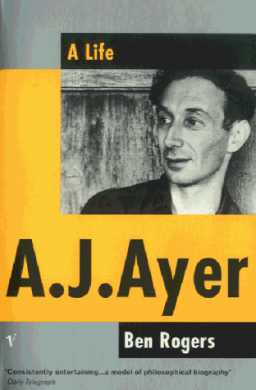 A. J. Ayer spent much of WW2 working in intelligence, finally ending up in MI6. In this well-researched book Ben Rogers has filled in what little was known previously about Ayer’s intelligence career and also provided enough of the social and political background to assess its significance. Ayer’s career is an exemplary illustration of the way in which Anglo-American cultural and academic life overlapped with the spheres of intelligence and politics in the post-war world, particularly on the liberal left.
At the outbreak of war, through the intercession of fellow philosopher Gilbert Ryle, who had managed to secure a commission in the Welsh Guards, Ayer joined them as an ordinary guardsman. He was quickly assigned to officer training at Sandhurst, and then to the Intelligence Corps in Curzon Street, where he interrogated German prisoners. In addition to this, he toured London pubs in the evenings fraternising with and listening to the conversation of ordinary soldiers in order to compile reports on possible security leaks. This semi-social eavesdropping became characteristic of his intelligence life.
In September 1941 he was officially transferred from the Guards to SOE in Baker Street and then, two weeks before Pearl Harbour, to British Security Coordination in New York where his intelligence career began in earnest. He worked on the South American desk under Bill Deakin, later the head of St. Antony’s College, Oxford, a college which retained throughout the Cold War a reputation as spook-connected. Ayer remained close to Deakin throughout his life, as he did with many other intelligence personnel first met at this time. His main work with BSC involved researching and writing reports on the various left and right-wing groupings operating in South America. These reports would later provide the basis for the CIA’s operations in South America. They were made available initially in case Germany was planning an invasion and later formed one of the planks of the information exchange on which the Anglo-American ‘special relationship’ was built.
Bill Deakin’s American opposite number was Nelson Rockefeller, in charge of all American intelligence in Latin America during WW2. (2) Saunders writes: ‘When Nelson Rockefeller was appointed by Eisenhower to the National Security Council in 1954, his job was to approve various covert operations.’ And also to subsidise them. The Rockefeller Foundation not only part-funded the CIA’s MK-Ultra programme, but also the Congress for Cultural Freedom, whose two principal officers were Charles B. Fahs, ex-OSS, and the RF’s head of the humanities division, and Chadbourne Gilpatric, ex-CIA, the people responsible for actually dispensing the subsidies.
The first chairman of the CCF, and the principal force behind it, was Sidney Hook, who also became close to Ayer. They had first met before the war when Hook was still a Communist. Later in 1948, Hook arranged a short teaching-post for Ayer at NYU. In New York Ayer’s social life centred round the intelligence world and the British expatriate art-community which overlapped with it. For a while he was the film critic of The Nation under the pseudonym P. H. Rye. These contacts were also maintained for the rest of his life. It was here he first met many of the people concerned with film psy-ops, an activity which continued well into the Cold War – if, indeed, it ever stopped.
Ayer est un con
Disillusioned with his lack of promotion within BSC, and with Bill Stephenson, whom he thought to be a charlatan, Ayer arranged a transfer back to SOE which (after a disastrous nine-day secondment to the Gold Coast, where he gave the impression that the work was beneath him) placed him as a political advisor with RF, the section of SOE which liaised with BCRA, De Gaulle’s own special operations organisation. Ayer’s job was to assess the strength, aims, tactics and political allegiances of the various Resistance groups, particularly the Communists, on whose prospects and structure he wrote a classic report. This helped Ayer to achieve his final official intelligence posting, when, after the liberation of France, and after being transferred from SOE to MI6, he was posted to the British Embassy in Paris. Ambassador Duff Cooper had requested this because he regarded Ayer as a ‘first-class political observer’. Ayer was vague as to what his specific duties at the embassy were, where he was described simply as a ‘political attaché’, but he sat in on Duff Cooper’s weekly staff meetings. Rogers suggests that he was there as MI6’s political analyst on the spot: MI6 were worried about the possibility of a Communist coup. This notion seems to be confirmed by the fact that Ayer had arrived in April 1945, a month before the German surrender, and left in October the same year, immediately after the free elections.
During his stay he cultivated much the same varied social life he had in New York four years earlier, meeting Malraux and others; and many on what was to become the post-war existentialist French left, including Camus. But Sartre refused an invitation to meet Ayer, saying simply, ‘Ayer est un con’ (Ayer’s a cunt). Ayer was living in some style: Guy de Rothschild lent him the family mansion on the Avenue Foch, the one in which Victor Rothshild, Guy’s cousin, had recently suggested to Malcolm Muggeridge and Kim Philby that the allies share all intelligence with the Soviets. (3)
Back to philosophy
After demobilisation, Ayer returned to academic philosophy, though he kept his hand in as a spook, working part-time for MI6 at Broadway as a political analyst. In this he was joined by Goronwy Rees, later to have his own difficulties within the intelligence world. Rees was suspected of being a Soviet mole himself after attempting to persuade Dick White that Blunt was one in 1951. Ayer, who stayed close to Rees after he was later dropped both socially and professionally, was also probably keeping an eye for him for MI6. Rees only knew for certain that Blunt had been a Soviet agent when Margaret Thatcher confirmed it in the Commons. Ayer had known it since at last 1963. He never told Rees.
Before the war Ayer had not only been a radical philosopher, but was also attracted to radical left politics. He had nearly joined the Communist Party at the request of Philip Toynbee, but backed-off on the grounds that Marx’s theories weren’t actually true. Toynbee thought this frivolous on Ayer’s part. Ayer if not valiant for truth – he lied to his women throughout his life – was at least a stickler for accuracy. He joined the Labour Party, instead, where he was chairman of his local branch.
His politics mellowed and he moved towards the social democratic wing of the Party. With Hugh Trevor Roper, now Lord Dacre, he attended the opening conference of the Congress for Cultural Freedom in Berlin, where they were both appalled by the religious fervour and hysterical anti-Communist atmosphere generated. Trevor Roper compared it to ‘a Nuremberg Rally’. Trevor Roper’s opposition was that of a high Tory and Ayer’s that of a liberal. Ayer attempted to get Bertrand Russell to resign his honorary presidency of the CCF.
However, none of this stopped Ayer writing for Encounter, the Congress’s CIA-subsidised magazine, nor from letting IRD fund his trip to Berlin. Ayer was aware of the origins of these subsidies, later expressing surprise at Encounter editor Stephen Spender’s professed ignorance. Nor did he let it sour his relations with the mainly Jewish group of pugnacious Cold War Warriors centred round City College in New York who were attached to Encounter and the CCF.
In the sixties Ayer moved into Regents Park Terrace in London NW1, an area then taking over from Hampstead as the effective literary centre of London, and whose residents were much parodied in the media. He continued to cultivate new friends and renew old acquaintances, of whom the most important was probably Hugh Gaitskell (living in Hampstead), then the leader of the Labour Party and the expected next Prime Minister. Ayer had known most of the emerging social democratic Labour politicians – Patrick Gordon Walker, Douglas Jay, Tony Crosland, Roy Jenkins – at Oxford before the war but he was closest to Gaitskell, who had also served in SOE. Ayer had remarried. His new wife was the American journalist Dee Wells and they spent their honeymoon in Yugoslavia as guests of the Gaitskells, themselves guests of the Yugoslavian government. If Gaitskell had lived and become Prime Minister he’d intended to make Ayer a peer. In the Lords Ayer would no doubt have performed similar services for the government as Meta Ramsay is now thought to provide the Blair administration.
Having later to settle for a knighthood, left Ayer with a life-long detestation of Harold Wilson. This whole Camden Town social group felt, though they could not rationally argue the case, that Wilson was somehow illegitimate as Prime Minister, even though he won three general elections. Rather vulgarly, they felt that, ‘We woz robbed’. It was this unarticulated feeling of disappointment that in part later enabled some people even to entertain the notion that Gaitskell had been bumped-off by the KGB to make way for Wilson. This notion wasn’t entertained in NW1 but there was a feeling that Wilson had been suspiciously quick to take advantage of the Profumo affair. Cui bono notions were in the air. Perhaps the Soviets had arranged it for Wilson’s political benefit? If so, what did that say about Wilson? Remember that Peter Wright knew Gaitskell slightly, and admired him. Golitsyn’s little fantasy found some disturbing echoes even in the more liberal corners of Britain.
Among Ayer’s other close friends and immediate neighbours in NW1 were Colin Haycraft, the publisher, and Stuart Legg, the thirties film director. Both of these had family connections with intelligence. Haycraft, a semi-distant cousin of Cecil King, was King’s personal assistant early on at the time of the so-called Wilson plots. Haycraft had also known Harry Wharton, thought to have been the security services’ Fleet Street runner, when he had served as the Daily Mirror’s West African correspondent at the time of Nigerian and Ghanian independence. Though having some leftish sympathies at that time, Haycraft moved to the right in the seventies and eighties, expressing the opinion that the eighties Spectator was ‘full of lefties’. He became increasingly eccentric, once greeting his guests dressed as Gibbon, the historian, believing that Britain’s decline paralleled Rome’s.
Legg worked with John Grierson’s film units in Britain before the war and as a psy-ops propagandist with the National Film Board of Canada during the war (when he coined the phrase ‘world in action’). (4) He quickly left public life after Blunt was internally exposed in 1963. He had been at Marlborough with him and had been an early member of the so-called Cambridge Comintern. He later made IRD-backed films for Shell in the fifties, laundering funds with Rothschild and Korda (see below). Legg, too, became a Wilson-hater, denying publicly his own communist past, writing a short book espousing geopolitical views derived from Haushofer, the Nazi political theorist.
Two younger Labour figures moved into the area and joined this group: Giles Radice, who later helped arrange Tony Blair’s parliamentary seat in 1983, and William Rodgers, another Labour Party fixer, Wilson-hater, and one of the co-founders of the Social Democratic Party. An odd, occasional visitor to these circles was William Whitelaw, who became Margaret Thatcher’s fixer after the murder of Airey Neave.
Through the influence of his wife, Dee, a close friend of Susan Crosland, Ayer was once again politically active in the sixties but increasingly came to feel out of sympathy with the New Left, though he often supported them on individual issues such as homosexual law reform and the right to abortion. He’d become an end-of-ideology man, no longer believing in the need for any radical change in the structure of society: though, without living to see it, he did foresee the collapse of the Soviet Union in the eighties, believing that no society based on secrecy, and therefore ignorance, could survive indefinitely in the modern world. He obviously wasn’t listened to, the collapse of the Soviet Union apparently surprising MI6 as much as anyone else.
The increasing conservatism in Ayer was noted in 1995 by Stuart Hampshire, his long-time philosophical and sexual rival:
Freddie became a different person in the years after the war. From being a man of the Left, he became Establishment. From being anti-club, he joined them and was always having lunch at the French embassy. He came to see himself as an important cultural figure……it was downhill.’
Further downhill, he and Dee Wells separated, and Ayer married Vanessa Lawson, twenty-six years younger than him, and the divorced wife of Nigel Lawson, soon to be Margaret Thatcher’s Chancellor. He had completed the first part of his autobiography, Part of My Life, rejecting Christopher Hitchens’ counter suggestion for a title, The Leisure of the Theoried Class.
Vanessa Lawson gained Ayer entry to the salon of the leading Tory political hostess of that time, Margot Walmsley. For many years the managing editor of Encounter, according to Saunders, she had arrived there in 1953 ‘straight from her job as a clerical officer with IRD, and remained the Foreign Office’s “line of contact” into Encounter for over two decades’. Dying in 1997, Walmsley never disclosed that she was a Foreign Office employee. (5) Also, according to Saunders, Alexander Korda and Victor Rothschild wrote the first cheques. When the magazine’s intelligence funding was first blown in the mid-sixties, it was Cecil King who took over the role of funding cut-out, thus continuing editor Stephen Spender’s salary. If there is still any doubt as to the extent of King’s involvement with British intelligence, it should be stilled by the fact that Stephen Dorril was recently denied access by the CIA to any documents relating to King.
Despite energetic lobbying by himself (Ayer was vain not proud) and others, Ayer was not elevated to the Lords when the Thatcher government was elected. She thought him a terrible lefty.
Ayer’s stepson, another ex-resident of NW1, Dominic Lawson, was recently said in the British press to be an MI6 asset. Certainly, his brother-in-law, Tony Monckton, was on MI6’s desk in Croatia at the time Lawson published in The Spectator the articles on Bosnia by ‘Kenneth Roberts’, a name now known to be an MI6 cover. Lawson was defended by Worsthorne – who confessed in print a couple of years ago to his own involvement with MI6 and the CIA during the Cold War – on the grounds that he was such a selfish little shit, he lacked the necessary patriotic motivation (I am not making this up) to be a spy. Lawson did move into a series of increasingly expensive houses through the eighties and nineties, however. But his wife’s family are rich.
Ayer’s final years were patchy. Vanessa died and he remarried Dee. He wrote an incisive, liberal study of Tom Paine and a lucid though unsympathetic study of Wittgenstein. He never quite came to terms with the fact that Wittgenstein had never been a philosophical empiricist. He died in University College Hospital on June 27, 1989. (6)
Notes
- This confusion as to whether this corner of WW2 was one between countries, or simply a civil war, continued in Bosnia in 1992. It resulted in much puzzlement in the West that the Bosnian Muslims seemed to be fighting both with and against the Croats. This was a recapitulation within Bosnia of what had happened within Yugoslavia as a whole fifty years before. It goes to explain not only how Milosevic, the inheritor of Tito’s Communist pan-Yugoslavian mantle, could so quickly adopt Mihailovic’s Serbian nationalist mantle as the Cold War thawed, but also how such unlikely anti-war alliances as those between the late Alan Clark and Alice Mahon were formed: Clark, from the right, supported the Serbian soldier and warrior, Milosevic; while, from the left, Mahon supported Milosevic the Socialist.
- Who Paid the Piper?, Francis Stonor Saunders, Granta, London 1999, p. 144
- This now semi-legendary story, which came from Muggeridge, should perhaps be treated with the same degree of caution as the equally legendary story that Jim Angleton used to tell in which Philby, after an investiture at Buckingham Palace, was supposed to have told Angleton that Britain needed a ‘stiff dose of socialism’. This story has been doing the rounds unchallenged for years, last surfacing in Morris Riley’s recent book on Philby. If anyone bothers to check the record, the Investiture was cancelled that year due to George VI’s illness. A fairly classic example of an intelligence myth which survives unchecked for years, but which could have been nailed through an elementary fact check.
- On Legg’s post-war role in film see Chloe Metz, ‘The Marshall Plan seen through film’ Columbia Historical Review Vol. 1 no. 1.
- Other regulars at Walmsley’s salon were Ferdinand Mount, Peregrine Worsthorne, Charles Moore and Roger Scruton. I wonder who funded the Salisbury Review?
- Bernard Crick reviewed this Ayer biography for Tribune and made no reference to Ayer’s intelligence career. OK, it was a short review. But Frank Kermode’s one in the London Review of Books wasn’t. He covered the whole period, 39-45/ Welsh Guards to Paris embassy, without once mentioning that Ayer had been a spook; and the details I have given above of Ayer’s SOE/MI6 were taken straight from the biography.