
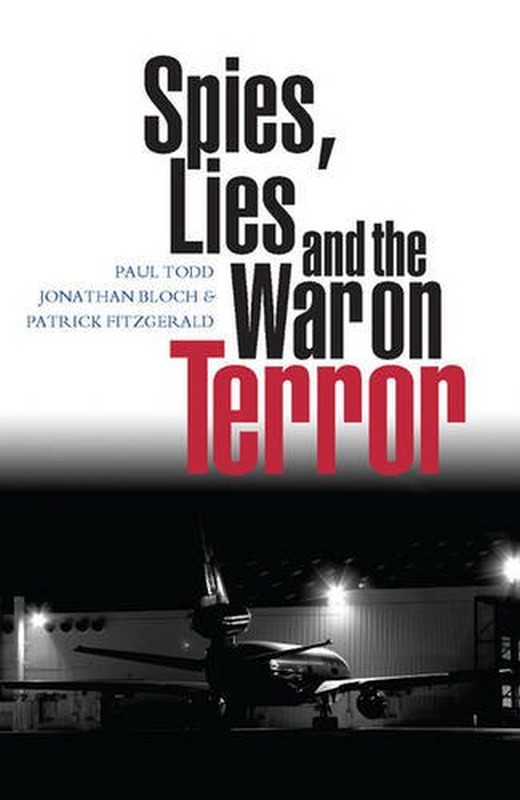
Paul Todd, Jonathan Bloch, and Patrick Fitzgerald
London: Zedbooks, 2009, £14.99, p/b, £39.95 h/b
This book is published as the debate rages in America about whether or not the activities of the Bush regime, specifically the torture of various combat detainees and suspects rendered from various parts of the world, should be subject to some sort of investigation, if not a truth and reconciliation commission. The larger issues, involving the systematic bending of the tasks of the intelligence community to create enough of an excuse for war, but also concerning both the morality and legality of such aggressive war, lie dormant behind the sexier images of torture and Abu Ghraib. But the odd thing is that, in America’s public debate, ‘the facts’ of the past eight years remain contentious, and debatable, whereas, as this book clearly illustrates, they are part of a policy continuum, whose boundaries had been set out clearly in the decades before 9/11, and, on a broader scale, whose basic premises continue to threaten civil liberties in the West.
The strength of this book is the way it considers a spectrum of issues, and draws the lines which connect them. It starts by examining the threat of ‘Islamism’, not in the wake of 9/11 but tracing it back to its roots in the Carter administration’s support for Afghan resistance to the Soviet invasion. The simple point, that the US and Britain now find themselves just as mired in that country as the Russians did three decades ago, barely needs to be stated. That the architects of Iran Contra, an earlier alliance of ‘creative destruction’, in the brilliant terms of neo-con apparatchick Michael Ledeen, should be setting the agenda for the second President Bush came as no surprise; that there was such a continuum through the Clinton years perhaps should. Depending now on a Sunni ‘arc of moderation’ has simply inflamed the area further, with Pakistan, now destabilising, at the fulcrum of this divide.
Having set out broadly the strategies responsible for creating this mess, and made clear that those responsible for the mess remain determined to make it worse, in the interests of promoting their concept of an American (and British) ascendancy, the book sets out briefly but comprehensively the nature of the alternative intelligence (and media) structures created to massage the facts into creating justifications for enacting those plans. Bush, Cheney and Rumsfeld created their own intelligence apparatus, not only to produce the desired results, but also to wage a propaganda war on their own population.
Of course, this material has been out there for years, but what is interesting in this new look at it is the way it is put into the context of an overall approach to the ‘threat of Islamism’. Besides revealing the smoke and mirrors behind this essential charade, the book’s examination of other key long-term links, such as those between the Project for the New American Century and Benjamin Netanyahu’s first Israeli government, whose focus continues into the second Netanyahu era, indicate the absurdity of believing the present policies of the West have any desire, much less possibility, of actually achieving a ‘solution’ in the Middle East.
That Richard Perle was passing information to the Israelis from Senator ‘Scoop’ Jackson’s office, where Paul Wolfowitz also worked, in the early 1970s, simply reinforces the idea that we are seeing a continuum of policy, a ‘long war’ whose modus operandi, as the authors make clear, we’ve seen before. The phoney intelligence estimates of the Soviet threat, produced in the 1970s by the so-called Team B, were drafted largely by Wolfowitz. The neo-con movement in the state was experienced at phoney excuses for military chest-thumping thirty years ago; they simply got better with practice.
After a discussion of the eroding of civil liberties during this ‘war on terror’, the authors move to a specific discussion of Europe. The US used the 9/11 attack to invoke Article 5 of the NATO charter, and create a platform from which to launch many of its covert operations. One quest-ion the authors do not address is the parallel between the way the Pentagon in the US sought to control intelligence, and thus create a policy-making platform for itself, and the way NATO has become an autonomous policy-making body, rather than a mutual defence treaty. They do trace another parallel, in the way the European Union has morphed from a trade and travel agreement into a vast non-elected form of government. They trace in great detail the growing and most worrying aspect of control acquired by unelected bodies, bureaucrats, and indeed failed or disgraced politicians from member countries. Though we look to Europe to protect human rights through its courts, the amount of intelligence currently shared automatically by its members is staggering, and puts projects like the introduction of ID cards in this country into an even more worrying perspective.
Early in the days of ‘axis of evil’ and ‘war on terror’, those of us who alluded to George Orwell and the notion of perpetual war were derided, while the David Frums of the world inhabited the BBC’s analysis programmes. If one were to further draw connections to the paranoid work of Philip K Dick in today’s electro-magnetic world, one would be similarly marginalised. Yet, as this book concludes, ‘calls are monitored, travel circumscribed, and torture is again being routinized (sic). All this is done in the name of security in the War on Terror.’
What was most worrying about the recent G20 protests in London was the way the police have been encouraged to distance themselves from the citizenry, whether protesters or passers-by, and consider them uniformly as threats. This is the enduring legacy of the ‘war on terror’, and it begins, and ends, with the twisting of intelligence to suit the purposes of bureaucrats with power. This is the chilling warning this book provides.