
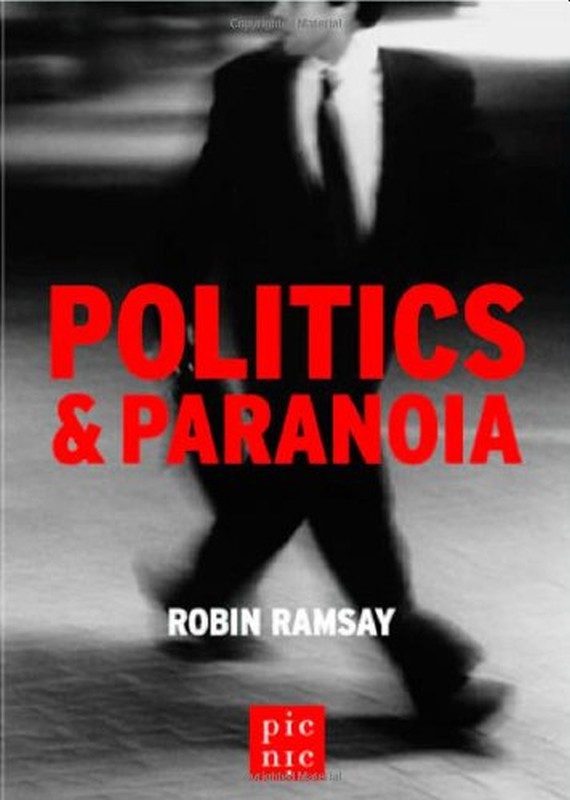
Politics and Paranoia I wrote this for Picnic Publishing’s website.
Talks, 1986-2004
Robin Ramsay
Picnic Publishing, 297 pages, index, £9.99, ISBN 9780955610547
There are a number of talks in Politics and Paranoia about Colin Wallace and Fred Holroyd. (Holroyd had been in the British Army Special Military Intelligence Unit and Wallace had been a Senior Information Officer for the Army, both in Northern Ireland in the 1970s.) Looking back on this now it is hard to remember just how little we – i.e. Steve Dorril and I, who began working with Fred and Colin, and the world at large – knew about the British secret state and its activities in Northern Ireland in 1985. This was one of the problems faced by Fred and Colin: presented with their stories, most journalists simply didn’t know where to start. We did: we went into our respective university libraries and, using some of Colin’s accounts as guides, began rummaging around in the extant information there and in the few books we had on our shelves about Northern Ireland and intelligence. Within hours it became quite clear (a) that Wallace was probably telling the truth and (b) this was a really big and really complex story.
For the first few months of the relationship Colin was still in jail, doing the final year of six he served for a manslaughter he didn’t do, and Steve, who had made the initial contact with him via Fred, was doing the corresponding (which in those days meant letters). Then Anthony Summers invited Steve to co-author a book on the Profumo Affair – this meant serious money, and Steve and I were both poor – and Steve began working with Summers and I took over the correspondence with Wallace and Holroyd. A couple of months later I wrote Lobster 11, an account, really, of our attempts to understand what Colin and Fred had told us about Northern Ireland and covert operations and bureaucratic politics there and, more significantly, here. (Lobster 11 eventually sold over 4,000 copies and pretty much set the magazine on its feet.)
Not that Lobster 11 was an immediate success. The journalists to whom we dished out copies at a press conference in the House of Commons in 1986 were not interested and, while we thought we had a story which might bring down the Thatcher government if taken seriously, not a word appeared in print in the following months. Figuring that my part in the story was over, that the major media would pick up the ball, I went back to other material (the British Right) for the next issue of Lobster and not a word about Colin and Fred appeared in it. My phone only began to ring when the first rumours began to arrive about Peter Wright’s Spycatcher book. While Colin’s stories of anti-Labour psy-ops issuing from the Army and the spooks in Northern Ireland could be ignored (he had been in jail and had been a professional disinformer, after all, for the Army), Wright’s much less interesting allegations apparently could not. And so began nearly four years of work on the Wallace material, mostly as an interpreter of it to the Higher Media, who are not greatly inclined to actually read hundreds of pages of documents and correspondence.
Looking back on that period it still strikes me as peculiar that the media in this country gave so much attention to Wright (who was 12,000 miles away in Australia, and saying nothing) and so little to Colin. Or is that a tribute to the campaign by the Ministry of Defence to rubbish Wallace as a fantasist, a ‘Walter Mitty’? (The same description of Dr David Kelly was given to the media by a no. 10 spokesman.)
Thinking the story might bring down the government is terribly revealing, of course. What did I know about actual politics in 1986? In my innocence I thought I had just handed the Labour Party (of which I was a member at the time) an enormous stick with which to thrash the Thatcher government (the ultimate beneficiaries of the smear campaigns, after all, some of whose senior members had links to it). As it turned out it was a stick the Labour Party leadership wanted nothing to do with. Why? I think there are a number of reasons.
- They didn’t understand the material and were too busy to learn it.
- The Labour Party leadership was then and remains utterly paranoid about going near ‘national security’ issues, afraid of being smeared as ‘unpatriotic’ by the Murdoch-owned media.
- The Labour Party leadership, then and now, is afraid of tangling with the secret state for fear of damaging their careers.
And so the biggest British domestic political story for about 20 years, a story of how elements of the secret state and the Tory Right worked together against the Wilson and Callaghan governments of the 1970s, was spurned by messieurs Kinnock and Hattersley; and instead of talking to me about a campaign to uncover the truth about the 1970s, the Labour Party began its fateful relationship with Peter Mandelson instead. And style triumphed over substance.
Advertisement
Politics and Paranoia
Talks, 1986-2004
Robin Ramsay
Picnic Publishing
297 pages, index, £9.99,
ISBN 9780955610547
From bookshops and Amazon.co.uk