
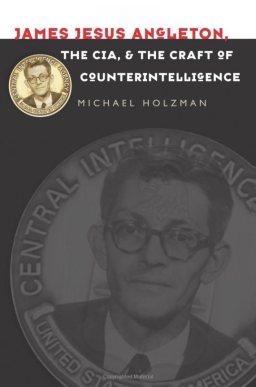
James Jesus Angleton
The CIA and the craft of counterintelligence
Michael Holzman
Amherst: University of Massachusetts Press, 2008, p/b, $28.95
Of all the figures in the Anglo-American spy world that we have been made aware of in the last 40 years, James Jesus Angleton was the most glamorous: the chain-smoking, the orchid-growing, the poetry-writing – here was the antithesis of the dull, one-dimensional plodders in the FBI (or, for that matter, most of the CIA’s ‘company men’). Or so reading books and watching movies about spies has told us.
There have already been two books about Angleton (1) but, as Holzman notes, they were produced during the domestic ‘spy wars’ period after the crises and sackings of the 1970s, and were the result of the two factions, pro- and anti-Angleton (and mostly the ‘antis’) briefing and leaking. This is the first attempt at – I was going to write an objective biography but ‘objective’ now has to have scare quotes round it – so let’s say a reasonably dispassionate version of the man and his times. At any rate the dust has settled a bit; the US won the Cold War and Angleton is an historical relic.(2)
Like his biographer, Angleton had a background in literature and Holzman shows in some detail the young Angleton, a literary entrepreneur at Harvard University as the war began, corresponding with some of the major poets of the day, publishing a poetry magazine, and studying a particular kind of literary theory, the New Criticism, which teaches the adept how to read the layers of meaning in a text. So here is one the author’s theses: the skills Angleton acquired analysing poetry were transferred, during WW2, into the intense study of a different set of texts – intelligence reports. Angleton’s office at CIA HQ, desk piled high with file folders, sounds just like that of a particular kind of academic.
One of the author’s other themes is that Angleton was a member of a particular social and class milieu, which ran America during and after WW2 and, without much time spent on self-reflection, tried to run the entire world after it with the conflict with the Soviet Union as the rationale.
‘Angleton was educated by men paid to educate men of his class to believe – and to behave as if by second nature – that protecting the interests of that class was identical with patriotism.’ (p. 333)
Holzman guides us through Angleton’s career, from his wartime intelligence apprenticeship in London and then Italy, through the birth of the CIA and into the Cold War. Angleton became very important within the CIA. Not only head of counter-intelligence, but also CIA liaison with the Israelis and the FBI; he ran labour operations in Europe with Jay Lovestone; took responsibility for the surveillance of the American opposition to the Vietnam War; and, finally and fatally for his career, obsessively poked through the CIA for a ‘mole’ he believed was there. (Holzman provides enough glimpses of other Angleton operations to suggest that we have only a partial view of his activities.)
Civilised and educated Agency men like Angleton – and CIA officers of the period were almost all men – didn’t seemed to notice that when challenged by the New Left and the anti-war movement in the late sixties, they created in America a rough facsimile of the total surveillance society of their global opponent, the Soviet Union. Holzman notes that at its peak Operation Chaos, the CIA’s surveillance of the American anti-war movement, the left and civil rights campaigners (under the supervision of Angleton’s counter-intelligence branch), must have covered at least 10% of young Americans.
This is a familiar tale in places but with much material not available to earlier accounts, it feels fresh. And unlike the other versions, Holzman’s is not dominated by the ‘great mole hunt’. When he does discuss it he makes a serious attempt to show us the world as Angleton saw it at the time as rational (given his premise about the existence of the Soviet ‘monster plot’). He even presents Golitsyn, the Soviet defector who fuelled Angleton’s paranoia, as a serious figure and not the madman he appears to be in most accounts.
Yet Angleton’s obsessive hunt for the ‘mole’ who Golitsyn told him was within the CIA led to the complete destruction of its Soviet branch. Unable to find the ‘mole’, Angleton transferred or fired every member of the Soviet department – an act of bureaucratic insanity which ensured that he would get the boot. (The revelation of Operation Chaos by Seymour Hersh, with a helping hand from DCIA William Colby, was what did for him, in the end.)
As well as a biography of James Jesus – and there is quite a bit on the domestic, private Angleton – this contains an account of the intelligence cold war, and large chunks of American political life from post-WW2 to beyond Angleton’s fall in 1974 and the post-Watergate Senate and Congressional inquiries. This is seriously good history, as well as a biography; Holzman is a very good writer, with a style somewhere between the academic and the journalist, and this was a pleasure to read.
Notes
- David C. Martin’s Wilderness of Mirrors (Harper and Row, 1980) and Tom Mangold’s Cold Warrior (Simon and Schuster, 1991) and others have been heavily influenced by him, notably Edward Epstein’s Deception (Simon and Schuster, 1989).
- Well, almost a relic: one of the Angleton’s colleagues in counter-intelligence, Tennent H. Bagley, is still fighting the fight on Angleton’s behalf, with a book, Spy Wars (Yale University Press, 2007) reviewed in Lobster 54, and a tour of Britain to promote it.