
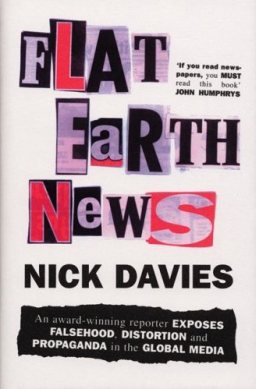
Flat Earth News: An award-winning reporter exposes falsehood, distortion and propaganda in the global media
Nick Davies
London: Chatto & Windus, 2008, £17.99,
For many taking a dissenting view of our national life, The Guardian and The Observer have long been part of our diet – the morning fix that sustains us in our daily desire for a better world. Since 1975, Peter Preston has been the principal gatekeeper at The Guardian, the paper of liberal conscience launched in Manchester in 1821 as the voice of reforming non-conformity. For 20 years he was editor and then became columnist and eminence grise when The Observer came under the wing of the by-then London-based Scott Trust. One of the Preston’s earliest protégés when he took over the daily’s editorship at 37 was Roger Alton – like him a fellow Oxford University and Liverpool Post man – who resigned from The Observer late in 2007 after nine years as editor and much longer in senior positions on its daily sister publication.
Alton’s sudden disappearance from the Farringdon Road offices that were home to his career on the two papers for more than 30 years coincided with that of his former political editor, Kamal Ahmed. Alton has since been appointed editor of The Indepen-dent: Ahmed is communications director of the tax-funded Commission for Equality and Human Rights headed by Trevor Phillips (Lobsters passim).
Preston, Alton and Ahmed all featured prominently following the launch of Flat Earth News: Preston as a highly critical reviewer of the book by The Guardian senior reporter he styles ‘Saint Nick’, and the other two as figures strongly criticised in Davies’s chapter on The Observer. There has been much speculation that the resignations of Alton and Ahmed were at least in part a result of the allegations due to be made against them in the then forthcoming Flat Earth News.
We shall return to this later, but first let me summarise the criticisms of his trade that veteran reporter Davies makes in a book no newspaper chose to serialise. ‘Churnalism’ is the word Davies uses to characterise the journalistic activity of our time. He says overworked, under-resourced reporters are recycling press releases, PR briefings and news agency wire copy without checking the truth of their hectic output. Outnumbered by well-rewarded public relations people – an experienced journalist can readily triple or quadruple earnings by moving into some areas of PR – reporters and their production colleagues are locked into an unremitting treadmill of filling pages with largely unoriginal copy, much of it without verification even less investigation.
His theme draws on Cardiff University research into the news of five daily national newspapers and confirms the frequency with which all publish stories with similar content, a phenomenon easily demonstrated by typing a chosen topic into Google News and hitting the return key.
Davies identifies 10 ‘rules of production’ in the news business: run cheap stories; select safe facts; avoid the electric fence (Israel is a particularly dangerous one); select safe ideas; always give both sides of the story; give the readers what they want; the bias against truth, especially if it is complex, including what Tom Fenton of CBS called ‘the natural selectivity of ignorance’; give them what they want to believe in; go with the moral panic, and, finally, what Davies calls the ‘Ninja Turtle syndrome’ – run stories of doubtful merit if other news outlets are doing the same. Of this last he gives the example of Alton, editor of the Iraq war-supporting Observer being in the habit of ‘speaking on Saturday afternoon to Michael Williams, the deputy editor of his supposed [anti-war] competitor, The Independent on Sunday, to swap notes on the stories they were planning to run in the following day’s papers’.
While the general themes Davies addresses are not new, it is these personal references – the detail of the way named senior journalists have behaved – that have drawn the most stinging criticisms from fellow professionals. Journalism scholars, including Bob Franklin from the university where Davies’s research was undertaken, have rehearsed many of these matters thoughtfully before. Other reporters, including, for example, a Guardian writer of a slightly earlier vintage than Davies, Dennis Barker, have given insider insight on what goes on. Barker’s low-key Tricks Journalists Play: How the Truth Is Massaged, Distorted, Glamorized and Glossed Over ( London: Giles de la Mare, 2007) deserves a wide audience for its breadth and witty clarity.
Naming and shaming
No, there’s little greatly original in what Davies has to say about the state of journalism and there is much available material not included that could have fortified his book’s arguments. But what matters, and clearly what upset his media critics, is that he isn’t a whacky weirdo polytechnic-educated veggie beardie who couldn’t earn a decent crust in the business. He had experienced directly many of the things he found troubling about the news business in which he has built a successful career – ‘I am taking the snapshot of a cancer’ – and exemplified it in his chapters on specific publications with a bit of good ol’ newspaper naming and shaming.
Let’s take his chapter on what he calls ‘The “Blinded” Observer’ as an example. He tells us that on seven separate occasions in the build-up to the war on Iraq editor Alton refused to publish well-sourced stories from its US correspondent that the CIA knew that Saddam Hussein had no weapons of mass destruction. Ed Vulliamy repeatedly filed his on-the-record account with supporting documentation from Mel Goodman, the former head of the CIA Soviet desk. Each time Alton killed the story.
Davies says:
‘Something happened to The Observer in the build-up to the invasion of Iraq. The problem was not simply that they refused to print Mel Goodman’s revelations. There were other stories of a similar kind which also struggled to make it into print. And the rejection of those stories which occurred while the paper was engaged in publishing a sequence of high-profile, high-volume falsehoods about the alleged threat from Iraq, some of which went far beyond false claims that were made in other media. As the deadline for invasion drew nearer, the paper declared its support for war.
This was a newspaper which had historically positioned itself on the left of centre and had taken some pride in its willingness to swim against the mainstream. Most famously The Observer had stood out against the British invasion of Suez in 1956, despite courting the scorn of the government and the loss of some of its more conservative readers and advertisers.
And yet this newspaper which had thrived on scepticism was seduced into accepting unproven and extravagant claims; this flagship of the left was towed along in the wake of a determinedly right-wing American government; on this crucial, long-running story, the essential role of journalism, to tell the truth, was compromised.’
Alton’s role goes missing
Something else happened when Flat Earth News reached the critics; not one of them mentioned the suppression of the Vulliamy story. Instead, the praise for Alton’s leadership of The Observer was widely parroted and the criticism was of Davies for his ‘personal’ attacks on the man who by then had left the editor’s chair. In none of the reviews by journalists I’ve seen does even a summary of Alton’s role over the war make an appearance. The readers of the reviews – as far as most people get in learning about new hardback books – are left in ignorance and then asked to do the decent thing in rejecting what Davies says on grounds of it being too personal – ‘the poison in the prose’, in Peter Preston’s phrase.
Preston, in his Guardian review, first misrepresents Davies’s views and then tells a straight lie. ‘Davies believes that, once upon a time, the press enjoyed a golden age,’ he writes. In the book Davies clearly and unambiguously states the exact opposite: he ‘believes’ no such thing. He is well aware of past weaknesses and details many of them, including sections on the media activities of the intelligence services and the Information Research Department. Davies’s belief is that today’s situation is bad and that the future looks bleak.
Something troubling is going on when a figure of Preston’s importance in the political life of this country for over three decades goes to such lengths to damn the work of a fellow Guardian writer. Preston has enjoyed a lucrative and influential career in the 25 years since he failed to prevent civil servant Sarah Tisdall going to jail after she leaked confidential documents to The Guardian. Many at the time – the height of the renewed Cold War under Ronald Reagan and Margaret Thatcher – thought the editor of The Guardian would resign, a course of action over failure in civic duty his newspaper’s leading articles have frequently urged on many accused of much less. Not a bit of it, and all these years later he is still around denying his own paper’s readers an accurate picture of a serious and well-informed book on journalism and its consequences for democracy.
At no time in Preston’s review does he declare an interest – his close friendship over 30 years with his protégé Alton – or the way that this Observer editor used his position and his closeness to key people in New Labour to keep his readers in the dark over matters of peace and war and much else under the Blair premiership. Preston practises deception by omission as well as by lying.
Network of influence
It will take a longer piece than this to trace the network of influence over liberal opinion developed by The Guardian and The Observer in the postwar world, but it’s urgent work long overdue given the parlous state of our democracy today. Preston was the choice of Hugh Gaitskell’s friend and ally Alastair Hetherington to succeed him in the editor’s chair. It wasn’t just a political alliance: in those far-off days Gaitskell’s young nephew Nicholas de Jongh (now of the Evening Standard) landed a reporting job on the paper and David Marquand, son of the Gaitskellite MP Hilary Marquand, became a leader writer there at the age of 25 after St Antony’s College and the University of California.
It is this tight networking of key media and political figures that Davies hits upon in his chapter on The Observer, the build-up to war and uncritical reporting of New Labour, with political editor Kamal Ahmed and reporter David Rose – both close friends of Alton – doing so much in promoting the Blair and ‘war on terror’ line at a critical time. Perhaps it is this that causes Preston so much distress: the puncturing of a few myths about the place where he has spent most of his life.
There is much missing that would make Flat Earth News a better book: a bibliography; more acknowledgement of work done by others in the field; more context and history by drawing on published work that shows owners do set more of the reporting agenda than Davies’s ‘churnalism’ theme allows. But Davies has chosen a narrower track and can only fairly be assessed on what he has written, not what he hasn’t.
The big plus of the book to me is that he has named names: that he has clearly got under the skin of lots of important media figures in addition to Preston, Alton and Ahmed, important though they are. One of them, by a nice irony, is Sir Simon Jenkins. Knighted by Tony Blair for his services to journalism in 2004, he styled Flat Earth News ‘rubbish’. Jenkins, it may be remembered, was the editor of The Times – then the so-called newspaper of record – who first ended proper parliamentary news reporting in its pages. The trend then to parliamentary sketch writers with picture bylines soaking up precious space has contributed to the cultivation of ignorance and cynicism about politics Jenkins now is paid for attacking in his Guardian columns. Nice work if you can get it, Sir Simon.