
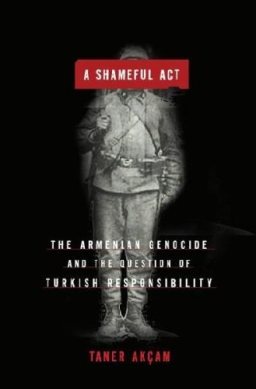
A Shameful Act:
The Armenian Genocide and the Question of Turkish Responsibility
Taner Akcam
London: Constable, 2007, 576 pp., £9.99, p/b
The Kurdish and Armenian Genocides:
From Censorship and Denial to Recognition
Desmond Fernandes
Apec Forlag: 2008, 309 pp., £16.99, p/b
Denial of the Holocaust is very much the preserve of the fascist right and its sympathisers in Europe. It persists as a coded way for anti-Semites to indicate their support for Hitler and the Nazis. Denying the Holocaust has become a thinly disguised way of supporting it.
What we confront with the controversies surrounding the attempted Armenian genocide during the First World War, however, is a denial that has been supported over the years by the Turkish state. Far from being the work of a discredited handful of fascists, denial of the Armenian genocide is Turkish government policy and it has been sustained by powerful diplomatic and commercial pressures. Quite remarkably, it has even succeeded in enlisting the Israeli government in its cause.
The futility of this exercise in denial is conclusively demonstrated in Taner Akam’s definitive account of ‘The Question of Turkish Responsibility.’ Here he painstakingly establishes that it was the Turkish government’s ‘intention to destroy a people’ between 1915 and 1917, a policy that resulted in anything from 600,000 to 1.5 million deaths. To carry out this crime, the regime established its Special Organisation, a paramilitary force of Kurdish volunteers, hardened criminals specially released from prison, and refugees bitter for revenge against the ‘Christians’ who had driven them from their homes in the Caucasus and elsewhere. These were the men responsible for the murder, rape and pillage that characterised this particular horror. There can no longer be any serious doubt about the origins of the Armenian genocide, and Akcam has put us all in his debt.
Akcam is also to be congratulated for his account of opposition to the genocide within the Turkish administration and of the gangster fashion that it was dealt with. As he points out:
‘Some of the governors refused to accept the Central Committee’s instructions that deportation was to be understood as annihilation. In several cases uncooperative officials were actually murdered. Huseyn Nesimi, the prefect of Lice, refused to obey a verbal order and asked for the written copy. He was fired, called to Diyarbakir, and murdered on the way. Abidian Nesimi, the prefect’s son, wrote that the liquidation of government officials was ordered by Mehemet Resih, the governor of Diyarbakir, amongst others.’
He lists other officials killed for refusing to carry out the massacre.
Akcam also provides the most accessible account of the unsuccessful attempt by the British and their Allies to bring the culprits to account after the War.
It is worth noticing here that Akcam himself has fallen foul of the Turkish authorities. He was a student activist in the late 1960s and was eventually sentenced to ten years in prison for publicising the oppression of the Kurds. Today he is an eminent historian, living in Germany, but still the victim of harassment. In 2007, for example, in well-publicised episodes, he was detained by both the Canadian and United States immigration authorities because of allegations on the internet, including his Wikipedia biography, that he was a terrorist.
 Whereas Akcam’s volume is based on archival research, Desmond Fernandes’ book is more a critique of the contemporary phenomenon of denial. Although his title refers to ‘Kurdish Genocide’, in fact, he only briefly considers the Turkish state’s oppression of the Kurds. The bulk of the book focuses on how the Turkish government and its accomplices have tried to suppress discussion of the Armenian genocide. He provides an excellent demolition of Guenter Lewy’s The Armenian Massacres in Ottoman Turkey: A Disputed Genocide. But of greater interest is his recounting of Turkish attempts at closing down debate. An attempt was made, for example, at intimidating Microsoft into suppressing an online encyclopaedia entry. They ‘threatened Microsoft with serious reprisals unless all mention of the Armenian genocide was removed.’ He marshals an enormous amount of material demonstrating how Turkish governments have used their diplomatic and commercial clout to sustain denial. Once again, perhaps most surprising, is the way that Israeli governments have collaborated in this.
Fernandes’ book is very densely argued and comes with an overwhelming mass of footnotes. He touches on so many issues that he left this reader with a huge number of references to chase up. This is an important book that deserves more attention than it, unfortunately, is likely to get.(1)
Notes
- Fernandes’ book is sold and distributed in the UK by AK Press, <www.akuk.com/>