
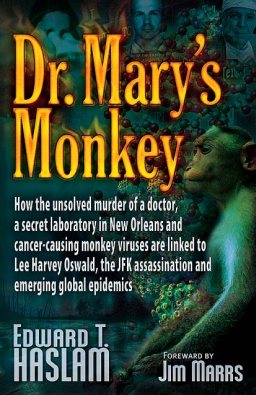
Dr Mary’s Monkey
Edward T. Haslam
Waterville (Oregon): Trineday, 2007
(www.Trineday.com) $19.95 (US), p/b
The Kennedy assassination literature has produced some oddities over the years but this takes the biscuit. A sense of this is conveyed by what must be one of the longest subtitles in publishing history:
‘How the unsolved murder of a doctor, a secret laboratory in New Orleans and cancer-causing monkey viruses are linked to Lee Harvey Oswald, the JFK assass-ination and emerging global epidemics’
Kennedy assassination initiates will glimpse a little bit of the story from that subtitle. Cancer and New Orleans? Wasn’t David Ferrie keeping thousands of mice in his apartment? Yes, he was. And he was, apparently, doing cancer research on the mice. In his apartment when he died was found an anonymous treatise on cancer. (Haslam thinks he has identified the author.) Skip to page 329 and the author provides a handy summary of his story so far:
‘In the morning, the young cancer-researcher rides the bus to work with the “defector” who is about to be accused of assassinating the President. In the afternoon, she goes to the underground medical laboratory run by a known Mafia asset to develop a biological weapon. In between the two, she works at a cover-job under the supervision of an ex-FBI agent, who sends her on errands to deliver “envelopes” to the office of the Congressman who chairs the House Committee on Un-American Activities.’
The ‘young cancer researcher’ is Judyth Vary Baker who has claimed for years to have been the lover of Lee Harvey Oswald. The underground lab is ‘known Mafia asset’ David Ferrie’s mouse research where, says Baker, they were trying to develop a rapid-acting cancer with which to kill Fidel Castro (which is – just – within the extant parameters of the known attempts to kill him, not much crazier than some of the CIA’s other wheezes). The ‘cover-job’ was at the Reilly Coffee Company where Lee Harvey Oswald also had a ‘cover-job’.
A surprising amount of this is sort of stood up by Haslam, but an awful lot of it hangs on the story of Baker, whose status in the JFK world is ambiguous at best; and there are a great many connecting suppositions between the bits Haslam has stood up and the wider thesis. This involves: the unsolved and very strange death (murder? freak accident?) of another cancer expert, Dr Mary Sherman; a particle accelerator at a nearby university lab which may or may not have been the cause of Sherman’s death and which may or may not have been used to modify viruses; not to mention the final layer of the cake, the strange tale of the monkey-viruses in the polio vaccines and their possible links to the epidemic of soft tissue cancers in America.
Is this enormous thesis linking JFK’s death to a rise in cancer America credible? No, it isn’t. There are just too many places in the story where guesswork takes the place of evidence. But oddly fascinating this profusely illustrated account certainly is.