
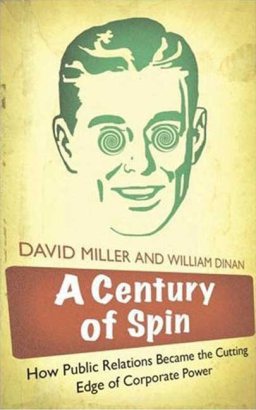
How public relations became the cutting edge of corporate power
David Miller and William Dinan
London: Pluto, 2008; £45 h/b and £14.99 p/b
This is big stuff, ambitious and wide-ranging with an enormous amount packed into 180 pages of text (with 50 pages of notes, tables and index). Many books are too long: this is too short for its subject matter, which is….well, what is it? Yes, it is the rise of the global companies and the PR apparatus which has accompanied them; but it also much more than that. This is the history of our time, of how the left was defeated and how the free marketeers won by ‘bringing democracy to heel’.
This is an essay about power in the Anglo-American world from a couple of serious left academics: Miller is Professor of Sociology at Strathclyde, in the semi-socialist, semi-republic of Scotland, where the idiocies of the free market are still regarded as idiocies by many. The book’s title doesn’t do it justice. When did British sociologists last write a chapter called anything like ‘The Real Rulers of the World’, discussing the creation of the ‘architecture’ of the global economy by groups such as the elite planners of the 1920s? This is power analysis. This is C. Wright Mills or William Domhoff de nos jours.
They trace the antecedents of the modern corporate-dominated world back to three elements in the 1920s: the beginnings of contemporary understanding of psychology – Freud meets the advertising industry, especially the figure of Edward Bernays; the formation of what the authors call ‘elite planning groups’, beginning with the Round Table in the early 1920s and thence into the CFR, Bilderberg, Trilateral etc.; and the appearance of political warfare organisations, notably the Economic League in Britain, in response to the rise of the left.
For left academics, some of this is rather bold, striding into the kind of territory usually held by the right – all those elite planning groups, for example – and the authors feel obliged to admonish the reader that this is not about a conspiracy. Or rather it’s about lots of them:
‘Yes, they plan and organise with each other, but there is no secret conspiracy operating behind the visible front. The visible front does just what it says on the tin – it aims to run the world.’ (p. 81)
About half the book is on Britain. There is a chapter on ‘The Hidden History of Corporate Propaganda’, on the Economic League and its forebears, such as the British Commonwealth Union. (But this section omits the fact that these groups were initially formed not just to oppose organised labour and the left but also to fight for the interests of domestic manufacturing against the interests of the City. The struggle with globalisation began a long time ago.)
We get two excellent chapters on the demise of the left and the rise of the right in the Labour Party, both similar in approach though not in detail, to the views expressed in these pages over the last decade. More interesting to me (because less familiar) was the chapter on Cameron’s Tories. This, I realised with surprise, is the first serious analysis of the Cameron group that I have read. Their links are very similar, of course, to those of NuLab’s leadership. Why would they differ? Both groups of politicians are pro-American, pro-Israeli, pro-globalisation, pro-free market, pro-nuclear, pro-EU and pro-destroying the public sector. The only significant difference is that the Cameroons are linked to a different cluster of corporate sponsors. The NuLab and Conservative parties’ use of PR is discussed but that isn’t the meat of those chapters.
This is the best introduction to real power politics in this society that I have read. Anyone who finds Lobster interesting will find this congenial and stimulating. Large chunks of this book would sit very comfortably in these pages and many themes which have appeared in Lobster are discussed here and on the site with which the authors are associated, www.spinwatch.org.
There is one major bone that I would pick with the authors. After their account of how the left was vanquished they note, in their final paragraph, that we need
‘an alternative worldview as part of a concrete coalition of interests; a counter-hegemony which is not afraid to act.’
What that would that look like I have no idea. What is striking about this book is the way the authors ignore the ‘world-view’ which preceded globalisation in this society: i.e. the nation state and the mixed economy. The creation of this planet-destroying, globalised economy was preceded by the partial destruction of the nation state as the regulator of the excesses of capital. Looking at the last thirty years is it not quite clear that things have gone wrong as the state has been forced or persuaded to leave the arena? Reduce banking supervision and we get ‘predatory lending’ and the current subprime debacle, not to mention the last decade’s inflation of the housing market and the vast personal debt in this country. (And, unless something is done – by Brown and Darling; you think? – we will get more of the same.) Reduce local state control of the environment and you get Tesco, Sainsbury and Walmart destroying our town centres and the local retail economy. Reduce control of capital exports and the money leaves the country, as it did here in the early 1980s. And so on and so on.
The authors want to create a new ‘worldview’. More prosaically, now that we have seen what happens when the bourgeois state is reduced to a rump, and politicians are persuaded that they are part of the problem, maybe we could begin by saying: well, the bourgeois state was far from perfect but it was a good deal better being ruled by local and central government than it is being ruled by bankers chasing bonuses and global companies seeking to maximise their profits. So I wonder: do we need a new ‘worldview’? Are the concepts and the tools required to stop the current madness not to hand?