
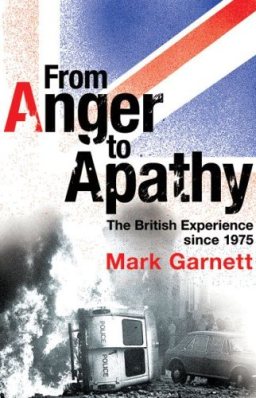
From Anger to Apathy: the British Experience since 1975
Mark Garnett
(London: Jonathan Cape, 2007)
Dead Men Don’t Eat Lunch
Geoffrey Gilson
(self-published)
Beyond Bullets
Jules Boykoff’s
AK Press, 2007: <www.akuk.com>
Briefly
Mark Garnett’s From Anger to Apathy: the British Experience since 1975 (London: Jonathan Cape, 2007) has had some fairly sniffy reviews but I enjoyed it a lot.(10) But then I would, for this book covers the period during which I have been politically conscious; and even when you don’t agree with something – and I disagree with many of the author’s interpretations and biases – there is a distinct pleasure in being reminded of things; and Garnett certainly has spent the time in the microfilm archives. But, for example, one index reference to North Sea oil? Garnett doesn’t know enough about British economic history (let alone parapolitics). But he’s not the first contemporary historian to have that blind spot, is he? It still surprises me that historians and political scientists find it possible to write about this society without feeling obliged to include its economic history. The cultural events which Garnett describes so entertainingly are the superstructure to an economic base. At some level that Stalinist model always applies; and in this account of our ‘experience’, not our history, brute economic reality intrudes too little.
In Dead Men Don’t Eat Lunch (self-published) Geoffrey Gilson describes of his attempt to unravel the life of Hugh Simmonds, his business partner (and political rival in the Tory Party). A solicitor, Simmonds died having apparently misappropriated millions from his clients’ accounts. He claimed to have been a member of SIS and Gilson, after much stumbling around the interface between Tory Party, SIS and the arms industry, thinks he has found that Simmonds was using clients’ funds to run SIS ops in the Middle East. En route, via consultations with several mediums (a first, perhaps in a political investigation?), he meets a cavalcade of what the police would call ‘persons of interest’ to the readers of this magazine.
This is seriously bad at almost every level – unedited or edited by an idiot – and is virtually a primer on how not to do self-publication. Much of the time it is unclear whether or not the author has interpreted what is going on around him correctly. And yet the parade of the military-political characters from the Thatcher years, an almost palpable smell of the growing British arms industry in the period, not to mention a picture of a world I know a little about from an entirely different perspective (the Tory right), kept me going, albeit at a thick skim, right to the end. The author may be correct and has uncovered a significant and hitherto unknown set of SIS ops in the Middle East in support of US policy in the 1980s. Equally the late Hugh Simmonds might have been a fantasist and his hints of derringdo for SIS et al pure moonshine. I really can’t tell.
This can be downloaded (the author would prefer this, he tells me) for $1.25 at <www.lulu.com/content/384105> and the author is at <> if any reader has information about Simmonds and his milieu.
Jules Boykoff’s Beyond Bullets (AK Press, 2007: <www.akuk.com>) is a big (450 pages, 300 of text, 150 of documentation and index), detailed account of the American state’s repertoire of responses to radical or even reformist movements, from the Palmer raids, through HUAC and Cointelpro, down to the post 9/11 era. This is very good indeed but I found myself unable to read more than a short section at a time. It may be necessary to study the details of state strategies, from assassination (if you’re black or a Native American) through to media character assassination, but it is a grim read. By world standards, The Great Satan hasn’t had to kill many at home since 1900; and why it hasn’t needed to is explained here. The author argues that the American state has gone ‘beyond bullets’, that it doesn’t need violence to quell/discourage dissent. But I suspect the bullets are still there, in reserve, just in case.
Notes
- As did David Osler (who wrote in Lobster 33) who called it ‘one of the most enjoyable current affairs books I read in 2007’ on his website. <.http://www.davidosler.com/2007/12/book_review_from_anger_to_apat.html>