
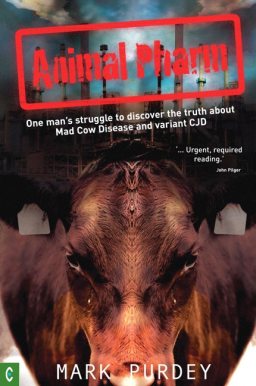
Mark Purdey
Edited by Nigel Purdey
East Sussex: Clairview Books, 2007
247 pps text, 8 pps of tables, £12.99 p/b
Mark Purdy was an organic dairy farmer. This book results from his long battle against conventional wisdom concerning the source of ‘mad cow disease’, the variant CJD, and other neurodegenerative diseases which also affect humans. In joining this battle Purdy had to undertake wide and deep self-education in the biological and chemical sciences involved.
Because Mark died from a brain tumour before the book was completed it was finished by his brother Nigel. The evidence is drawn from field research carried out in disease ‘hot spots’ around the world. From his findings Purdey produced many peer-reviewed papers, lectures and TV programmes.
The criticism I would make of the book is not of the information it contains, this is comprehensive, but of the mix and format in which it is presented. Perhaps this is unavoidable with two hands at the production tiller. Personal, cultural, emotional and factual are put together anecdotally in a way which I found made it hard to separate and focus on key points of the main argument. ‘Soft’ information, while interesting, is mixed with ‘hard’ scientific facts. I cannot help thinking that if Mark lived he may have realised he was dealing with a wealth of information which would have made two or more important books.
However the information given is extremely valuable. I can find no fault with the biological our other scientific evidence presented, and this is the aspect I shall concentrate on. It is both extensive and detailed, exposing the negative effects of environmental and imposed chemical agents which can lead to forms of incurable fatal neurological degeneration.
The many trails followed began when Ministry vets tried to impose toxic Warble fly treatment on Purdey’s cattle. In winning a court battle he encountered what was to become a common feature of establishment practice and belief – they had no knowledge of any secondary effects their required actions could cause. When later tests revealed conditions which demanded the slaughter of his cattle, conditions of which he thought the supposed cause illogical, an intuitive light switched on. Could the treatments used in fact be triggering the disease – in fact making it worse?
Purdey’s approach was realistic. He sought, and discovered, a range of multi-causal contributors to the neurological diseases, diseases which of themselves are symptomatic expressions of many underlying causes. The book is therefore very complex in tracing the causal pathways. These severally consist of pharmaceutical products, many pesticides, other specifically used chemicals in specific places, trace heavy metals, and what must be thought of as localised industrial pollution.
The main problem Purdey faced is that of confronting established wisdom. Much of this is based on either blind habit or assumption. Because of the Reductionist mindset of scientists (and those in authority), a single cause is always sought for every disease. Having ‘found’ the one cause, positions, careers, resources, whole industries with their lawyers and political muscle, are devoted to maintaining the ‘wisdom’ of this finding. One common example of this faulty wisdom is the frequent demand to kill badgers because they are believed to be the source of TB in cattle. Not so. The almost endless resources of government and the pharmaceutical industries were what a lone individual, Purdey, confronted in his search for the truth, initially simply to save his beloved cattle from extermination.
There is also a paradox which lurks beneath the text of this record. The remedy for disease must be simple, preferably profitable, and politically acceptable. When unwanted effects, side-effects, emerge, the same thinking is required to prove there is a problem. Even if it seeks to prevent the death of people or killing of cattle, the mechanisms which Purdey exposes are far too complex to fit within the established rules.
Certainly Purdey was confronted by many levels of vested interest. Perhaps if he had more time he would have understood that he confronted the philosophy of all those interests, the philosophy which motivates many scenarios described in Lobster. It is a philosophy which has run its course and now hinders rather than helps. True, Reductionism has revealed and enabled much to happen. But it can no longer explain the effects of the complex world we have created – the sort of effects Purdey wrestled with. Holism has become a weaselled word. Take it to mean that all wholes are potentially more than the sum of their parts, and clarity emerges. What also emerges from the synergy of things are random unpredictable events.
It is such disastrous events with which this book deals. It is an essential resource for anyone interested in the stonewall deviousness of governments and their agencies, with human or animal health, and the unchecked interests of the pharmaceutical industries.
Colin Johnson was an organic livestock farmer and has written many books on health and environmental issues.