
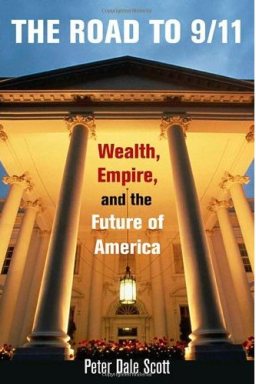
The Road to 9/11: Wealth, Empire, and the Future of America
Peter Dale Scott
London and Berkeley: University of California Press, 2007, prices in the UK from £16.95
The first third of this book, 120 pages or so, is part parapolitical and part deep history of America from Nixon to Ronald Reagan’s first election victory. Crudely summarised, Scott shows the rise of the Pentagon and its industrial allies and political front men (almost entirely men). Recovering from the set-backs of Watergate, failure in Vietnam and associated revelations and Congressional enquiries, they revived the Cold War with Soviet Union – Team B and the Committee on the Present Danger etc. in the 1970s – found a way round Congressional restrictions on covert operations (using proxies, such as the Safari Club) and got the contracts flowing again. En route they sabotaged Jimmy Carter in the same way that Nixon had sabotaged Hubert Humphrey in 1968: by doing a political deal with America’s notional enemies (Iran in Carter’s case; North Vietnam in Humphrey’s) to prevent Democratic success in the run-up to the presidential elections. In a sense, as Scott acknowledges, this is partly an elaboration the Yankee-Cowboy conflict first so described by Carl Oglesby. But just as this story is almost entirely about men, it is also mostly about Republicans. To the Yankee-Cowboy conflict we have to add a purely political conflict which is not entirely explained by Oglesby’s analysis.
Scott doesn’t take the story back to the 1960s but the Walton book, Brothers, reviewed above, shows that the struggle between the Pentagon and civil America dominated the Kennedy Presidency; and it now looks entirely plausible to view post-war American history as centred around the problem created by the successful ending of the American depression of the 1930s by military spending during WW2 – the creation of Ike’s military-industrial complex, which needs enemies to justify its budget and it profits. Having created it, no-one has found a way to put it back in its box.
At chapter 7, ‘Afghanistan and the origins of al Qaeda’ the focus of the book narrows onto the direct links to 9-11. Scott takes us through the disastrous connection between what he calls the American deep state, trying to make trouble for the Soviet Union in Afghanistan with Islamists and jihadis. Billions of dollars and high tech weaponry flow into Islamist hands; tons of heroin return from Afghanistan as the ‘cowboys’, headed by Casey at the CIA, start to spread an enormous net of American money and personnel across Pakistan and the Middle East, much of it going through the BCCI. This disastrous connection runs through Bosnia in the 1990s and thence into America, as American money continues to fund jihadis on American soil and American diplomats provide them with visas for ‘training’.
From this we are taken through the US links with the Saudis (whence Bin Laden and most of the 9/11 hijackers came) and into the oil politics of the post-Soviet era – the Caspian basin’s oil, pipelines, deals with the Taliban etc. All the big ticket items are discussed in Scott’s meticulous, footnoted style.
But there is another theme running through this and Scott announces it early on when he notes the appearance in the Ford administration of Cheney (in the White House) and Rumsfeld (at the Pentagon) and their role in that period working against what we might loosely call the Yankees – symbolised by Kissinger (held over from Nixon) and the Trilateralists (who appeared in Jimmy Carter’s administration which succeeded Ford in 1976). Although he declines to use the word, this thread is American fascism; or militarism, any way: the subversion or supplanting of democracy by the military. Scott follows this thread through the Reagan years and clandestine plans for the ‘continuity of government’ (COG) after a variety of hypothesised national emergencies (Oliver North was involved at this juncture) – the procedures by which democracy would be suspended and dissenters rounded-up and interned. He suspects, and tries to show by micro-analysis of the events around the White House just before, during and immediately after the plane strikes, that COG procedures were implemented by Rumsfeld and Cheney on 9/11. How important this is – if true – I am unable to decide. Since the Pentagon has control of most things which affect its well-being, why would they bother with a formal coup?
When I first came across Scott’s term parapolitics in the 1970s, as well as being a subject area, it also seemed to me to be a method: even in apparently secret areas, if you could read everything you could connect more of the dots than any of the individual authors could and thus could produce a new synthesis. And this new synthesis, Scott’s deep politics of America, is offered here in what we might call its full maturity.
Scott was the first person I heard use the expression ‘knowledge speaking to power’, something he has tried to do for nearly forty years. What we are really talking about is knowledge speaking to politicians, and as everybody who has tried to do so discovers, this is much harder than it looks at the outset; at any rate it is with the kind of knowledge which people like Scott have to offer and the kind of limp, career-minded politicians we now have in the Democratic and Labour parties.
This is vintage Scott. He remains my model of how to do this.