
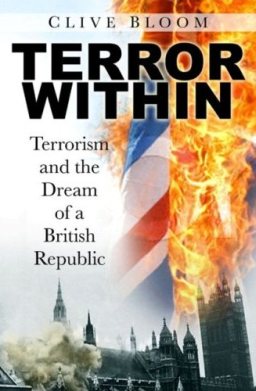
Stroud, Glos.: Sutton, 2007, h/bk, 297 pages, h/b, £20.00
This sets out to provide a narrative describing the range of ‘attempts’ to set up a republic in Britain from the time of the French revolution until the present day. (Although the bulk of the text deals with the period up until the First World War, the text also carries on until the end of the 20th century in a sketchy and unsatisfactory fashion.) There is some detailed information on the various plots hatched to bring down the government especially in the early 19th century – plots which now seem more fantasies than fully realisable attempts to overthrow the existing regime and institute some form of republic. Students of the arcane arts of espionage, agents provocateurs and of secret policing will find much of interest in the book.
However, somewhere in that dark and unknowable place between the original pitch for it, the author’s research and the publisher’s choice of title, something seems to have gone wrong with this book. That is not to say that it is badly written or that the author has not done any research or has got his facts all wrong; or indeed, that the publisher has made a mess of the finished product. No, these are fine in themselves. The problem lies in distance between the title (including the subtitle) and the actual text.
The first part concerns the use of the word ‘terrorism’. I realise that publishers are keen to jump on any bandwagon that happens to be passing, but this book seems to be keen to include certain activities, including military mutinies, ‘physical force’ suffrage agitation, land wars and bread riots under the rubric of ‘terrorism’. To most people, the term implies the indiscriminate use of violence against persons or property to coerce governments or communities to accede to the demands of the ‘terrorists’; but many of the instances in this book of physical force are either non-violent (i.e. use weapons more as display or in self-defence) or the violence, such that it is, is specifically targeted against political and economic opponents. For example planning to blow up the cabinet as apart of a coup would be seen as political violence but not terrorism.
The second main problem lies in the choice of the term ‘British Republic’. Firstly, because many of those included in the book were not necessarily republican and secondly because few, if any of the republicans in this book were fighting for a British republic (that is a republic that encompassed the entire British Isles.) As a general rule of thumb those people in Scotland, Wales, Ireland, Cornwall and the Isle of Man who fought for a republic did so first and foremost as nationalists, who wanted independence from England rather than wanting a single republic for the whole area. English radicals, on the other hand, tended to be fighting more of a class war, for whom the monarchy was a symbol of power and unearned wealth.
Further, having declared that it is about the ‘dream’ (i.e. something that is unachievable, and therefore not something sensible people should attempt) of a specifically British republic, the book then goes into considerable detail about Chartists, Irish Nationalists and others engaging in political violence (including the attempted invasion of Canada) overseas. Now, Bloom does trace the linkages between activists across the waters – much of it due to exile or transportation – but the gold miners’ struggle in Ballarat in Australia, while very interesting and while some of the participants were former Chartists, was not a struggle for a British republic.
The book also suffers from strange lacunae in its coverage. Bloom has much to say about Irish nationalist violence in England in the 19th century, but totally ignores the IRA bombing campaigns in the 1950s and then from the 1970s until the 1990s (apart from the attempt to blow up Margaret Thatcher and her cabinet at Brighton in 1984) – even though those would presumably be sufficiently ‘terroristic’ to qualify for inclusion. (And if the problem is that they are conducted by Irish nationalists then why include the 19th century Fenian outrages?) Further, he fails to mention the Irish Republican Socialist Party and its associated paramilitary activities. Elsewhere he has some information on Welsh nationalist actions, but omits any mention of the Welsh Socialist Republican Movement and the associated ‘terrorist’ actions they planned to undertake in England in the late 1970s. Oh, and the Angry Brigade? – totally absent. One gets the feeling that the chapters dealing with the 20th century were added more as an afterthought than as an integral part of the text.
This book would have been much improved if it had stuck to one of several themes: the history of republican (or nationalist) movements in Britain; the use of political violence in Britain in the 19th and 20th centuries; or ‘physical force’ class struggle. Each would be a viable undertaking and worth reading. However, the author has attempted to stitch bits of each of those themes together in an apparently inconsistent approach, leaving us with a book which fails to do any satisfactorily.
One should always be careful when questioning an author’s research, but the absence of a bibliography means we can only go by the notes appended at the end of the text, and these reveal little original research. Also, there seem to be obvious omissions from the possible published sources for several subjects: for example, Tristram Stuart’s excellent The Bloodless Revolution provides much more information about people such as John Oswald, vegetarian and republican who died fighting for the French Republic. Equally John Jenkins’ Prison Letters and Derrick Hearne’s The Rise of the Welsh Republic would be useful for a proper examination of the ideology behind the Welsh paramilitaries. (Sadly the extensive literature in the Welsh language is not accessible to me nor, I suspect, to the author, which means we are missing a vital aspect of the struggle.) One final omission seems to stand out. There is nothing in here about terrorism and the dream of an Islamic republic in Britain – yet we are all too aware that that struggle has already given rise to acts of terrorism.
And whilst I’m having a gripe – the index. Mary Shelley is in, but Percy Bysshe Shelley is absent. The IRA is in but the Provisional IRA have been missed out. The Scottish National Liberation Army are in, but not the Scottish National League (Comunn nan Albananch). Wendy Wood appears in the index, but Hugh MacDiarmid (on the same page) doesn’t. At best the index is incomplete, at worst almost random in what it includes and excludes.
Generally the emphasis on ‘terrorism’ has skewed the text towards a more sensationalist rendering of the events, at the expense of a proper political contextualisation. Finally there is no mention of more recent English republican political movements, such as the Movement Against the Monarchy or the more respectable Republic pressure group.
Overall then, the text is generally well-written and informative but anyone reading it to obtain a comprehensive picture of either the use of ‘terror’ in Britain or about the history of republicanism in Britain (whole and segments) should be aware that it is very patchy in its coverage.