
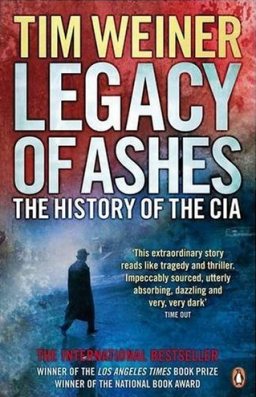
Tim Weiner
New York: Doubleday, 2007, h/b, $27.95
This book’s existence is a surprising development. The author is a New York Times journalist and for one of the NYT’s writers to produce a critical study of the CIA is unprecedented to my knowledge, and tells us much about the diminished status of the Agency.
Of course it isn’t the history of the Agency, merely a history. Huge areas of the Agency’s activities have been ignored, as Jeffrey Richelson, one of the best informed historians of intelligence points out.(7) Richelson’s complaint is that the author has concentrated too much on the Agency’s covert operations. This is clearly true if we are to take the book’s title seriously.
From the other side of the political divide Bill Blum, author of the best single volume history of those covert activities, commented(8) that by using as sources only interviews and declassified documents, the author manages to side-step the firsthand accounts by Agency whistle-blowers Philip Agee, John Stockwell and Joseph B. Smith,(9) as well as all the post-1980 radical critics who emerged, such as David Carmichael and Ray McGovern, not to mention the academic students of the Agency. Thus he doesn’t even give a comprehensive sketch of the Agency’s covert operations; and, worse, is unable/unwilling to rebut some of the outrageous statements that he quotes, for example the claim that the CIA had nothing to do with the slaughter in Indonesia in 1965.
Nonetheless, as Blum concedes, it is an interesting book. It is also a strikingly critical book. Weiner presents variations on themes of brutality and incompetence. In this version, the CIA was never any good, even in its early years. Even its early successes, the coups it ran in Iran and Guatemala, were close-run things, with the Agency and its allies/proxies more or less staggering over the finishing line, just ahead of chaos and failure; and its ability to generate intelligence on its targets, especially the Soviet Union, was virtually nil. Weiner also shows the Agency always lied to the politicians and the President, nominally its bosses, and was routinely involved in assassination in its various coup plots.
So: incomplete and partial, yes; but also full of fascinating bits and pieces. In any other period of the history of the American empire this would have been a sensation. To give just one tiny example, on p. 97 Weiner tells us that in advance of the coup in Guatemala, CIA HQ sent to one of its personnel preparing it a list of 58 Guatemalans to be assassinated after it. In the post 9/11 world, however, nobody cares and the book is just one more attack on the CIA, which has all but been supplanted in Washington by the Pentagon, which is not accountable to Congress for covert operations, and the rise of the private sector intelligence firms.
Notes
- <www.washingtondecoded.com/site/2007/09/sins-of-omissio.html>
- <http://members.aol.com/bblum6/aer49.htm>
- Author of Portrait of a Cold Warrior (New York: Ballentine, 1976)