
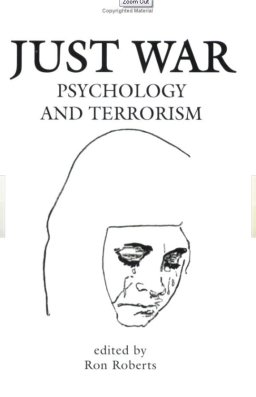
Just War: Psychology and Terrorism
ed. Ron Roberts
Ross-on-Wye: PCCS Books, 2007, £20.00, p/b
This is a curious collection in which a group of psychologists, with one exception all employed in higher education, try to get to grips with and form a response to the current Anglo-American ‘war on terror’. The responses vary. Two of the essays are about post-war British anti-war campaigns of various stripes, and the difficulties of keeping such things going with so little positive feedback. In the first essay David Harper assembles the public knowledge that we have on the collaboration between psychology and the military in Western societies: psy-ops, MKUltra, sensory deprivation in Northern Ireland and the contemporary uses of torture by Americans in their global network supplied by ‘extraordinary rendition’ with British co-operation. This will be more or less familiar to anybody who has been keeping their eyes open in the last few years.
The editor, Ron Roberts, shows in the first of his essays that the British Psychological Society hasn’t done anything or even said anything about the Iraq war, and contrasts this with the reaction of the British Medical Association which has.(22)
Julie Lloyd and Steve Potter contribute an essay on Cognitive Analytic Therapy and use it to analyse the speeches of Blair and Bush. They show that Bush, Blair (or their speechwriters, more likely) use language to present their case in the best possible light and play on the fears and prejudices of their audience to win approval. Well, yes, they’re politicians, and this is what politicians do. They write at the end of their essay, ‘To some readers this chapter may seem to have been describing the obvious.’
In ‘Deconstructing Terrorism: Politics, language and social representation’, Chris Hewer and Wendy Taylor describe social representations and social constructionism, whose
‘central idea is that the selective use of language and discourse, the arbitrary identification of historical precedent and the formation of culturally derived constructs actively structure and generate cultural meanings….. people rely on the media to report, interpret and provide meaning to events and those representations are later reconstituted as common-sense knowledge resulting in the dissemination of a “processed” version of reality.’
But all accounts of reality which are wider than our firsthand experience are unavoidably ‘processed’ by something – if it is only another pair of eyes and a brain. It depends who is doing the processing, doesn’t it? This is politics and the ownership and control of the media, rather than psychology. I don’t see what the authors think is going on here. Yes, they have redescribed the notion of ideology; but beyond that?
In his second essay editor Roberts wonders how it is possible for most people not to notice or care about what the British and American empires have been doing – he lists the millions of dead – some of the basic building blocks of reality as we (readers and writers of this magazine) understand it. Generally at this point we think of Marxist concepts, alienation and false consciousness. Roberts offers us Chomsky and R. D. Laing.(23)
‘[RD] Laing’s unravelling of family dynamics, alongside Chomsky’s functional analysis of international power relations, reveals to us the origins of the irrationality underlying “the total world system”….threats, violence and deceit underlie the fabric of consensual reality, and that the operations of power in the construction of our “internal” mental life mirror those operations used to fashion the external world …….each of us is living in a society that has a vested interest in our alienation from reality and the indoctrination of new recruits into the collective fantasy of Western benevolence [towards the world and Iraq, in particular].’
This struck me as novel and interesting. Laing claimed to have revealed the dynamics of the family and Chomsky, as it were, does the same for the dynamics of the family of nations. But what is Roberts suggesting by the idea that ‘operations of power in the construction of our “internal” mental life mirror those operations used to fashion the external world’? Is he suggesting a kind of causality, that the experience of the strategies identified by Laing in personal relationships – denial, splitting, projection, introjection, repression, rationalisation etc. – is then transferred into the public, political sphere?
Roberts is concerned about lies and truth – no pissing about, hand-job post-modernism here! – and thinks that the ‘behavioural sciences’ (i.e. psychology) must play their part in ‘the struggle ……to reclaim some credible version of the truth behind the operation of our modern societies.’ Roberts is almost saying, and certainly implies, that a psychologist’s job is to join with others help to demystify political reality.
This is undoubtedly interesting but is it plausible? Would we find a common set of childhood experiences (or family structures) if we surveyed the people running American or British foreign policy? I don’t think so. (Nor would you find an agreed foreign policy, come to that.) What you would find is a mixture of recognisable character types, working in little subsections, within a larger system over whose aims and direction they have no control.
From the point of view of the averagely ignorant American or Western European consumer it is not obvious yet that the ‘total world system’ is ‘irrational’. Are the shelves of Tesco still groaning with the world’s produce? Yes, they are. Can they fill their cars at the Tesco pumps? Yes, they can. It’s not that people need to be indoctrinated into continuing to believe in the myth of Western benevolence, which centrally concerns Roberts, so much as most people simply don’t care about what happens outside their family, street or town; and, as far as I can see, they never did; and as far as I can see this is true across all cultures and all manner of family structures.
The Left likes to believe that John Pilger’s films are put on TV late at night because they are subversive of ‘common-sense reality’; but really it is because relatively few people want to watch them. Explaining why Pilgerland is less appealing to most people than say, a soap or a big sporting event such as the recent rugby world cup final, gets very complicated very quickly and I am not persuaded that the key lies within family structures or individual childhood experiences, as Roberts, after Laing (and it might have been Reich or Fromm), appears to believe.
In his introduction Roberts calls for a ‘more socially responsible psychology ……..unshackled from state interests.’ I understand ‘socially responsible psychology’ as a euphemism for ‘left-wing’; but as for the profession being ‘unshackled from state interests’, all the contributors to this volume work for the state in medicine or education and so I don’t know what he means by that.
Notes
- The role of American psychologists in torture is discussed in Katherine Eban, ‘Rorschach and Awe’ at <www.vanityfair.com/politics/features/2007/07/torture200707>
- I Googled Roberts to discover that he is a leading member of the Society of Laingian Studies.