
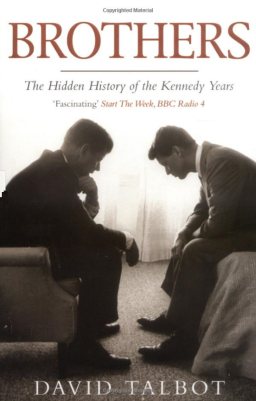
Brothers: The hidden history of the Kennedy years
David Talbot
London: Simon and Schuster, 2007, h/b, £20
Another Kennedy book? Yes, but a good one. Talbot may not have anything new of substance to tell us about the assassination per se but has much new material about events before and after it.
Talbot’s JFK is a complex figure and while a politician, with all that entails about strategies and the primacy of electoral considerations, he was also (by American standards) a left-leaning Democrat who thought it might be possible to diminish if not actually end the Cold War with the Soviet bloc. Talbot recasts events in this period as attempts by Kruschev and JFK to wind down the Cold War which were frustrated by their military-industrial-intelligence complexes who were making too much money and generating too many good careers for that to be accepted.
Talbot conveys better than any other account I have read the conflict between JFK and those bits of the state, the Pentagon and the CIA, chiefly, which had serious vested interests in the Cold War. The centrepiece of Talbot’s account of this conflict with the US military, is Cuba. For the military it was straightforward: the US had the strategic nuclear advantage (the ‘missile gap’ had been forgotten) and thus could and should invade Cuba. Never mind even pretending to the world that it was a Cuban insurrection – the dumb little plan behind the Bay of Pigs invasion. As if the cover story would have stood! (2)
Talbot has talked to the surviving members of the Kennedys’ political staff and discovered, if not quite a hidden history, much new detail about JFK’s struggle with the military-intelligence complex. With a very small majority obtained in a bent election, JFK was a pinko ‘yankee’, facing – and during the Bay of Pigs and the Cuban missile crisis, facing down – the ‘cowboy’ leadership of the world’s most powerful military and intelligence forces. I had not previously grasped how much the Kennedys and their staffs talked about the possibility of a military coup being run against them and how much of the time the Kennedys used back channels to circumvent bureaucracies they didn’t trust.
Talbot answers the question, Why didn’t Robert do more about his brother’s death? He shows that the Kennedy’s entourage did make a number of discreet and, as far as we know, unsuccessful efforts to find out what had happened. They all knew it wasn’t ‘a lone nutter’ but were persuaded not to talk about it. Robert didn’t publicly pursue his doubts about the Warren Commission cover story because of the possible damage to his political career. Politics was the Kennedy family business and the pursuit of the truth came second. Robert was eventually pushed into saying that he would do nothing before acquiring the powers of the president. This, I suggest, is was what got him killed; and I presume he was killed, if not by the same conspiracy which killed JKF, by a conspiracy emanating from those forces or interests which did not want the original killing investigated. We will probably never know the details because those forces had interests so widely spread it could have come from almost anywhere.(3)
If the conflict with the military-industrial complex and explanation of Robert’s apparent inactivity are the major sections here, the book is full of fascinating little snippets about many of the aspects of the Kennedys’ activities, and the reaction of the rest of the political system to them. There are detailed and interesting accounts of the Garrison events, Robert’s activities between 1964 and 68, and the interaction between the Kennedy entourage and those who were trying to refute the Warren Commission’s Report, who presented a most acute political problem for Robert’s political ambitions.
Talbot writes well and the book was a pleasure to read (and a pleasure to read the second time). Highly recommended, both for the JFK assassination buff and for the reader with a general interest in this most fascinating period in American political history. With the conflict between the Pentagon and American civil society now in the press over Iraq, Talbot’s story of politicians versus the state resonates loudly.
With one foot in the ‘alternative’ or radical media (Mother Jones) and one in the major media, in this book Talbot has come close to bridging the gap between mainstream American political history and parapolitics.(4)
Notes
- The Cuban exile community was routinely penetrated by Cuban intelligence, keeping an ear on what the exiles and the spooks were up to. This continues. Take the case of Anna Belen Montes, a Cuban who rose to be the Defense Intelligence Agency’s top Cuban analyst, while working for Cuban intelligence from 1985 onwards. She actually wrote a 1998 Defence Department report which announced that Cuba posed no military threat beyond its borders. Montes spied for political beliefs not money – she was a Cuban patriot – which the US media had terrible trouble digesting. But she pulled off one of the most striking intelligence coups I have heard of. The case received little publicity, getting buried under 9-11. See the collection of articles at <www.martinoticias.com/cima/documents/SelectedArticlesAnaBelen.pdf>
- There is also a sense that in not taking serious security precautions while running for the Democratic nomination in 1968, Robert was inviting his own death.
- Talbot has/had an interesting blog documenting the reaction of the American media to his book at <www.salon.com/books/authorstalbot/about/blog.html>.