
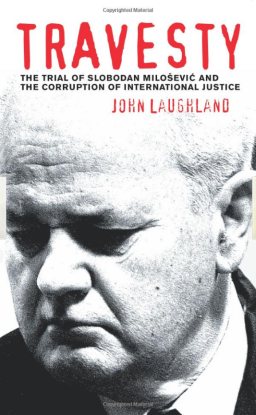
Travesty: The trial of Slobodan Milosevic and the corruption of international justice
John Laughland
London and Ann Arbor: Pluto Press; 2007, £14.99 (UK) $24.95 (US), p/b
Laughland is an interesting figure, whose writing appears in media across the ideological spectrum, from the conservative right to The Guardian and here, Pluto Press. It is thus a little hard to identify his politics. Three years ago David Aaronovitch wrote about him. (14)Aaronovitch noted that Laughland is European Director of the European Foundation whose patron is Margaret Thatcher, and concluded by describing Laughland (and his associates) as ‘right-wing anti-state libertarians and isolationists, suspicious of any foreign entanglements’.
Aaronovitch’s description above isn’t entirely inaccurate, though ‘isolationist’ is false. Aaronovitch is misreading Laughland’s belief that multinational institutions should not replace the nation state because when they do you get antidemocratic institutions, such as the EU. His ‘foreign entanglements’ are our ‘global responsibilities’ – i.e. our fealty to America and our subscription to NATO, the international police force of global capital. Look, says Aaronovitch: links to Thatcher, anti-EU, nation-staters, isn’t this a familiar package? Right-wing nutters.
Curiously Aaronovitch didn’t refer explicitly to the most obvious thing about Laughland: he is anti-American; and anti-globalisation. But not from the left. His very interesting article on the CIA (and wider American) role in the politics of the Soviet bloc countries post 1991, ‘The Technique of a coup d’etat’, ends with this sentence:
‘But, after Marshall’s exposé of the reality behind the almost identical events in Serbia, there can be no doubt that the US take-over of Georgia is a textbook case of covert operations at work.’
Since when did people on the right talk like that?
Aaronovitch also didn’t mention the interesting fact that Laughland is, as the jacket of this book tells us, a former lecturer in politics and philosophy at the Sorbonne and at the Institute of Political Science in Paris; and many of the people Laughland has written about and/or tried to defend – notably the left leaders/regimes of the former Soviet bloc countries – have also been allies/friends of the French state, which is the enemy of America. (Basically, if America is against you, other countries on the American shit-list become your friends.) Therefore Laughland is…….a Gaullist?
Is any of this relevant to the book? Well, here he goes again, defending Mil-osevich – whom he has defended before – while analysing his trial and the new court body, the International Criminal Tribunal for the former Yugoslavia (ICTY) which was trying him. I didn’t pay particular attention to either the break-up of Yugoslavia or the trial of Milosevic and am thus ill-equipped to assess Laughland’s version of the trial; but unless his selection of the evidence is shown to be utterly false, the trial was as it appeared to my casual gaze and to Laughland: a farcical (and incredibly expensive) example of ‘victors’ justice’, with its procedures loaded against the defendant and the verdict predetermined.
Laughland thinks Milosevich has been misrepresented by the Western media (which was conned by NATO propaganda) and outlines a serious case for this here.
Running parallel to his account of the trial is a critique of the ICTY and its legal basis. His central point is this:
‘…the contrast between Nuremberg and the ICTY is therefore clear. Whereas the Nuremberg judges said their legitimacy derived from the fact that they were acting on the instructions of the sovereign power in Germany, the ICTY judges say that morality alone, or other vague and emotional notions, justifies their jurisdiction.’
Laughland quotes from the ICTY’s first ruling on jurisdiction:
‘The Trial Chamber agrees that in such circumstances, the sovereign rights of States cannot and should not take precedence over the right of the international community to act appropriately as they [the crimes alleged] affect the whole of mankind and shock the conscience of all nations of the world’.
This argument of Laughlan’s may seem of little relevance when compared to the tens of thousands of people killed in that war; but he has some weighty voices in his corner and does show that the trial and the creation of the ‘court’ were mounted on little more than the kind of vague, liberal guff (‘the international community’) which is running round in Tony Blair’s brain posing as thought. Laughland thinks this is a dangerous step.
Even without the arguments about the basis of ICTY’s legitimacy, the account of the trial and, arising from that, the discussion of some events in the Yugoslavian civil war and NATO’s intervention in it, are extremely interesting. This book is about the trial but its real target is the NATO version of the break-up of Yugoslavia. I wonder if Laughland is going to try a full-scale critique of those events?
Notes
- ‘PR man to Europe’s nastiest regimes’, The Guardian, 30 November 2004.Aaronovitch is another sometime lefty who discovered that there is a warm and sometimes lucrative welcome in British society for those who move, publicly, from left to right.
- <http://globalresearch.ca/articles/LAU402A.html>