
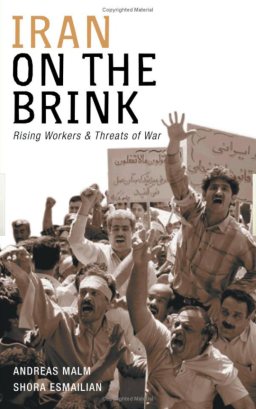
Andreas Malm, and Shora Esmailian
London: Pluto Press, 2007, P/b £17.99
At a time when Iran is in the news on a daily basis, when war and rumours of war are being constantly circulated and global warming and peak oil are finally filtering into the public consciousness, the release of this book could not have been timed better. It brings together an historical background to the present crisis (which goes back 100 years), on-the-ground research done by the two authors on behalf of the Swedish weekly Arbetaren (The Worker), and extensive reading of both the émigré and internal publications that stand outside both the official media of the state of Iran and the liberal democratic consensus of the western democracies.
The first part of the book is a look at Iran from the inside. It gives a full account of the events that lead up to the Islamic Revolution of 1979 that overthrew the hated regime of the ‘Shah of Persia’ and his equally hated security and police apparatus; explains why the revolution took the form of both a nationalist struggle and a religious one; and what the results of this have been for the people of Iran. It also explains the different class interests of the ‘bazaar’, the unemployed and the salaried working classes, and how the present leader of Iran, Ahmadinejad, a former leader of the lumpen ‘Pasdaran’ (Revolutionary Guards) managed to gain power by being both a populist and repressive at the same time
Unlike most studies of Iran, this one foregrounds the efforts of the Iranian working class in their struggles against the ‘Millionaire Mullahs’ who currently rule the roost in Iran, with coverage also of women’s and ethnic struggles. The text reveals a highly combative class struggle that is unknown in the West, but one which has seen its position continually undermined by the application of ‘Islamic’ laws to the work-place. As a result, strikes have become ‘unIslamic’ and therefore severely punished (not to mention illegal); women’s place in the economy is deemed secondary, their wages have been cut and they have been forced from various sectors of the economy; and overall ‘real wages’ have been slashed. All this in a country sitting on vast reserves of oil.
The second part of the book concerns the relationship of Iran to the rest of the world. The current furore over Iran’s nuclear programme is covered in detail, revealing in passing that in the mid-1970s, when Washington’s favourite was in power, the US encouraged the start of the Iranian nuclear programme, when it was understood that Iran had a need for a power-generating capacity that would take over when its supplies of oil started to decline – something the present leaders in London and Washington are rather hoping nobody will remind their populations of. The scare story about Iran having nuclear weapons is exposed as being, at worst, something that would still take many years to come to fruition; but it also exposes the sheer hypocrisy of nuclear-armed nations demanding that another nation not have them – especially when that nation is practically surrounded by nuclear-armed states or bases.
The problem of oil is, however, central to the Iranian situation. Iran has the second largest reserves of oil of any nation. The supply of oil from Iraq, which presumably the 2003 invasion was meant to secure, has been reduced by the continual sabotage by those resisting the US-led occupation, and all the while the global reserves of oil continue their steady depletion; and, even more worrying for the western democracies, most of which are dependent now on imported oil, countries such as Iran seem keener to develop their oil industry (it has suffered considerably from lack of investment for many years) with emerging powers such as China. A similar scenario was emerging in Iraq prior to the latest invasion where Russian and (in particular) French companies were signing deals along similar lines – deals that were torn up as soon as the Saddam Hussein regime had been toppled and a US-dominated government installed.
One of the strengths of this book is the way it doesn’t dodge the contradictory situations the Iranian working class finds itself in, not least when it comes to religion and the threat of a US-led invasion. Despite Islam being the ideological underpinning of the repressive labour (and other laws), most Iranians remain Muslims and would want any political changes to respect that. This accounts for the comparative lack of success of more secular (Western?) revolutionary groups who target religion per se along with other class enemies. Equally, whilst detesting their current regime, they would oppose any attempts to impose a change of regime by force from outside. There is also little support for any attempt to break up the country on ethnic lines. There are ethnic political groupings, but these only come into existence when the particular ethnic groups are targeted, marginalised or discriminated against. (This does, of course, mean that regional conflict can also be used as a technique for destabilising the Tehran regime from the outside.)
On a pure class struggle basis, certain sectors have bravely been fighting back against their bosses (effectively the religious oiligarchy), organising strikes and other forms of struggle, often in the face of vicious repression. Whilst they would welcome solidarity from those outside the country, they certainly don’t want another ‘Solidarnosc’ fiasco, when a reactionary political movement grew out of what were legitimate workers’ struggles, not least because of the input of money and resources by various western pro-capitalist intelligence and ideological agencies. The numbers of those on strike has increased dramatically in the past few years. As the book says:
‘The current unrest signifies the externalisation of misery. Ground down by misery’s corrosive internalisation, genuinely sick of the race to a nadir of insecure, miserably paid jobs, narcotic escapes, (2) and self-humiliation under capricious employers, more and more Iranians have reversed their hardships outwards in the form of protests….’
There is no abstract, non-personal, self-regulating market ruling Iran with an invisible hand, but rather an extremely visible class of millionaire mullahs interfering personally in all economic activities. (3)
There is a great deal more in this book. It eschews the traditional marxist dogma of favouring a ‘party’ to lead the people of Iran out of their present situation. Rather it points to the self-organisation and self-activity already being shown as the starting point for the struggle for emancipation. Those outside the country can assist by working in solidarity with those organisations in the country that express genuine working class aspirations – not easy with the way the state tries to control the flow of information into and out of the country. Equally we need to support the antiwar movement but not at the expense of forgoing our criticisms of the Islamic Republic and its repressive policies towards the mass of the population. We should also be aware that certain liberals in the west are trying to promote the interests of a small middle class minority by representing their views, aspirations and life-styles as typical of the rest of the population.
There’s very little I’d want to criticise in this book. Rather I can thoroughly recommend it to anyone wanting a nuanced, class-based analysis of what is going on in Iran today, which also understands the geopolitical and environmental situations. It is fully referenced, indexed, and comes with a handy glossary, chronology and map.
Notes
- Iran has the highest per capita rate of heroin addiction in the world, apparently.
- The Pasdaran (Revolutionary Guards) make a small fortune out of the burgeoning prostitution industry – Tehran has 300,000 prostitutes, something to remind those who bang on about Islam being a religion that respects women and safeguards their dignity.