
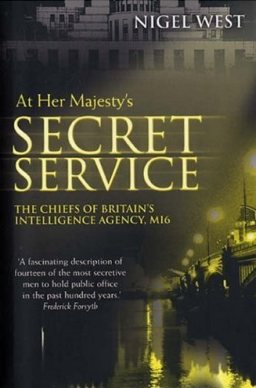
Nigel West
London: Greenhill Books, 2006, £25, h/b
The books of ‘West’ that I have read all have the same problem: he tells you that some of the material comes from past or present intelligence officers and hints that in those sections you are getting ‘the real inside story’. Somewhere along the way, for example, I have acquired the idea that his second and third books, MI5: A Matter of Trust and MI6 were both something like in-house histories, given – edited no doubt – to Allason in the great spook rivalries of the 1980s. Is this true? Maybe I used to know and have forgotten. In the introduction to his MI5 book he quotes from the language of the injunction which the then Attorney General, Michael Havers, tried to enact against the book:
‘…there are many references……… which can only have been related to the Defendant by past (or present) officers…. incidents, operations, investigations and other matters which have not previously been made public.’
You can’t buy an endorsement better than that, thanks very much. And if ‘the Establishment’ was cross with ‘West’ it didn’t stop him becoming a Conservative MP; and under Margaret Thatcher, who hated dishers of dirt and secrets. So, for me, ‘West’ has always been a puzzle: a conservative (and Conservative) historian of spookery with ambiguous relations with the services about which he was writing. I bought his first books back in the days when there were so few books you bought everything, then gave up. As did most people, I think. But ‘West’ is now taken seriously by some people: he is a professor in the expanding field of intelligence and security studies; and, let it be noted, he is not Professor Rupert Allason but Professor Nigel West. (Is he the first academic to be employed under a nom de plume?)
This new one has the same faults as the others. In the introduction he lists a bunch of retired intelligence officers who helped him write this but there is very little documentation – from a professor? – and you can never be sure what the status of any claim is. I don’t think there is much that is new in this but I don’t know the subject well enough to be sure. Each chapter begins with a brief potted biography of a ‘C’ and then recounts the big incidents of that ‘C’s’ time in office. Did I really want to read another synthesis of the Greville Wynn/Oleg Penkofsky story, important though Penkofsky was? Much of this feels like churning the old files. The later chapters are more interesting and, as befits a former Conservative MP, he has a serious go at the latest ‘C’, John Scarlett, for his relationship with the Blair government and the fiasco over Iraqi WMDs. He also drops some hints about blemishes on Scarlett’s career which can only have come from SIS personnel.
The core of ‘West’s’ thesis is this: ‘SIS rarely embarked on a project without the fullest ministerial approval’ (p. 17). And the only instance he allows in which they didn’t was the ‘Buster’ Crabbe affair in the 1950s. This is the official line of the new, open, website-building era: we were only following ministerial orders. There is enough anecdotal evidence to say simply that this is nonsense and ‘West’ must know it is nonsense. Being extremely charitable I might say ‘West’s’ thesis has not been substantiated: no foreign secretary has discussed the relationship with SIS in any detail. We simply don’t know; nor is it obvious to me how any foreign secretary could know if the spooks decided to deceive him/her.
There are, as always, interesting snippets. ‘When Britain’s application to join the EEC was finally accepted he [Oldfield] was allowed to place some of his personnel on the personal staffs of British commissioners, making George Thomson’s private office in Strasbourg a useful source of information about the community.’ (p. 143 – but unsourced)
But it’s all whiter than white. He describes Maurice Oldfield gathering his staff together in the canteen to tell them that though SIS had been running Kenneth Littlejohn in the Irish Republic against the IRA, he had not been given a licence to rob banks, as he had claimed (p. 146) Yet Captain Fred Holroyd, of the Special Military Intelligence Unit in Northern Ireland, told us that the SIS man there in his day, Craig Smellie, asked him a year later if he wanted to rob some banks. ‘West’ is just running the departmental line.
His Oldfield chapter ends with a pasted-in erratum slip correcting errors in the paragraph on Colin Wallace after Wallace complained to the publisher. ‘West’ appears to have been unaware that Wallace’s conviction for manslaughter had been quashed and thought his wife worked for Oldfield in Northern Ireland.
Given the chance ‘West’ does bits of editing for his ‘friends’ and his political friends.
On page 266 he writes of Libya’s ‘astonishing admission of responsibility for the Lockerbie bombing’ without mentioning that Libya merely accepted formal responsibility, as a condition of restarting normal diplomatic and trade relations with the West, but still denies actually doing it.
On pages 210/11 he reports that KGB defector Gordiefsky told them the the ‘KGB rezidentura [in London] had……. taken steps to cultivate several highly-placed trade union leaders, among them Richard Brigenshaw, Ray Buckton and Alan Safer’. ‘Taken steps to cultivate’ – that much, eh? And who is Alan Safer and where did his name come from? Buckton and Brigenshaw are mentioned in Gordiefsky’s memoir, the source of this, but not Safer (whoever he is). I wonder if ‘West’ means the late Alan Sapper?
On page 178 he describes the defection of ‘Victor Suvorov’, real name Vladimir Rezun, and refers to some of the books ‘Suvorov’ wrote hyping-up the Soviet military threat in the 1980s. But he omits the first one – who said first pressings from a defector are always the most important? – The Liberators, which portrayed the Soviet Army as a near mutinous, underpaid, under-equipped, bunch of skiving drunks, held together solely by the brutality of the disciplinary system, and no threat to any one. This is the army which was defeated in Afghanistan; and reading ‘Suvorov’s’ account, no wonder!
It’s all mildly interesting but as you know that ‘West’ is not going to tell you anything too funky or too damaging to the service, why would you bother?