
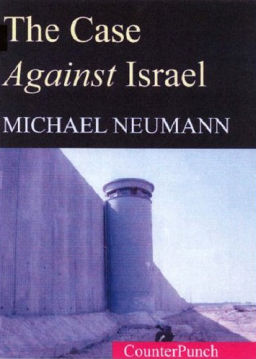
The Case Against Israel
Michael Neumann
Oakland (US): CounterPunch, $15 Edinburgh (UK): AK Press, £10, 2005
The Power of Israel in the United States
James Petras
Atlanta and Black Point:
Clarity Press and Fernwood Books, 2006, $16.95
In a year in which Israel’s attacks on Lebanon and Gaza were accompanied by more stories of New Labour loans and the arrest (twice) of Tony Blair’s fundraiser and Middle East ‘envoy’ Lord Levy, it would have been good to have seen British publications examining how Israel is bound up with the politics of its allies. But apart from the decision in March by the London Review of Books (LRB) to publish US academics John Mearsheimer and Stephen Walt on the Israel lobby in their country, Britain has seen no serious recent initiatives on that front.
The New Statesman (NS) made a stab at the job in 2002, but suffered very heavy criticism for its ‘anti-Semitism’ from, among others, the then Labour general secretary and now Foreign Office minister and colleague of Lord Levy, David Triesman. In the week that I write this, the award-winning NS political editor Martin Bright describes ‘Blair’s twin shame of Iraq and cash for honours’ as ‘on the one hand, a foreign policy catastrophe; on the other, a classic domestic sleaze scandal’. Several American writers, including one of the two authors under review, try to investigate links between ‘foreign policy catastrophe’ and ‘domestic sleaze’. One wonders how many years will pass before the NS will feel able to return to the subject of Zionism and New Labour, and when the LRB will feel able to run a piece on the Israel lobby in the UK.
When journalists and academics tiptoe around this elephant in the front room of British politics they leave a gap in our political understanding that is important for at least two reasons.
One is that the links between Israel and its supporters in Britain are a legitimate subject for inquiry given the extent to which those advocating terrorist tactics here often identify themselves as critics of Israel. If, as Home Secretary John Reid said in October, the ‘war on terror’ now demands the ingenuity shown by Barnes Wallis and Alan Turing in opposing Nazi Germany, we are surely under a democratic obligation to ask how matters have come to such a pass that our traditional liberties are being so readily and uncritically jeopardised.
A second reason is that the ‘war on terror’ agenda has now become indelibly linked in the minds of many with hostility to Muslims, a recipe for serious difficulties in a society as diverse as Britain. This is paralleled in some circles with talk about the ‘clash of civilizations’ stimulated by Bernard Lewis and Samuel Huntington soon after the collapse of the Soviet Union.
The work of Benjamin Netanyahu and the Jonathan Institute (Lobster 47 et seq) in promoting the ‘war on terror’ agenda to serve the interests of Israel goes back well before that time. But once the Berlin Wall fell, the blame for terrorism switched from the Kremlin and KGB to Israel’s neighbours and Islamic radicalism. Yet virtually all of the British electorate remains in ignorance of the origins and purposes of this strategy.
These two books by small US publishers are not in themselves likely to change the direction of global politics. But to the extent that they chime with shifting American perceptions of Israel and policy in the Middle East (this is written ahead of the November mid-term elections), they may inform some in that movement for change. As we in New Labour Britain follow the US on so many things, the work of Michael Neumann and James Petras may just tempt the odd British writer and publisher into trying something similar here.
Neumann is a philosopher who, in the first sentence of The Case Against Israel, spells out his biases: ‘Mine are pro-Israel and pro-Jewish’. He says he uses ‘no material from Palestinian sources’ and adds that his book ‘presents the case against Israel, not Israelis’. Having further cleared the decks by telling us of his family’s suffering at the hands of the Nazis and his early predisposition towards Israel, he sketches his main argument as follows:
‘The Zionist project, as conceived and executed in the 19th and early 20th century, was entirely unjustified and could reasonably be regarded by the inhabitants of Palestine as a very serious threat, the total domination by one ethnic group of all others in the region. Some form of resistance was, therefore, justified. That Zionist Jews, and Jews generally, may later have acquired pressing reasons for wanting a Jewish state does not change this. The legitimacy of the Zionist project was the major cause of all the terror and warfare that it aroused.’
Neumann says what followed did not result from a long-standing territorial dispute between long-established populations. Rather, he says, the Zionists sought
‘to implant an ethnic sovereignty in what was to them a foreign land, on the basis of a population expressly imported to secure that end. Unlike other occasions for territorial compromise, this one did not involve two existing people pursuing competing claims. Instead, there was a claim at whose service a people was to be created by immigration from outside the area. That claim was to be pursued against the existing inhabitants, who had never thought to advance some claim of their own against the Jewish people.’
The writer concludes his section on the birth of Israel thus:
‘The illegitimacy of Zionism has important implications for the legitimacy of Israel itself and for the early history of that state. It was wrong to pursue the Zionist project and wrong to achieve it. For that reason, how it was pursued and achieved has little bearing on the fundamental rights and wrongs of the Israel/Palestine conflict…..Zionism initiated a process whose evolution was foreseeable and understandable. Zionists are, therefore, to an unusual degree responsible for the consequences of that fateful step. Their project was not like raising a child who, unexpectedly, turns psychotic, but like releasing a homicidal maniac – a child of ethnic nationalism – into the world. This is why the blame for the conflict falls so heavily on Zionist and so lightly on Palestinian shoulders.’
But all that, says Neumann, does not argue the case for Israel’s destruction, any more than that fate should befall the United States because it was founded on genocide, massacre and exploitation. He says: ‘Israel’s existence is tainted, not sacred, but it is protected by the same useful international conventions that allow others, in the name of peace, to retain their ill-gotten gains.’
Neumann then moves on to what Israel should do now to ensure its survival: it must leave the Occupied Territories.
‘With the acquisition of the Occupied Territories in 1967, Israel had a chance to make handsome amends for the crimes on which it was built. Saintliness or selfless optimism were not required. Israel could have sponsored and supported, with true generosity, the establishment of a sovereign Palestinian state by backing those amenable to reconciliation and attacking those who were not. This might not have been a just settlement, but it would have worked.’
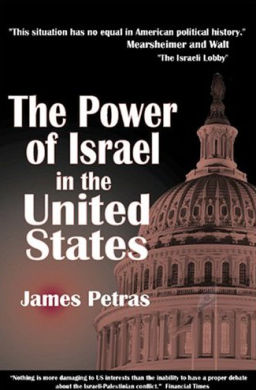 American support for Israel following 1967 has made that possibility harder to achieve, and an exploration of this relationship is the subject of the book by James Petras. He dedicates The Power of Israel in the United States to Rachel Corrie, ‘US citizen and humanitarian internationalist volunteer in Palestine murdered by the Israeli military’. His style is that of the committed activist, in sharp contrast to the cool rigour of Neumann. There are times when his use of capitals, as in Terror Experts or Zionist Power Configuration, irritate. But while his writing is urgent, at times to the point of stridency, it is well sourced and invites the reader to inquire further into the areas he explores. Here is a flavour of the Petras style:
‘Through overseas networks the Israeli state can directly intervene and set the parameters to US foreign aid in the Middle East. The overseas networks play a major role in shaping the internal debate on US policy toward Israel. Propaganda associating Israeli repression of Palestinians as the righteous response of the victims of the Holocaust has been repeated throughout the mass media. President Ahmadinejad’s suggestion that Holocaust victims might more properly be compensated by land located in Europe or in the countries that victimized them was misreported, then highly circulated to fuel, instead, the notion of a rabid anti-Semitic Iran. From the height of the network to the lawyers’ boardrooms, and the doctors’ lounges, the pro-Israel supporters of the network aggressively attack as “anti-Semites” any critical voices. Through local intimidation and malicious intervention in the professions, the zealots defend Israeli policy and leaders, contribute money, organize voters, and run for office. Once in office they tune in to Israel’s policy needs.’
But hasn’t the United States always been subject to pressures exerted by those of its citizens with connections to other countries, be those links with Ireland or the countries of the former Eastern bloc? Petras accepts this, but answers:
‘The Cuban exiles in Miami exercise significant influence in both major parties. But in no other case has linkage led to the establishment of an enduring hegemonic relationship: an empire colonized by a regional power, with the US paying tribute to Israel, subject to the ideological blinders of its overseas colons, and launching aggressive wars on its behalf.’
Who are these ‘overseas colons’? Petras has a very long list of ‘Israel Firsters’, people both inside Congress and electoral politics, and those unelected, such as Paul Wolfowitz and his friends in the Office of Special Plans driving the Iraq invasion, as well as many in the media. He tells us about the muscle exerted by the American Israel Public Affairs Committee (AIPAC) of the Conference of Presidents of Major American Jewish Organization with its Daily Alert (www. dailyalert.org/) prepared by the Jerusalem Center for Public Affairs; the American Jewish Committee; the Anti-Defamation League, and the Zionist Organization of America.
Petras looks critically at the four principal US sources of financial support for Israel he lists as:
‘1: Wealthy Jewish contributors and powerful disciplined fund-raising organizations. 2: The US government – both Congress and the Presidency. 3: The mass media, particularly the New York Times, Hollywood and the major television networks. 4: The trade union bosses and the heads of pension funds.’
In addition there are well-organised fundamentalist Christian groups with close links to Israel. Petras also sees the emergence under President Yeltsin of the Russian oligarchs (most possessing Israeli passports and having major financial interests in that country) as in part being due being due to President Clinton’s closeness to the Zionist lobby in the United States.
At times Petras is a little breathless in his description of the activities of those close to Israel, especially the people against whom legal proceedings have been taken after spying for that country while holding important Washington positions. This seems to be a measure of his anger and frustration at his native country being drawn into conflicts that he believes do not serve its interests. While I prefer the cooler logic of Neumann, I also recognise the value of an emeritus professor of sociology like Petras alerting his readers to matters they can then look into in their own way and about which they can reach their own conclusions.
If Attorney General Lord Goldsmith advises prosecutions over cash for honours we may learn something of the financial network to which Tony Blair’s Middle East ‘envoy’ seems so central, and then perhaps something of the extent to which the Israel lobby has been influential on the policies of New Labour. Whether or not the Crown Prosecution Service gets to dig a little below the surface of our political life, Britain could use both a Neumann and a Petras to provoke examination of the way our electoral politics is linked to the fortunes of Israel. We should not be distracted by controversy over the veil covering the faces of Muslim women: there are other forms of concealment requiring our more urgent attention.