
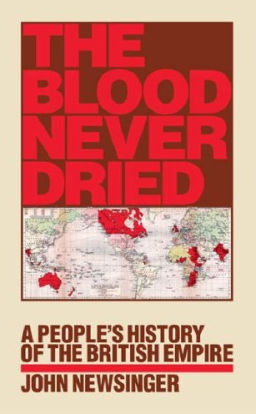
John Newsinger
London: Bookmarks, 2006, £11.99, p/b
Fifty years after Suez is a good time for Britons to reflect on empire. Our military is again deployed in regions of the world more associated in the national mind with the 19th century than the 21st, while the children of the poorer regions of Britain are still losing their lives defending the overseas interests on which the nation’s precarious financial well-being is seen to depend.
John Newsinger is the latest venturer into looking critically at the times when much of the world atlas was coloured red. It’s not an attempt at a comprehensive history, but the retelling of fragments of imperial history ranging from the Jamaican and Indian rebellions through the Palestine revolt, Mau Mau and Suez to the Bush-Blair alliance of our own time.
It’s a very useful short antidote to the well-publicised sweep of Niall Ferguson. The telegenic Harvard academic tells us of his ‘magical’ childhood in the Kenya where a few years before an old friend of mine had spent his Army years killing and torturing the natives. The memorable phrase my pal used to me as an impressionable youth, years after his ‘national service’ fighting a colonial war, would appeal to Newsinger more than Ferguson: ‘We didn’t get the Empire by being nice to people, you know.’
The value of a book like this to me is not to make us feel bad about our past, but to engage us in the more constructive process of deciding where we go now. It’s a task more urgent for those of us born in a United Kingdom, because we didn’t lose our empire by being invaded, by being defeated in war or by internal revolution. The European imperial powers that did have one or more of those experiences in the 20th century were forced into the drastic national revaluation we have never had to make in such a conscious way.
Emerging exhausted though victorious from the Second World War we, as a nation, have gone through the Suez debacle and then followed the US line on almost everything since without any serious, conscious decision in which the public has played a part. When we get involved in a war, we are urged not to let down our boys and girls in uniform by questioning their mission. For most of the rest of the time – not many long periods without wars under New Labour – critics have usually been charged with being anti-American and/or soft on communism or terrorism.
The history of the decline and fall of other great powers from the Greeks, Romans and Imperial Spain does not suggest an adjustment to new realities is easily accomplished. The sheer scale of the British Empire might suggest our task is even harder. Newsinger’s tales from our bloody past prompt us to engage in that pressing duty.