
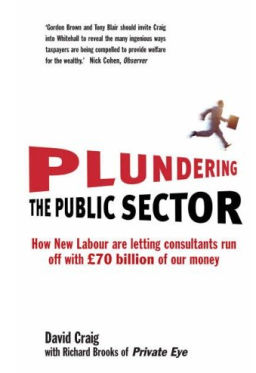
David Craig and Richard Brooks
London: Constable, 2006, £9.99, p/b
When the Blair faction took office in 1997 as ‘New Labour’ we knew that they were going to be pro-American, pro-NATO, pro-business, anti-union and media conscious. What we did not know then was just how completely they had internalised the Thatcher ethos, how hostile they were going to be the public sector and, as a result, what a complete bunch of schmucks they were going to be when it came to the state’s dealings with business. Once upon a time the Labour Party wanted office to enable it use the state’s assets for (delete according to your view of the party) the national interest/ social improvement/ the working class/ progress/ redistribution/ justice. New Labour wanted office, as far as I can tell, simply to be in office; and arrived with the basic view that the state was always less efficient than the private sector, that only efficiency mattered, and the best thing they could therefore do was get the private sector in to teach the public sector how to do things, and transfer as much as possible from public to private. (And because they were the Labour Party, they could do this without the opposition from the unions and the public sector that the Conservative Party would have faced. Many of the trade union supporters and members of New Labour have been in a state of total denial about the reality of the party they have been supporting.)
This book describes some of how this was done. In the words of the book’s subtitle, ‘How New Labour are letting consultants run off with £70 billion of our money.’ £70 billion is a lot of money; and although the authors are describing the behaviour of some of the really big consultancies in this country, familiar to readers of Private Eye in recent years, including KPMG, Accenture, Capita, McKinsey and Ernst and Young, the authors are describing something very close to organised crime.
Think of New Labour as the marks in an elaborate long con. Hicks in town, with barrow-loads of taxpayers money, with notions of modernity and enterprise (and nothing much behind the phrases), and a blind faith in IT, they had a desperate need of advice on how to do things. Got a problem? Hire a consultant. So in they came with their Powerpoint presentations and management-speak, hyped-up some projects, got the budgets and began siphoning off the dosh. Accountability? Almost nil. Financial supervision? Ditto. In effect they were invited by New Labour to take over the state. (New Labour thinks, ‘And why not? These are the experts.’) And so they did. The authors note on page 46:
‘At the end of 2005, ex- Accenture consultant Ian Watmore was appointed head of the Prime Minister’s Delivery Unit at top Civil Service level of permanent secretary. With a senior ex-McKinsey partner, David Bennett running the Policy Unit, the consultants’ takeover of No. 10 was almost complete.’
This will probably turn out to be one of the key texts to understanding New Labour. Or, rather, it would had it an index. But it doesn’t.