
Dan Berger
Edinburgh and Oakland (USA): AK Press 2006; £15 and $20, p/b
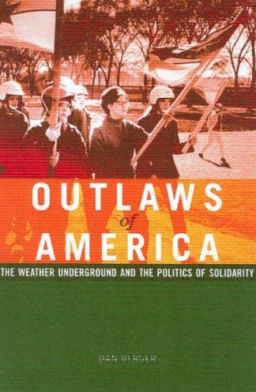
The front cover of this history of the group shows a small group of the Weatherwomen, most with crash helmets on, carrying North Vietnamese flags, marching through Chicago to fight the Chicago police who were waiting in the centre of the city for them. There were about 80 of them in all that day. (The Weathermen had marched and fought the day before.) This was 1969.
This big (430 pages) book describes the process which led to that moment and the subsequent decision of some of the group to ‘bring the war home’ by bombing symbols of American imperialism and militarism. As the state pursued them, the group disintegrated under internal and external pressures and some of them went underground in America, to live as the outlaws they were being portrayed as by the American state and media.
Here is one of the oddities of the group: they went from demos to bombs, almost missing out on the reading, writing and propaganda stage of the ‘normal’ left group’s development. Their major publications appeared while some of them they were on the FBI’s ‘most wanted’ list. Outlaws indeed.
This group began in the 1960s as members of Students for a Democratic Society (SDS), split and developed in two directions: they began self-education in theory and history and discovered Marxism. Socially, this mostly white, mostly male and mostly middle class (though the class thing isn’t discussed here) group of students met the black power movement and then the rise of the women’s movement. What began essentially as a protest movement against the war in Vietnam changed as the group experienced the politics of ethnic and sexual identity and tried to reconcile this with their newly acquired politics of class and imperialism. At its sharpest, here were some white male revolutionaries, living underground, facing long prison sentences at the hands of the state if apprehended, being berated by black ‘comrades’ for being racists and by female ‘comrades’ for being sexists. Pick your cliché: this was a very steep learning curve, a hard row to hoe, etc etc.
At the beginning the group had almost no creed. The doctrinal disputes and splits came later, after they learned to make bombs. We might say that being a Weather person in the early 1970s involved trying to process much complex historical and political data under conditions of extreme stress. Quite a strong sense of what this felt like is conveyed in the author’s interviews with group members. But parallel to this he shows us the political/intellectual development of the group. This I found dull and much of it I skipped. (The thinking of most left groups of the period would be dull if looked at now: without the historical context the issues lose some of their meaning.)
More than 30 years on, the decision to take on the American state in an armed struggle looks as mistaken as it did then to most of the American left. Did those who took up arms think they would win? Some believed that ‘the masses’ would rise up to support them. The ‘days of rage’ in Chicago in 1969 were supposed to be the kernel of a mass uprising against the Vietnam war. But nobody else turned up. Or did they do it just because they felt they had to? Though the Weather Underground had some support among the ‘alternative society’ – blowing up a draft office or a bank seemed sexy and exciting at the time – the group did not connect with the working class or organised labour, let alone with straight America, grazing in the malls.
The author tries at the end to show that, despite their complete failure, the WU were important to today’s political struggles. Were they? I kind of doubt that; but either way this is a really interesting, thorough and well produced book.