
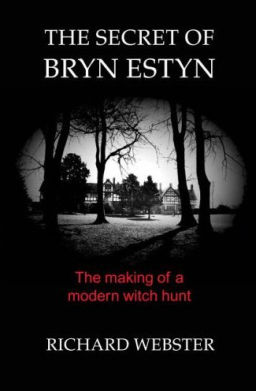
The Secret of Bryn Estyn: The Making of a Modern Witch Hunt
Richard Webster
Oxford: The Orwell Press, 2005, £25
This is an account of the various child abuse and satanic abuse cases that developed across the UK from the mid ’80s onwards. At the phenomenon’s peak, around 1995, many police forces were carrying out ‘trawling’ operations, seeking child abuse that had never been previously reported or investigated. The book is over 700 pages long and contains 647 footnotes including many references to expert testimony. It relies almost entirely on primary evidence and is centred on a study of events at Bryn Estyn, a former children’s home in North Wales.
These began in 1984 when a member of staff began making claims that children were being abused. They accelerated in 1987 after this individual was sacked by Gwynedd County Council, and again in 1990 when another member of staff, who not been previously involved or mentioned in the claims about Bryn Estyn, admitted, in an entirely different case elsewhere, that he had abused three boys. Thereafter the claims spread rapidly via the media, local councillors and a police investigation; and by late 1991 produced a crescendo of stories in the national press and television The book covers these events in great detail over the twenty or so years during which the episode unfolded and should be required reading for anyone in the police, judiciary, media and social work.
New social work theories
Webster points out that the genesis of the rash of child abuse and satanic abuse cases in the UK in the 1980s and 90s lies with the emergence of what are called ‘new social work theories’ in California in the 1970s. These could be broadly reduced to the following propositions
- There was more sexual and physical abuse of children than was previously reported.
- As this was the case much of it must be being ‘covered up’.
- Children do not make false claims.
- Because children are not coming forward with allegations they must be ‘in denial’.
- Because they are ‘in denial’ the children should be placed in appropriate therapy programmes until they admit that they have been abused.
- Anyone who has been abused will automatically deny this in the first instance.
The first of these propositions is undoubtedly accurate. The second, third and fourth are extremely questionable and the fifth is an assumption likely to produce the result sought by the enquirers. The sixth was demonstrated to be false some years later.
Because of the professional standing of those holding these views, the approach toward child protection in the US changed dramatically, eventually producing a number of particularly lurid cases, often involving allegations of sexual abuse of children by members of highly placed satanic cults.
The theories duly crossed the Atlantic and by 1988 a number of sensational cases had appeared in the UK. These included an alleged satanic ring in the Orkney Islands and allegations of mass sexual abuse in Cleveland. No proof of a satanic cult was ever found in the Orkneys. Despite this, people were convicted and imprisoned and children separated from their parents. It is clear now that the basis for this was not sound criminal or forensic evidence, but the credibility that the UK legal system was willing to give social workers and their theories. It now seems clear that the Orkney case was a miscarriage of justice. ([1]) In Cleveland it was at one time considered that hundreds, perhaps thousands of young children were being molested. The claims were picked up by Stuart Bell MP who demanded an investigation.([2]) Many children were taken into care. The basis for this was an ‘anal dilation test’ that had been devised in the US and which was supposed to prove that children had been sexually assaulted. Later investigations by clinical paediatricians demonstrated that anal dilation is present in 50% of the population. Unlike Orkney, and perhaps because of the astonishing publicity the allegations received and the involvement of the local MP, Cleveland produced the Butler-Schloss Enquiry. This demonstrated that there was little or no substance in the claims made by local social workers and doctors.([3] )
Nevertheless a bandwagon of prominent and (on the face of it) appalling child abuse allegations developed across the UK from the mid-1980s onward, following the trajectories of many similar incidents in the US. The case around the Bryn Estyn children’s home was one example and, via the expansion of the investigations into abuse allegedly perpetrated by its staff elsewhere after they had left Bryn Estyn, would eventually produce a huge volume of claims by apparent victims.
The role played by the media in this is examined, and found wanting. The main proponent of the initial Bryn Estyn allegations, Dean Nelson,([4]) a freelance journalist then used by The Independent, appears to have made little to no effort to check the various accounts made to him about abuse at the establishment. As a result of his articles the newspaper lost a libel case brought by a former police superintendent.([5]) Nelson maintained that he ‘stood by’ all his statements. Given that he failed to testify in court about any of these very grave matters the reader may conclude the opposite to be the case. His reports, nevertheless, established in the public consciousness the idea that a great many juveniles and young men at Bryn Estyn had been sexually and/or physically abused and that a local senior police officer was somehow involved.
Paul Foot
This theme was later expanded by Paul Foot, in both Private Eye and The London Review of Books. Foot wrote a column in which it was stated that highly placed local Freemasons in North Wales were attempting to cover up huge amounts of abuse because one (or possibly more) of their number were involved in a paedophile ring. The basis for the claim appears to be that Lord Kenyon, a Conservative member of the House of Lords who lived in Shropshire but had been a member of the Police Authority that covered north Wales, was a Freemason and that his son had been implicated in one of the claims;([6]) and that the former police superintendent mentioned in The Independent was also a Freemason. No evidence of any such paedophile ring, or of Masonic involvement ever emerged. Foot had previously made similar statements about the Kincora Boys Home in East Belfast. Here abuse had indeed taken place, some staff sexually molesting some young men, but the specific claims made by Foot were that a range of local notables and celebrities had also been involved, and that this had been covered up by ‘the British state’. No evidence has been produced to support this. In fact the particular claims made by Foot about Bryn Estyn actually fit quite neatly into a conspiracy theory held by many on the left: that Freemasons have undue power and exercise much of it through the establishment and, in particular, the official structures of the judiciary and the police.([7]) A less grand, psychological explanation could be offered for the disposition of Paul Foot to believe claims of this type: he had been to a private school, Shrewsbury, where he had himself been abused by a member of staff.([8])
How did the Bryn Estyn case conclude? Until reading this account, I would have assumed that, given the media coverage at the time (and subsequently), that many perpetrators were imprisoned; and that it had been a clear case of ‘no smoke without fire’ However only two people were convicted following ten years of claims and investigations. One of these was the former games teacher who only received a suspended sentence, having been found guilty of being physically heavy-handed with the inmates at Bryn Estyn. Webster bases much of his book on the fate of the sole individual imprisoned, Peter Howarth, and argues that, had Howarth not died awaiting an appeal, he would have been cleared. On the account given in this book this does not seem improbable. Whatever one’s views on the matter it, seems an extremely slender return for the resources expended on pursuing the various claims made about abuse at Bryn Estyn.([9])
Compensation culture
If I have any criticism to make of Webster’s book it would be that relatively little space is given to examining the role of possible financial compensation in encouraging alleged abuse victims to make their claims. It seems clear that this was a significant motive in many cases. The individuals concerned often lived in small towns with few prospects, were unemployed, had generally difficult circumstances, had debts and were dependent on drugs.([10] ) They would be contacted by former colleagues, journalists or solicitors, told that they could make financial claims funded by legal aid and sheltering behind the UK’s generous libel laws, and could usually do so via anonymous help lines set up by either the media or the NSPCC. Any local authority faced with large numbers of claims of this type would almost certainly settle out of court and might even be advised by their insurance company to do so: it would be cheaper than contesting the actions, even if many were dubious and some false. It is, from the point of the local authority or official body, a classic ‘lose-lose’ scenario. Once a settlement is reached, even if for purely pragmatic reasons, it vindicates the original allegation in the eyes of many.
Problems of legal methodology
Webster shows that the methodology by which allegations of this type are assembled and tested now differs very markedly from established and reliable practice in other areas of criminology. It would appear that this can be traced to a judgement written by Lord Denning which ruled that homosexual acts were a ‘crime in a special category’ and that the usual (and rigorous) rules of evidence should be relaxed or disregarded when dealing with cases of this type.([11]) As a result many defendants in abuse cases in the last twenty years have found themselves facing multiple charges stretching back decades. Previously this would have been disallowed: the defendants would still have been tried, but would have faced only a single charge or a strictly limited number of charges at any one time. A feature of many commentaries on current abuse investigations (such as those faced by the Catholic Church in the US or Eire) is the great difficulty defendants have in facing large numbers of multiple allegations over long periods of time, particularly when most allegations do not involve witnesses or have any supporting forensic, written or photographic evidence. In such circumstances it becomes difficult to tell the difference between a safe and an unsafe conviction. This approach would not be allowed in a murder or robbery trial, for instance. More importantly it would not be followed in instances where a child is kidnapped and murdered (Soham), or tortured and neglected so much that they die (Victoria Climbié). In neither of these cases would the police have toured the area where the crimes were committed and invited people to make allegations. Nor would telephone helplines have been set up allowing anonymous denunciations. Had either approaches been attempted, any subsequent convictions would be regarded as highly unreliable.
Denigrating local government
Another area where the book does not delve as much as it might is the erosion of respect for the local state and the law in British society in the last thirty years. Part of the undertow to the Bryn Estyn story (and all the others that followed) was a feeling that there must be some sort of a case to answer because it involved local government. A number of authors have commented on the great reduction in the ability of the state, at both local and national level, to maintain a stable and orderly environment during that time. The media, with its constant searching for bad stories and personal scandal, has played a significant role in this.([12])Programmes either ridiculing local government or calling it into question (‘Beadle’s About’, ‘That’s Life’, for example) are ultimately quite corrosive. The current BBC approach to reporting serious issues, Paxman scoffing at all interviewees, the daily knocking copy of the ‘Today’ programme and the various polite but lightweight Dimbleby panel shows, is similarly so; and reflects the general political circumstances that have developed in the last thirty years.([13])
Since the mid-1970s UK politics has been notable for an almost completely bipartisan agreement about deregulation and reducing the role of the public sector. The Criminal Justice Act (1982), which scrapped the previous methods of dealing with young offenders, a system involving approved schools, remote residential homes and borstals, and replaced them with the current somewhat ineffective regime of locally run care homes and day centres, is but one example of this. The reasons for doing this were given as being progressive and libertarian, ostensibly a desire to avoid institutionalisation and exposure to a harmful criminal milieu. The reality was that they were mainly financial. Establishments like Bryn Estyn, where there was a ratio of about 80 staff to 100 boys and young men, were very expensive to run. The Tories closed them.
Webster concludes that what we have seen since the mid 1980s is a continuation of the traditional witch hunt, based on fear and prejudice rather than reason. It is interesting that belief in widespread paedophile rings, satanic abuse cults and ‘cover-ups’ by highly placed figures (Freemasons etc) involves adoption of classic conspiracy theories and their accompanying mind-set. If the same approach, however, is argued in foreign policy or economics, it is usually quickly ridiculed and debunked. Perhaps the conspiratorial nature of these beliefs is due to the ‘new social work theories’ originating in the US.([14]) When considering the new ideas that ultimately led to the Bryn Estyn case one is reminded, by their assumptions, that they have what appears to be a common lexicon and belief system with other flimsy theories that have crossed the Atlantic and taken root in the UK during the same period. Neo-liberal economics, ‘the End of History’ trumpeted by Francis Fukuyama and the corporate management strategies of Tom Peters promoted a set of values (successfully in the UK but less so elsewhere) which maintained that traditional authority and structures were wrong and should be dismantled, that the state at all levels should be liberalised, that individuals were more important than the greater good of society; and that decision-making should be carried out at a low level by employees who have been ’empowered’ and ‘liberated’. It is significant that very little of these theories has been subsequently found to be either accurate or desirable.([15]) Indeed a notable feature has been the careful retraction and distancing from them by their authors, whenever events have clearly shown them to be wrong. Perhaps in time the ‘new social work theories’ will be seen in the same light and will suffer the same fate.
Although there appears to have been a slowing down in the emergence of the type of wide ranging abuse allegations prevalent between 1985 and 1995 (which may be the result of the introduction since 1997 of rules allowing the greater disclosure of previous convictions), cases of this type still occur. The Home Affairs Select Committee, chaired by Chris Mullin MP, reported their concerns about the conduct of abuse enquiries in 2002 and made a number of recommendations. Their findings have yet to be turned into legislation. Until they are, there will no doubt be further episodes of this type in the future. When they occur The Secret of Bryn Estyn should be returned to as a useful guide to how such matters ought to be handled.
In the meantime consider the very real dramatic possibilities of this book. With its various plot lines and characters, including crusading journalists, compensation-seeking solicitors, ‘whistleblowers’ and ‘victims’ (false and real), assorted conspiracy theories, court room scenes, politicians at all levels and segments that read like either ‘Our Friends in the North’ or ‘Shameless’, it would make an excellent film or TV series. ([16] )
Notes
[1] BBC2 broadcast a thorough account of this on 22 August 2006. The social workers who had caused the miscarriage of justice and all the subsequent uproar to which it led appeared unconcerned by the matter.
[2] In Cleveland the main proponents of the abuse theories were paediatricians and not social workers.
[3] The Butler-Schloss Enquiry included a comment from the Official Solicitor to the effect that many of those involved with the events in Cleveland appeared to have no common sense.
[4] Nelson now heads The Sunday Times Insight team.
[5] The libel case was heard in 1994 and resulted in substantial damages being granted to a former police chief superintendent against Private Eye, The Independent on Sunday and The Observer.
[6] Private Eye published a story,’The Off Scot Free Mason’, in January 1993 saying that ‘a number of the local great and good’ were involved in an abuse ring at Bryn Estyn. The involvement of Lord Kenyon in the story was due to his son having stayed (in 1979) at a flat where a paedophile had once lived and having subsequently alleged that a number of small items had been stolen from him at the address.
[7] In Martin Short’s Inside the Brotherhood (1989) Ken Livingstone is quoted as stating that half the Labour local councillors in some parts of London when he joined the Labour Party were Freemasons. He had no proof of this and later declined to provide any.
[8] The late John Peel also talked of being abused at Shrewsbury. Webster points out that it did not occur to Foot, and that he would not have known that the regime at Bryn Estyn, a local authority childrens’ home, was actually better than at a private school. It is interesting that unlike local government, private schools have not been condemned for their failures regarding child abuse.
[9] The Bryn Estyn Enquiry, which cost nearly £20m (for an event where one person was imprisoned?) was the most expensive of its kind in UK legal history at the time. It has now been superseded in cost terms by the Bloody Sunday Enquiry.
[10] A picture emerges in the book of the despairing nature of life in the landscape of Thatcher’s Britain with the emergence of a huge unskilled underclass.
[11] Denning wrote this judgement as early as 1946. He had a lengthy record of interventions on matters concerning sexuality, voted against homosexual decriminalisation in the House of Lords and conducted the cover-up inquiry in the Profumo case.
[12] In Thatcher & Sons: A Revolution in Three Acts (2006) Simon Jenkins comments that one effect of the Thatcher, Major and Blair years has been the running down of local and regional democracy and the enormous growth in the unelected power of the Treasury.
[13] The Conservatives had a unit at Central Office after 1975 that sniffed out stories of alleged ‘waste’ and incompetence in local government and then fed them to the media. This reached a peak in the lengthy campaign against the ‘Loony Left’ (c1981-1987) and its alleged obsessions with renaming manhole covers and banning Baa Baa Black Sheep etc. See ‘Where’s Ware?’ in Lobster 39.
[14] Surveys have shown that a significant number of US citizens believe in alien abductions.
[15] Price Waterhouse, the US management recruitment and accountancy consultancy, promoted a number of individuals in UK local government in the 1990s who implemented, or attempted to implement, the theories of Peters. The outcome was invariably disastrous and resulted in significant worsening of services and chronic overspending.
[16] Webster’s book includes an individual in a wheelchair who claims to have been abused in a care home. It later transpires that this is not the case and that he is also not disabled. He resembles the character out of ‘Little Britain’.