
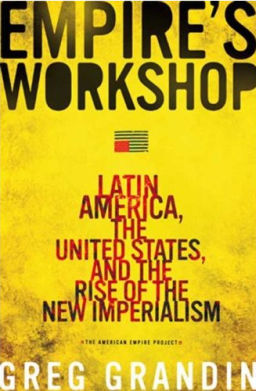
Greg Grandin
New York: Metropolitan books, 2006, $25.00
Reviewing a biography of Harold Laski in 1953,([1]) the historian A. J. P. Taylor remarked on ‘the dilemma of our times’: that ‘no-one who believes in liberty can ever work sincerely with communists, or trust them, yet no-one who has socialism in his bones can ever condemn communism without reserve.’ During the Cold War, leftist critics of US foreign policy had another dilemma to consider: how much weight to give their criticisms in the light of Stalinism’s crimes. Greg Grandin, New York University professor of Latin American studies, alludes to this in the preface to his book, The Last Colonial Massacre (2004), a masterly account of terror in Guatemala:
‘The enormity of Stalin’s crimes ensures that such sordid histories (US interventions throughout the world) no matter how compelling, thorough or damning, do not disturb the foundation of a world view committed to the exemplary role of the United States in defending what we now call democracy.’
Post Cold War, and post 20th century, the left has been confronted with a US taking on the role of creating new democratic regimes, rather than sustaining the repressive status quo in the interests of stability. Some most strident in their critique of past policies now write of a resurgent American idealism, a new era, during which, for example, the people of Iraq have been released from a fear unparalleled in the Middle East. Grandin does not take on critics who have defended the US since 9/11, many of whom came to subsequent events through an appetite for polemics rather than from a serious interest in politics or history. His new book, Empire’s Workshop, did arise, however, from discussions held at New York University on the invasion and occupation of Iraq. One firm observation emerged: that present US policy in the Middle East was predictable to those who had studied the Latin and Central American wars. Other commentators had noted how ‘recycled Reaganites’ (Bolton, Negroponte, Reich, Abrams) were dominating the new century’s doctrine. In those wars, writes Grandin, ‘the coalition made up of neo-conservatives, Christian evangelicals, free marketers and nationalists that today stand behind George Bush’s expansive foreign policy first came together.’
Grandin sees the evangelicals as a throwback to the Christian new right of Reagan’s days, a force that opposed the liberation theology of Latin America, which saw Christianity and capitalism as antithetical.
It is Grandin’s aim and achievement to bring together all these aspects of the new right, and to show how profoundly unoriginal it is, whether in its advocacy of preemption, or in its idealistic rhetoric about freedom from oppression. He notes, however, an important change in the modern world’s emphases:
‘the idea widely held at the end of WW2 that freedoms and equality are mutually fulfilling has been replaced by a more vigilant definition, one that stresses personal liberties and free markets'([2])
Yet, as Grandin aptly remarks, the doctrine ‘sees any attempt to achieve social equity as leading at best to declining productivity and at worst political turmoil.’ Such an attempt, we note, merits attention in present day Latin America, where the growth of the left, nationalist movements presents the US with its own dilemma or problem : how to confront a geopolitical threat (Venezuelan alliances with Iran, for instance) when the old methods of Reaganite-sponsored terror are no longer available. ([3])
Grandin’s book is wide ranging and detailed in its historical accounts of US interventions, of the personalities and ideas involved, and the failures of free market economics. For the reader educated by valuable past Lobster articles on the influence of the US lobby on embryonic New Labour (and since), the Reaganite doctrine that now animates the Bush administration and its speechwriters will seem familiar, and its influence in the UK even more transparent. ([4])
The reader may recall some time after the 2003 Iraq intervention, the Prime Minister studiously asserting, as a newly-minted philosophy underpinning his foreign policy, that ‘there is no clash between idealism and realism.’ My eyes therefore lit up on reading Grandin’s important discussion in Empire’s Workshop of the influence of Jeanne Kirkpatrick, stalwart defender of Bush 2’s foreign wars. He quotes from a Kirkpatrick essay of 1984, during which she muses that ‘in the cool, reassuring plans of our founding fathers, informed by history and inspired by a passion for freedom, idealism and realism were closely interwoven’. Subsequently, as Grandin remarked in an interview, ([5]) Reagan was to elevate the Contras – the Nicaraguan anti-communist paramilitaries – into the ‘moral equivalents of the US founding fathers’.
Readers will have to decide on Grandin’s case for the continuity of US policy against those who defend the recycled Reaganites as reformed and newly progressive. His latest book is essential reading, though, for the activist, student or dissenter. For the lazy polemicist, who reckons his or her judgements can rest safely on only a moral feeling, Empire’s workshop is a reminder of how much knowledge and analysis is needed before we come to settled views on international affairs.
Notes
1 Kingsley Martin, Harold Laski, London: Gollancz, 1953)
2 The core of the Bush (Blair) doctrine is the free market. Grandin comments: ‘Call it market polygamy, whereby the US can have multiple partners but each of the partners must be subordinate to it.’
3 On the growth of the Latin American left, see Grandin’s, ‘Latin America’s new consensus’ www.thenation.com/doc/20060501/Grandin
4 US influence on the Blair clique (its appropriation of ideas fit for slogans) has been well-documented. Grandin notes that after Bush’s first term, Cheney was asked to name the administration’s most important achievement. He referred not to Afghanistan, but to the ‘restoration of the power and authority of the President.’ The parallel with the British premier, a man who, by his own account, runs foreign policy, is striking.
5 In 1985, according to the late Eqbal Ahmad, president Reagan welcomed into the White House the Afghan Mujahideen, then battling ‘the Evil Empire’, and acclaimed them as ‘the moral equivalent of the founding fathers’ See ‘Terrorism, theirs and ours’ in Selected Writings of Eqbal Ahmad, Columbia, 2006.