
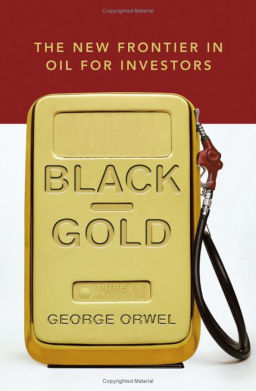
George Orwel
London, John Wiley, 2006, £18.99, h/b
Having reviewed Matt Simmons’ Twilight In the Desert for the last issue of Lobster I looked forward to reading George Orwel’s book as Simmons’ appreciation appears on its cover.
Orwel provides a good analysis of the peak oil debate concluding that the truth lies somewhere in the middle of the polarities of doomsters (geologists) and those who think there is no problem (economists). Orwel was a sceptic but now believes in peak oil and says it will occur in the next thirty years. Peak Oil is a realistic theory without sufficient details to allow a precise date when the peak will come; but it will be soon enough to frighten the children. Orwel suggests 2015, a date I heard in 1990 at an Iranian/USA oil industry seminar in London. The background on how Hubbert arrived at the peak oil curve is clearly explained. But the advice on investing in oil appears late in the book and comes over as an after-thought delivered by a snake oil salesman who is promoting his friends’ products. ‘Use Google to research companies’ he advises. Better still, as you might lose your shirt, hire an investor advisor although these too may be dodgy. Buy ExxonMobil, Andarko, or Valero shares and you can’t go wrong. Well, yes given ExxonMobil’s recent quarterly $5 billion profits, one might well agree.
The oil price is high due to limited refining capacity. In 1980 there were 425 refineries across America: there are 176 today. His understanding of the oil politics of Iraq is good and he admits the rebuilding programme has failed. You may puzzle why Iraqi oil is a ‘prize’ while the cost of the war exceeds $325 billion to date and may hit $2 trillion before the country can return to any semblance of normality; yet the $20 billion of US reconstruction money has failed to provide electricity let alone refining upgrades in Iraq. Given how precarious the supply to demand ratio is supposed to be, I am puzzled that no one appears troubled by the reduction of the supply from Iraq since Bush War II. Yet despite this reduction oil has dropped to below $60 a barrel. Orwel cites an article in Scientific American written in 2001 which predicted the catastrophic effects of hurricane Katrina, which reduced refinery capacity in the US by 20 percent. He has identified the voices of the prophets being utterly ignored by the seekers of the profits. Plus ca change!
He cites Wood Mackenzie’s prediction that Europe will be 50 million tones a year short of diesel by 2010. (No doubt the Russians will come to Europe’s aid!) The need for oil by China and the USA remain big problems as neither state will reduce consumption. China has gone from being an oil exporter just a few years ago to now being the second largest importer. Orwel speculates that the USA could take control militarily of the Middle East and West Africa; but reality is that the Americans have lost the war in Iraq, in a stunning display of zero planning and hubris. He speculates the cost would be prohibitive. One may think Iraq II is already the straw which will break the back of the dollar.
The most interesting quote in the book concerns the Iraq war and a warning given by a former fellow of the CFR, and energy reporter for the New York Times and Wall Street Journal, Youssef Ibrahim. He warned the war would back-fire and said:
‘The upcoming war against Iraq has nothing to do with the war on terror – Bush wants to turn “friendly” Iraq into a private American oil pumping station, to create a totally pro-American Middle East. You don’t impose democracy by installing an occupying power in a region that has no tradition for it.’
Alternative energy sources are defined but wind and solar make up a small fraction of alternatives. He praises Lord Browne of BP for being the only man with the guts to advocate alternative energy when ExxonMobil was pooh-poohing the idea of a crisis. (And he exposes Exxonmobil as funding a network of groups to challenge the existence of global warming.)
Gas to liquid energy is very important and nuclear power is also needed, the sooner the better. Wind power is a joke, figured at 2 per cent of 6 per cent alternative energy share.
This is a book you have to work at to find a few hidden gems and I would not recommend it. It is frequently repetitive, its style is awkward and much of what he writes is a revisiting of Simmons’ book, badly done.