
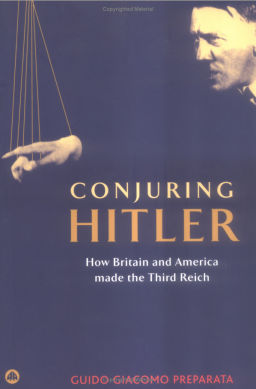
Conjuring Hitler: How the Western Elite Incubated Nazism – 1900-38
Guido Preparata
US: University of Michigan Press, 2005; h/b, $90.00; p/b $28.95
UK: Pluto Press, 2005; h/b £60.00; p/b £17.99
I would like to introduce a recently published book that has been overlooked. Guido Preparata’s Conjuring Hitler: How the Western Elite Incubated Nazism-1900-38 reinterprets key parts of twentieth century history in a manner I have not come across before. This is a contribution that many readers will find fascinating and significant.
I became aware of Conjuring Hitler in summer 2005, thanks to a friend who mentioned to me that standard accounts of the Hitler era were upended by Guido Preparata’s controversial volume. I ordered a copy from a local bookstore and discovered that Preparata’s book, like W. G. Sebald’s On The Natural History of Destruction (Penguin Books, 2003), Eric Markusen’s and David Kopf’s, The Holocaust and Strategic Bombing (Westview Press, 1995), or Peter Novick’s The Holocaust in American Life (Houghton Mifflin, 1999), offers a major rethinking of twentieth century world war and its ideological aftermath.
Preparata’s book represents radical scholarship at its best. He is breaking new ground, and inevitably, academics wishing to preserve conventional interpretations may heavily dispute this work: the more so as the issue and history of Hitler and the last great war of 1939 to 1945 still touch many raw nerves.
A skilful researcher, intrepid denizen of dusty Bank of England archives, and polyglot scholar of the oblique, of economic history normally left hidden, Preparata is also a consummate stylist, a quality that makes his work eminently readable and unusually compelling. This feature is clearest in Conjuring Hitler but also in Preparata’s journal articles, such as ‘Hitler’s Money: The Bills of Exchange of Schacht and Rearmament in the Third Reich’ (American Review of Political Economy, Vol. 1, No. 1, 2002), which assays the sinister resemblance between fiery episodes in Part II of Goethe’s Faust and the extraordinary efforts of Hitler’s financier, Hjalmar Schacht, in restoring the economic health of 1930s Germany. Schacht succeeded in launching an economic boom through a novel manipulation of the money system. By 1935 Bills of Exchange issued to heavy industry by the Reich,amidst a regime of draconian wage and price controls, propelled a thriving economy where half of government spending was dedicated to armaments and the military a share that would soon increase.
The book begins with an anecdote on memory that frames Preparata’s central proposition. Confounded by uncertainty, the author’s paternal Italian grandfather, seconded by his grandmother, had agonized for years over the outcome of the war. Was the defeat of Mussolini and Hitler a good thing after all? ‘My father and I the modern ones would listen to these tirades, rolling our eyes, and excusing the impropriety of even alluding to a possible Nazi victory on account of my grandfather’s earnest but essentially “screwed-up” world view.’ Certainly, as Preparata came to reconsider, the result of world conflict had not been kind to the former Axis powers, knee-deep in spilled blood and burdened with ineffable guilt for the Holocaust and associated Nazi terror; but was the American ascendancy, with its own imperial precepts of ‘shock and awe’, an entirely innocent global outcome?
Preparata’s major contention is that Hitler himself, and the Nazi apparatus, were aided and abetted by Anglo-American elites ‘the clubs’ who engineered the Weimar crisis, helped propel Hitler to power, and manipulated the Third Reich into a confrontation with the Soviets it could never win. Preparata’s thesis is partly supported by revelations, now being aired, of close Anglo-American identification with German industry and finance of the period, political intrigues with Hitler and Stalin, and even (as with the eugenics movement, widespread US anti-Semitism, or racial terror practised in the American South) the existence of Anglo-Americanideological trends that resembled in some ways the currents in pre-war Nazi Germany.
Preparata’s reckoning of the Nazi regime — especially its fabulous initial, and crucial, access to bank funding of military-industrial production (the centerpiece of Conjuring Hitler) draws from a profound knowledge not only of conventional economic theory but also of alternative, anarchist appreciations of capitalism, including, and most especially, Thorstein Veblen’s far-sighted comprehension of ‘the clubs’, the elite networks that steer western free enterprise, which are motivated by ‘spirits’ of greed and evil that Veblen alone identified within the context of socio-economic theory.
Mackinder’s vision
Although an original and unanticipated achievement, Conjuring Hitler offers ‘no more than a thread with which one may finally string together a collection of clues and solid evidence, which have been available for years and have formed ever since a platform for dissenters’ (p. xix). Foremost among these scattered indications of an imperial plot to weaken Russia and isolate and defang Germany is the influential 1904 piece by H. J. Mackinder that founded the modern perspective of geopolitics and spelled out the geopolitical strategy followed for the next century by Britain and its impatient successor, the United States of America. Simultaneously with the completion of Conjuring Hitler, and a century after Mackinder penned ‘The Geographical Pivot of History’, The Geographical Journal devoted an entire issue to Mackinder’s pregnant intervention, including a reproduction of the original article. While Preparata urges that Mackinder’s belligerently imperialist essay (which appeared in successive iterations up to 1919 and 1943) shaped Anglo-American policy ever afterwards, he is not alone. For example, Harvard historian Paul M. Kennedy, writing in The Guardian in mid-2004, made a parallel claim. ‘Right now,’ Kennedy wrote, ‘with hundreds of thousands of US troops in the Eurasian rimlands and with an administration constantly explaining why it has to stay the course, it looks as if Washington is taking seriously Mackinder’s injunction to ensure control of “the geographical pivot of history”.’ ([1])
Nor was Mackinder’s simply an academic voice in the wilderness:
‘British Prime Minister Balfour shared Mackinder’s concerns over the future intentions of Russia and a possible Russian-German alliance ….. Moreover, many military and political figures were worried about how India might be defended if Russia sought to continue the “Great Game” in the coming decades of the twentieth century. Perhaps, therefore, we should understand Mackinder as someone who not only reflected the strategic zeitgeist of the era but also challenged his contemporaries to wrestle with the global strategic picture.'([2] )
Preparata’s account of the influence of Mackinder’s paper is seconded (though partly shorn of warlike premeditations) by Pascal Venier ([3]) who claims, against the conventional view, that ‘The Geographical Pivot of History’ with its warning against a Russian-German coalition likely influenced British foreign policy leading up to August 1914.
Another piece of the puzzle assembled by Preparata is the mysterious Israel Helphand (also Helfand), otherwise known as Parvus, a well-regarded Marxist author, trusted associate of Trotsky and key mediator between the Kaiser and the Bolsheviks who arranged, starting in 1915, for the flow of German gold into Russia that funded the propaganda campaign of Lenin’s little band of anti-war Marxists. Some Russian revolutionaries grew to distrust this erratic and ‘Falstaffian’ figure, with his ‘fat, fleshy, bulldog-like head’; ([4]) and Trotsky finally broke with him after discovering that Parvus was, among other things, ‘engaged in vast commercial operations in the Balkans’. ([5])It was Parvus who arranged the sealed train filled with German bullion that with the connivance of the German high command brought Lenin to the Finland Station in April, 1917. ([6]) No one knows which great powers stood behind Parvus, but his actions were in tune with those of the British government. While Lenin journeyed across Germany toward Russia, Great Britain brought the Menshevik Plekhanov to the Russian capital, escorted by imperial warships, and sprung Trotsky from a jail in Nova Scotia, spiriting him to Moscow.
With the Bolsheviks in power, contends Preparata, the union between Russia and Germany, drawn by Mackinder and feared by the British government, could never fully come to pass. Instead, in Soviet Russia the Anglo-American powers had an unusual and fitful ally they would later sacrifice to the maw of the Third Reich.
Thorstein Veblen in his ‘Economic Consequences of the Peace’ (1920) accurately predicted the coming deadly struggle of the Russian Bear with the German Eagle. Preparata rightly calls Veblen’s fantastic prognostication, a great accomplishment of twentieth century political economy. Grasping its conspiratorial dynamics, Veblen recognized that the 1919 Treaty of Versailles would stir up forces of mystical German revanchism and cause financial distress to ordinary Germans, while leaving the upper classes and the military untouched and primed to attack Bolshevik Russia.
‘Veblen prophesied no less than: (1) the religious nature of Nazism (2) the reactionary coming of the Hitlerites, and (3) Operation Barbarossa, Germany’s invasion of Russia of June 22, 1941 (in his words “suppression of Soviet Russia…..Germany….. as a bulwark against Bolshevism”) more than 20 years prior to the events.’
But the gargantuan Eurasian conflict, thus foreseen, would follow upon a trail of blood and intrigue, assassinations, skulduggery and profound duplicity on the part of the Anglo-American powers that might surely warm the heart of any mafia chieftain or modern Machiavelli. The Allies manipulated the war between Red and White forces (e.g. Kolchak, the leading White general, was in the pay of the British) to ensure a Bolshevik win thus offering a tempting Russian target for future German militarism. A united White Russia, Prime Minister Lloyd George later admitted, was not in Britain’s best interests. When German monarchists in the Kapp putsch attempted to join with White Russian forces, the plot was spiked by collusion between the Soviets and the Anglo-Americans. Like Saddam Hussein (whom President G. W. Bush famously labelled ‘worse than Hitler’), the Fuehrer himself emerges more as an assembled evil pawn of dark forces than a self-articulated monster. The Weimar regime, pockmarked by three hundred political assassinations and debilitated by a quarter of a million suicides, never had a chance. A German-Soviet pact, secretly brokered by the British and concluded at Rapallo in 1922, supposedly on the basis of dividing Poland amongst the two partners, would last until Barbarossa, and help disguise German rearmament, allowing a smooth flow of military personnel and armaments across both sides of the border.
The hyperinflation of 1922-23 that delegitimized Weimar and catapulted Hitler into the public eye was mostly a result of capital flight, as wealthy Germans, in face of the massive Versailles war reparations, transposed marks into foreign currency to escape taxation and save property values. Middle class Germans, their savings debilitated and with fixed incomes reduced to nothing, fled to the Nazis. ‘In the end, the Reich was “purged” of the war loan. Germany’s entire war debt, which had amounted to over a third of the entire wealth of the Kaiserland at its apogee, was worth $1.23 (almost nothing) in November 1923.’ (p. 130). ([7]) Meanwhile, a domestic Red terror campaign, run from Moscow, fed the Nazis with convenient instances of scattered defiance they could heroically and easily extinguish.
The crisis of 1933
The keystone of Preparata’s research on the rise of Hitler is his account of the economic crisis in Weimar that brought the Nazis to power in 1933. Historians, unversed in monetary economics, have shied away from an analysis of the crisis, leaving this critical phase of German history an impenetrable enigma. Guided by the theories of Gesell and Steiner on the nature of money, and informed by thousands of yellowed pages in the archives of the Bank of England, Preparata throws a shaft of light into the mind of Montagu Norman, the bank’s Governor for almost a quarter of a century. Thus we embark on a world historical game of ‘follow the money’. Under Norman’s direction, the Weimar Republic was restored to health after 1923 with foreign loans especially American ones until it became practically a colony of Wall Street. The great military-industrial conglomerate I.G. Farben arose, funded by the Dawes plan and technologically twinned with giants of American industry. When the Anglo-Americans withdrew financial support from Weimar in 1932, the economy collapsed and opened the way for Hitler’s takeover of Germany.
Hjalmar Schacht, acolyte of Montagu Norman and the American trusts, became Hitler’s banker in 1933. He floated the German economy into massive prosperity on an ocean of loans backed by the Reichsbank, itself securely tied into the international financial grid led by the Bank of England. In 1942 Hitler would boast that the Reich had 1500 million marks available abroad. ‘We never find ourselves blocked for money,’ he advised.([8])By 1939 Germany was Britain’s largest trading partner, with the Reich absorbing more British goods than any other nation. An American observer, dispatched by Roosevelt, wondered at the logic of massive US corporate backing of Hitler. Du Pont, Standard Oil, International Harvester, and hundreds of other US businesses invested in Germany, he complained, but German law prevented American businesses from taking their profits home. While Germany rearmed, the British, Americans and Soviets nourished Hitler’s military production with loans, technical expertise, and installation of massive chemical and industrial facilities.
‘Many of these “foreign” installations would be spared by Allied bombs at the end of the war, and one is left to wonder when, in fact, the respective governments of Britain and the United States began to think of Europe as their own private domain the new western appendix to the empire and of Hitler and his regime as an obtrusive nuisance to be propped up at first and then annihilated in a prolonged international conflict.’ (Conjuring Hitler, p. 226)
Besides arming Germany right up to Operation Barbarossa (the 1941 German attack on Russia), in 1937 Stalin helpfully murdered his top general, Mikhail Tukhachevsky, and executed most of the Soviet Army leadership. Tukhachevsky had just returned from a failed mission to convince Britain to launch a preemptive strike against the Nazis. In 1939, the Soviets signed a non-aggression pact with Germany that envisioned the partition of Poland between the two powers.
Publication of Conjuring Hitler coincides with a renewal of memory in Germany of the Allied ‘bombing holocaust’ that destroyed 131 cities, evaporated countless cultural treasures, and took the lives of at least 600,000 citizens (far fewer than anticipated by Allied strategic planners but they would do better in Japan). ([9]) Jorg Friedrich’s influential 2002 Der Brand (The Fire), meticulously documents the devastation of urban Germany ‘and makes the concomitant point about the desire of the Allies to sever Germany from its history’. ([10] ) Preparata’s book recalls recent debates about why British and American bombing campaigns spared most German industry and left the transportation grid intact, including railroads that led to the concentration camps.
War crimes
The ferocity and raw fanaticism of the remorseless Allied attack on Germany casts a gruesome shadow over world history. Writing in December, 1943 a year before the most horrific period of civilian bombing peace activist Vera Brittain equated the murderous aerial onslaught with the Thirty Years War that left Germany prostrate for 150 years. ([11])In his magisterial study, Among the Dead Cities: The History and Moral Legacy of the WWII Bombing of Civilians in Germany and Japan (2006), philosopher A. C. Grayling makes it exceptionally clear that Allied bombers committed war crimes on an unprecedented scale, comparing, for example, Operation Gomorrah the surprise attack by British Bomber Command on Hamburg in midsummer 1943 with ‘the USAAF’s atom bomb attacks on Hiroshima and Nagasaki, and the destruction of the World Trade Center in New York by terrorists on 11 September 2001.'(p. 278)
Why did Britain and America incinerate virtually every German urban complex and its denizens, while leaving relatively unmolested the Third Reich’s industrial and communicative system? Much the same happened in Japan. These two rising challengers to Anglo-Saxon capitalism were virtually obliterated from the earth, separated from memory and history, and sentenced to decades of anguished guilt by western propa-ganda machines. Was this perhaps merely an excess of zeal?
Archives containing the secrets of the Second World War and its aftermath remained sealed more than sixty years after Hitler’s downfall. Definitive answers for critical questions raised by Conjuring Hitler must await full opening of diplomatic and military records of the Allied Powers. Meanwhile, it is highly likely that Preparata’s Conjuring Hitler will be recognized for many years to come as a monumental contribution to understanding the origins, process and outcome of World War II.
Notes
[1] Quoted in Klauss Dodds and James D. Sidaway, ‘Halford Mackinder and the “geographical pivot of history”: a centennial retrospective’, The Geographical Journal, Vol. 170, No. 4, December 2004.
[2] Dodds and Sidaway, p. 295
[3] ‘The Geographical Pivot of History and early twentieth century geopolitical culture,’ in The Geographical Journal, vol. 170, no. 4.
[4] Trotsky, quoted in Isaac Deutscher, The Prophet Armed, (New York: Vintage Books) p. 100
[5] Deutscher, Prophet Armed, P.219
[6] Richard Pipes, The Russian Revolution, (New York: Vintage Books 1991) p. 391
[7] The 1918 debt divided by the 1923 exchange rate after hyperinflation.
[8] Hitler’s Secret Conversations, 1953, quoted in Conjuring Hitler, p. 228.
[9] Eric Langenbacher, ‘Moralpolitik versus Moralpolitik: recent struggles over the construction of cultural memory in Germany’, German Politics and Society, Fall 2005, v23, i3, p.106 (29)
[10] Eric Langenbacher, ‘The return of memory: new discussion World War II’, German Politics and Society, Fall 2003, v21, i3, p.74 (15)
[11] Vera Brittain, Testament of a Peace Lover: Letters from Vera Brittain, (London: Virago, 1988) p. 177