
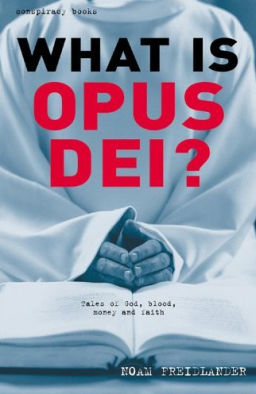
Noam Friedlander
London: Conspiracy Books/Collins and Brown, 2005, p/bk, £8.99
Apart from being an anagram of Oedipus, Opus Dei is a Roman Catholic organisation, which has grown from beginnings in Spain in the 1920s, led by José Maria Escriva, to being an evangelising force within the Catholic Church, aimed as much at the lay membership as the priesthood, a power within the church that some say rivals the Jesuits in its influence. It has spread itself widely, if somewhat thinly across the globe and now has, amongst other buildings, a multimillion dollar headquarters in New York.
The organisation is mired in controversy, which, in part, is due the secrecy with which it conducts its operations. Although O.D. is at pains to reassure people that they are not some sort of conspiratorial outfit or cult, and it is true that, unlike more dubious cults and movements, people can and do leave without too many problems, many former members do make allegations of cult-like behaviour, including monitoring of personal correspondence, restrictions on what members can read, what they can watch on television and with whom they can mix. Most of these allegations are disputed by O.D.
The organisation started to grow in Spain during the civil war and by the 1950s, with schools and other educational establishments under their control and a growing band of priests, they started to get members into the political establishment, with Opus Dei people becoming ministers in Franco’s cabinets. Again the organisation points out that such members were free to do as they pleased; but it comes as no surprise that O.D. members are rarely seen in left-leaning governments, as it is ideologically committed to capitalism and against any form of socialism and secularism.
Their system of secrecy reminds one of the ways that the CIA operates: routinely denying that people are members, unless it can be proved otherwise. When coupled with their doctrine of ‘individual freedom’, this means that when O.D. members are caught in the middle of financial scandals, as they have on several occasions, O.D. says that whatever these people had done was nothing to do with O.D., merely them using their ‘freedom’. This plausible deniability and use of ‘limited hang-outs’, coupled with the impossibility of finding out what is happening inside its upper reaches, means that conspiracy theorists have free rein. However O.D. simply rebuts them by pointing out the lack of positive evidence.
This problem pervades the whole book. Friedlander discusses various scandals that people have tried to associate with Opus Dei, including the Vatican/Nazi ratlines to South America, the Banco Ambrosiano/Robert Calvi case, the Swiss Guard murders and even alleged murders of recent Popes. As there is no proof of O.D. involvement and the organisation itself denies any involvement, the author simply returns his verdict of ‘nothing to see here move along’. (He may well be right do so in some cases; readers have no way of knowing.)
Much of the rest of the book reads like an extended apologia for Opus Dei, with plenty of data on all the schools and colleges, universities and business schools they have set up, and how well they alumni of such institutions have done. Which, of course, makes one wonder: if Opus Dei is a purely religious institution with no dogmatic political or economic policy, why do they put so much effort into educating those they see as the next generation of the ruling class (and converting existing members) if not for the political leverage that gives them in promoting their particular reactionary policies?
The book has certain problems which will make it difficult for some to read, not the least the constant repetition of Francoist propaganda regarding the Spanish Civil War; and it contains the following statement regarding the war in the former Yugoslavia, on p. 201
‘Naturally, the Vatican feared Serbia as a predominantly Muslim nation, its threat was far greater than “Christian” Croatia’ (emphasis added).
Now the author is here discussing a theory put forward by Robert Hutchison in his book Their Kingdom Come which I haven’t read. But either Hutchison is responsible for the howler and Friedlander hasn’t spotted it or it is Friedlander’s alone. Either way the editorial team should not have let such an obvious error slip through.