
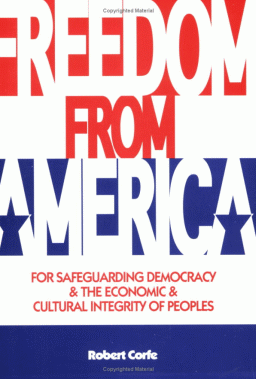
Robert Corfe
Bury St. Edmunds: Arena Books, 2006, p/b, £14.99
This has a great title but is not a good book. It is interesting to see an essentially middle-of-the-road Brit being so openly and utterly anti-American but the book is hard work to read. (1) Mr Corfe’s thesis is stated on p. 2:
‘America has now become an aggressive and tyrannical force throughout the four corners of the globe, oppressing industrially advanced and developing countries alike, and the time has now come for forming a great international bond of peoples against the world bully.’
There are two problems here. It isn’t true that America is a ubiquitous problem. And the clunkiness of ‘throughout the four corners of the globe’ is fairly typical of the writing. Here’s the opening paragraph.
‘The mental attitude of the American mindset is distinct from that of any other people or race on earth in a way that no other peoples or races are distinct from one another. This, therefore, marks a clear separation in the cultural-political understanding between Americans and the rest of humanity.’
I have no idea what ‘The mental attitude of the American mindset’ means. Had I been Corfe’s editor I would have removed ‘the mental attitude’. This would then leave the opening sentence as: ‘The American mindset is distinct from that of any other people or race on earth in a way that no other peoples or races are distinct from one another.’ And, if we grant that ‘the American mindset’ means something, his proposition simply isn’t true. On p. 11 we are told: ‘The American mind is crude and blunt, incapable of observing subtleties or perceiving shades of grey.’ But what is ‘the American mind?’
Corfe hates America and its imperialism, and their effects on the world and its cultures. I do, too; but I have reservations about the blanket condemnation of American culture. Much of ‘my culture’ – the books I have read and the music I have listened to – is American. Little of it was ‘crude and blunt’ and little of it had much to do with American imperialism – except to oppose it. Corfe’s repeated depictions of America as crude and unsophisticated compared to Europe or the Middle Eastern countries, say, is sort of true but far too general (indeed, is sort of ‘crude and blunt’). The culture and politics on the East and West coasts of America is every bit as complex and sophisticated as anything in Western Europe. America is a more diverse place than Corfe would have us believe.(2)
Corfe’s text is an analysis leading to a proposal for the creation of a body, the Freedom from America International (FFAI). He states in his preamble to the proposal (p. 199):
‘The major ills of the modern world are accountable to the malign power of America in the spheres of international finance, politics, and short-attention-span-deficiency-culture undermining civilisation throughout the world.’
I sort of know what he means by his hyphenated term – sometimes it does seem like a long decline, from Duke Ellington to rap, for example – but this is oversimplified. It isn’t just America which is responsible for the ‘major ills of the modern world’.
Corfe is one of those people who think big: big analyses, big proposals, lots of bullet-points, lists of things to be done. One of his chapters is ‘A global strategy for humankind’. Another is ‘Defusing the causes of terror’. Yet if you look him up on Google you discover that he is a member of Labour Reform, the group – to which I briefly belonged – which has been trying, without success, to resist the Blair faction’s destruction of the Labour Party. It isn’t just a cheap point to note that Mr Corfe may have plans to save the world from America but has been unable to save the Labour Party from the machinations of a relatively small number of misguided and/or shyster careerist politicians.
Notes
1 A short summary of Corfe’s philosophy is at <www.labour-reform.org.uk/main_ pages/ summary.htm>
2 Corfe writes of American culture as if there was just one when there are many cultures inside America, many of which had little or nothing to do with imperialism – jazz is the obvious example – though some of which were certainly used by American imperialism, e.g. via the Voice of America. Jazz was certainly used to present American race relations as being much better than they were. While the Klan was still active, some of the great figures, such as Duke Ellington, were being toured round Europe by the State Department. One of the slightly more interesting essays in the dull collection on public diplomacy, discussed below, refers to the massive impact on Europe of the Voice of America Jazz Hour. If we were going to compile a list of people who did the most damage to the Soviet empire, the host of that programme, Willis Conover, who died in 1996, and who was little known in the United States, should be on it.