
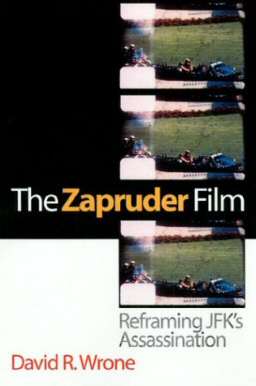
David W. Wrone
University Press of Kansas; 2003,
h/b, $29.99 (UK prices vary)
In the conclusion to his Pocket Essentials Who Shot JFK?, the editor of this journal asked: ‘Where are the historians?’ David Wrone is a former Professor of History at Kansas University, and so his book provides at least part of an answer. A confirmed conspiracist on the JFK shooting, Wrone has no qualms about saying so – partly because he is able to back up what he is saying through his interpretation of what is inevitably referred to as ‘The Most Famous Home Movie in History’. Now, this is something more than a mere retread of the usual quibbles about the Zapruder Film (hereinafter Z-film); this is a full-scale exhumation and autopsy on the most over-analysed strip of celluloid in existence.
One thing you can’t fault Wrone on is his handling of his source material. It’s all impeccably labelled and described, with 60 pages of fully sourced notes and 16 documentary appendices. (The last of the latter, which I had never heard of before, is an FBI damage-control ‘tickler’ (undated) which includes the stark phrase: ‘Basic facts yet contradictions on Oswald in Mexico; [redacted] photo not him’.)
Wrone is brisk to the point of bracing, and whatever else this book may be, it’s certainly not boring. I get the feeling that I’d have enjoyed attending a class taught by Wrone.
One thing Wrone is very good at is blowing away the cobwebs that have grown all over the subject. Take the matter of Oswald’s rifle, which he supposedly hid in a stack of boxes. We’ve all been assuming that Oswald could simply bung his gun over a row of crates and scarper. Wrone points out that Oswald would have had to physically scale a chest-high square of boxes, clamber across it, deliberately tuck his wiped-clean rifle inside the square, lug more boxes over the top of it, climb out and only then complete his alleged run down the stairs – all in the brief time frame allotted for the act and without leaving any fingerprints.
Wrone also slips the stiletto into the spivish Gerald Posner, whose hugely untrustworthy Case Closed was lauded to the heavens by the major media. Posner is one of several Warren Commission Report (WCR) apologists damned by name in the book’s epilogue for having ‘thrown more silt into these already-muddied waters’. Posner is also given a good slap more than once in the main body of the text.
This hasn’t stopped certain other apologists from mishandling Wrone’s text. The McAdams website, a pro-WCR set-up that has the distinguishing characteristic of being useful to a general reader, has used Wrone to demolish (yet again) David Lifton’s corpse-alteration theory. McAdams, as visitors will be aware, is very tight on insisting that documentation and sources should not be quoted selectively. However, at <http: //mcadams.posc.mu.edu/wrone. htm> the authors manage just that, by using a segment of Wrone’s Lifton critique to support a ‘nonspiracy’ agenda. Which is a bit rich.
To be fair, Wrone should perhaps have reined in his own enthusiasm; for a book that is ostensibly about the Zapruder Film, large stretches of his text are severely off-topic. Indeed, periodically, he will be off on a digression and suddenly throw in a mention of the Z-film almost as a sop. Sometimes this is annoying. Sometimes, it’s grudgingly pleasant: I didn’t know, for example, what was on the rest of the Zapruder film (the bit before Zapruder went to Dealey Plaza). Somehow, knowing the answer puts the film in perspective. It seems obscene in a way that the shooting itself hardly manages. At other times, it’s most welcome. One thing Wrone accomplishes – and it came as a bit of a shock – is to show that whoever else the famous Man In the Doorway might have been, it 100 per cent certainly wasn’t ‘Lee-alike’ Billy Lovelady. This is only tangentially related to the Z-film, but I’m glad he put it in anyway.
The chief chapters that deal with the Z-film are the first seven, which discuss the recording, development and ownership of the film in detail which verges on the excruciating. However, this is not wasted effort, as later on Wrone uses his earlier research to prove that there was no time for the Z-film to be altered by conspirators: indeed, he devotes an entire chapter to showing that the Z-film is 100 per cent reliable (apart from the missing and damaged frames, which he merely mentions in passing). This is where it gets sticky for me. The alteration theories are not ones that I have grappled with properly and I find myself unable to judge: missing films, blink-patterns, anomalous blobs, registration marks…….aargh!
Read it and judge for yourself. Or, if some bright spark is up to it, turn it into a CD-ROM so that we can all have a look. It just doesn’t work as text.
Nevertheless, having established the Z-film’s bona fides (to his own satisfaction, if not to that of others, and no doubt to the mystification of many more), Wrone moves on to prove that the Z-film records a conspiracy. In this, we have come full circle, back to the early WCR critics who used the Z-film as their ‘exhibit A’. Wrone is pretty good on this topic, and his writing is short, sharp and to the point.
In conclusion, this is a heavyweight bit of work from a heavyweight author. It’s not very quotable, which means that it provides few verbal grenades that could be lobbed at WCR apologists; but it is very readable and provides one with some quite devastating facts.
In fact, my only major gripe about the book is that the introduction reads exactly the same as the introduction to every other book about the shooting: ‘Shocking day……like September 11 …….America lost its innocence…….. tragic event….. lost leader….if we value our freedom……..’ and so on and depressingly on. I mean, really! Surely even the most reflexive American has become numb to this sort of maudlin melodramatic window-dressing-by-numbers? Far simpler to say: ‘Our president had his head blown clean off in a public place and we still don’t know who did it.’ Which, incidentally, is precisely the position at the end of Wrone’s book. He analyses the evidence for conspiracy but doesn’t attempt to solve that conspiracy, for which he makes no apologies.
This book will have a treasured position on my own shelves: a thorough, heavily researched, intelligent, well-reasoned, pro-conspiracy JFK book by a respected historian.
And I note that the WCR-apologists have left it well alone, which is a very good sign. People with agendas to sell don’t like asking questions if they don’t already know the answers.