
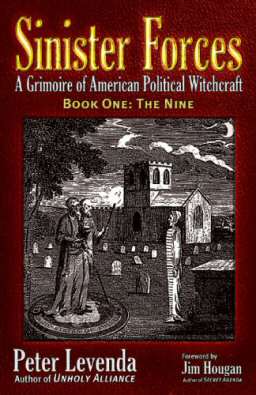
Peter Levenda
Waterville (Oregon); TrineDay; 2005, h/b, $29.95
This has a foreword by Jim Hougan who describes it as ‘one of the darkest and most provocative books that you are likely to read’. I’m a big fan of Hougan’s but I didn’t get this book. Not that it isn’t an interesting read: it is. But you would have to be seriously incompetent to make uninteresting a subject list which includes assassination, mind control, the occult, extraterrestrials, channelling etc. My problems are with the author’s belief in the Jungian notion of synchronicity, in his words: ‘another mechanism in the universe that binds together events seemingly unrelated’. I have never found this convincing but the author uses it to linkup all manner of what appear to be discrete events into apparent patterns
For example, on pp. 90/91, in a chapter on Charles Manson, we bounce from John Keel’s The Mothman Prophecies, back to neolithic times, thence to the Druids, to Crowley’s Golden Dawn, to William Sargant’s Battle For the Mind, to Robert Graves (a friend of Sargant’s) and finally to the apparent fact – from Keel – that Native Americans shunned West Virginia. In my universe these are simply not connected, or so loosely connected as to be virtually meaningless. But for the author, for example, the fact that Sargant knew Graves is significant:
‘Thus, this strange nexus of mythologist and mind control expert is one of many reference points or “cultural traces” in our strange matrix where the spoor of sinister forces may be discerned.’
But ‘nexus’ and ‘matrix’ are like synchronicity, implying causality without demonstrating it.
Take another example. The author discusses the wartime OSS propaganda career of the writer Hans Habe and links this to the murder in 1968 of Habe’s daughter, Marina. He writes:
‘Marina had been known to the Manson family and thus they would have presumably known of her famous father and his activities during the war.’ (emphasis added)
From what I have read of the women around Manson, I wouldn’t presume that they could tell you when WW2 began, let alone something as minor as the work of an obscure OSS officer. But Levenda needs the OSS link because the father of the actress Sharon Tait, the Manson gang’s most famous victim, was an American intelligence officer serving in Vietnam when she died. What he wants to say is: Look, both girls with spooks for fathers! Both killed by the Manson gang! But there is no evidence that Marina Habe was killed by the Manson gang. He does the same sort of thing with Arthur Young and Ruth Paine. Young was a psychic researcher, inventor, astrologer, and a member of a group of people who were assembled by Andrija Puharich (later famous for his association with Uri Geller) in 1953 to witness a channelling session with an Indian mystic. Puharich was then employed by the US Army in psychological research in the field that we now think of as ‘mind control’. But Arthur Young was also the father-in-law of Ruth Paine, the woman who befriended Marina Oswald in Dallas. Yes, it’s another matrix! At this stage you either go, ‘Wow!’, and begin speculating about a hitherto undetected occult dimension to the Kennedy assassination, as the author does, or ‘So what?’ as I did. The author’s approach can be summed-up by his trip to Charles Manson’s home town of Ashland, Kentucky, where he discovers two things: Manson’s uncle was stabbed to death by persons unknown there in 1969, three months before the Manson ‘family’ killings; and there are Native American burial mounds in Ashland. To the author these facts have some – vague, indefinable – explanatory bearing on Manson’s activities. To me they don’t. Manson’s behaviour is entirely explicable when you read about his appalling childhood. Indeed, America got off lightly.