
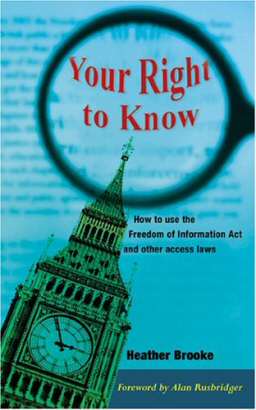
Heather Brooke
London: Pluto Press, 2005, £12.99 p/b
This book is an invaluable guide for anyone thinking of using the new access laws chiefly the Freedom of Information Act 2000 or the Environmental Information Regulations to obtain information from public authorities. It tells you how to go about obtaining information and appealing, and includes letter templates for making FOI requests and appeals. It describes the many classes of exemptions, and also provides a lot of useful and interesting background information. Having worked in America and used the (much stronger) US Freedom of Information Act, Heather Brookes is able to make comparisons between the situation here and in the US with regard to secrecy and the availability of various types of information:
‘Too often our civil liberties are invaded on the basis of ‘protecting national security’ ….The FOIA may help to curb this abuse because it adds a public interest test to the national security exemption. However, there are many obstacles to the public’s right to know in this area. Firstly, most security services are absolved from the public interest test by virtue of s23 of the FOIA [the MOD and Special Branch are covered by the Act] …… There are numerous dangers with having such a blanket exemption. One of the worst abuses came to light during the Matrix Churchill arms-to-Iraq case in 1992 when the government showed it was willing to see innocent people go to jail rather than disclose documents that proved it had secretly reversed its policy of denying arms sales to Saddam Hussein…..This is the inherent danger in letting those people who have a vested interest in suppressing information for political convenience make the decision about what is a matter of national security…It is therefore lamentable that all security and intelligence services have been given a blanket exemption from the Freedom of Information Act via s23…..It provides an absolute exemption for information that was supplied directly or indirectly, or relates to the following security bodies: the Security Service (MI5), the Secret Intelligence Service (MI6), GCHQ, Special Forces …the National Criminal Intelligence Service…a certificate from a minister is all that is needed for the exemption to apply…….The security services in the United States manage to operate within the confines of their (much stronger) FOI law. That is not to say they have welcomed such openness, but at least the public have some means of discovering whether these agencies are abusing their vast powers’
Chapter headings include Central Government; Local Government; Intelligence, Security and Defence; Health; The Environment; Law Enforcement and Civil Defence; Education; Information about Individuals (which involves using the Data Protection Act 1998). Each chapter provides detailed information on how and where to obtain different types of information, including addresses and, where possible, websites of relevant agencies; also names of Freedom of Information Officers, plus their phone and fax numbers and e-mail addresses; and websites of agencies’ publication schemes. These are required of public authorities under the FOIA and should contain, at least, a list of publications available, costs, and a contact for information requests.
The website <www.yrtk.org> accompanies and updates the book, section by section, and carries news, articles and information about the operation of the Act.