
Hugh Wilford
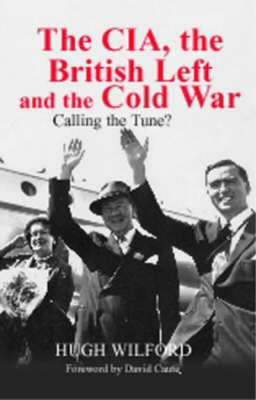
London: Frank Cass, 2003; £22.99, h/b
This book is a striking example of how far we have come. A senior British academic writing a book with this title was inconceivable 20, even 10 years ago. But there is now a group of British academics, historians mostly, who are working on the history of our secret state; and not just as cheerleaders, like Christopher Andrew. The picture we now have of British domestic politics and the role of the various secret or confidential bodies working in it is infinitely more complex than it was when this magazine first appeared in 1983.
Wilford’s subtitle tells us what the book is going to do. Francis Stonor Saunders’ account of the Congress for Cultural Freedom and the CIA (reviewed in Lobster 38) was titled ‘Who Paid the Piper?’ and implied, rather than actually demonstrated, that the CIA was calling the tune. Over a much wider field than Saunders, with chapters on IRD, the New Leader, labor diplomats (American labor attachés), the European Movement and the creation of Bilderberg, the Congress for Cultural Freedom and Encounter/, Wilford questions the conclusion of the musical metaphor.
Some of this is familiar; some familiar but with new sources; some new. Some of it involves the CIA, and some of it does not. There are few traces of the CIA in the IRD or Bilderberg chapters. Because of Retinger’s role in its creation, it always seemed likely that Bilderberg was a British enterprise; and Wilford concludes this, citing a C. D. Jackson comment that Retinger was a British agent, an opinion ‘pretty well shared by some other people who are in a position to know better than I [Jackson]’ – reference, presumably, to the CIA (p. 275). This is by far the most detailed account of Bilderberg’s origins and even includes a picture of the first meeting, with then Labour leader Hugh Gaitskell on the very back row.
Wilford thanks 8 bodies for financial assistance and 16 US libraries. The available archival bushes seem to have been thoroughly beaten and he confirms the basic thesis of the spook-wise left: American money was all over the British left in the Cold War:
‘CIA operations affected every section of the Cold War British left’. (p. 2)
But ‘affected’ doesn’t mean controlled.
‘To suppose, then, that those British leftists who became involved in the CIA’s operations were dupes or slaves of American foreign policy is to repeat the mistake made by Gaitskell and his followers when they identified all critics of their defence policies as puppets of the Kremlin.’ (p. 3)
Wilford shows that the relationships between the state and non-state forces in the anti-communist world of the early post-war years were more complex than simply the CIA running things, calling the tune.
Had his text not been framed as a kind of response to Frances Stonor Saunders, there is the outline of another book here, on wider US influence in Britain. For example, he refers to the various Congressional schemes which took labour figures and MPs to the US; a similar scheme, ‘Workers’ Travel Grants’, was run by the English-Speaking Union (ESU).
‘In January 1953 the ESU, with funding from an American source described as a private donor, established a Current Affairs Unit under the direction of intelligence expert General Leslie Hollis and the chairmanship of Francis Williams’ (p. 175).
I would need to see the evidence of the ‘private donor’; the presumption must be that this is another state – possibly CIA – operation. And you get many bonus points if you remembered that General Leslie Hollis crops up on Common Cause’s ‘Advisory Board’ and with the Chiefs of Staff’s anti-communist activities. Wilford’s section on Common Cause adds a number of details to the extant picture and illustrates his theme of the friction between state and non-state anti-communist forces; but its more important spin-off, IRIS, is mentioned only in passing. There’s even a reference to the Economist Intelligence Unit (p. 284), long suspected of being spook-connected.
The book is dotted with fascinating detail. The most telling concerns Sam Watson, the leader of the Durham miners, and Hugh Gaitskell’s closest ally in the trade unions. When Watson travelled down to London he didn’t stay in a hotel; he stayed in a room at the American Embassy. Had this been known at the time the entire history of the British Labour Party in the 1960s might have been different.
This is a very important piece of work.