
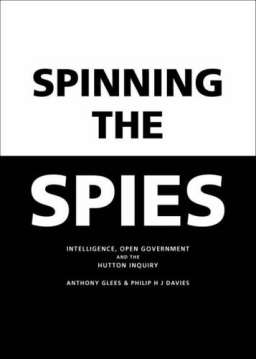
Anthony Glees and Philip H. J. Davies
London: The Social Affairs Unit, 2004, £30, h/b
This is a curious little book (112 pp.) in which two conservative intelligence academics wrestle with the realities of the events leading up to the attack on Iraq. But what manner of beast is a conservative intelligence academic? The basic view of these gentlemen is that the oiks us need not be consulted or informed; we should not bother our heads with such matters because:
‘Public discussions of many sensitive matters of foreign policy can invite political reactions and outside pressures that can prevent effective and comprehensive policy deliber-ation and consideration of all the available options’ (p. 19)
Further:
‘…official secrecy is a functional necessity of Cabinet government and the non-separation of powers’; (p. 19)
By which they mean that the public services, the state’s employees, have no political role unlike the US where there is ‘competition for influence and power between the Executive Branch and the Legislature, and between government agencies and bureaus (sic).’ (p. 19)
With this the authors rather pleasingly confirm one of the prejudices of the left: that the right can only sustain its beliefs by ignoring reality. The explosion of information in the last 20 years on intelligence events and history has shown that this model is just a model; and what we have in Britain is simply an undeclared and unpublicised separation of powers in which ‘government agencies and bureaus’ compete for power and influence. Describing and analysing this competition for power and influence is or should be a part of an academic study of the intelligence services.
To deny this seems perverse; but the authors would have rather perverse judgements than the real world. At one point they refer to ‘the supposed role of the CIA in the overthrow of Chilean leftist president Salvatore Allende’ (p. 35) Yet the documents, official US government documents, which show the CIA’s involvement in the overthrow of Allende are available on the Net. ([21])
In this parallel universe of theirs the authors believe that the publication of the ‘dodgy dossier’ on Iraq’s WMD
‘undermined the central concept of representative governance, namely that a government is elected to decide on behalf of the electorate what should be done, particularly in highly-fraught situations of grave national crisis.’ (p. 75)
Why did they use ‘governance’ and not ‘democracy’ after ‘representative’? Because ‘democracy’ means us oiks; our role is to elect others to decide for us.
The authors think that all this discussion of, and the political use made of, intelligence is a grave error:
‘….at the interface between the public world and the secret worlds, the pressure to use intelligence to gain public support for a policy allowed political considerations to feed into the intelligence ass-essment process. The net result may have been to omit words or qualifying statements or to present as certainties matters which were only probabilities misleading, though not, as the BBC, asserted, mendacious’ (p. 76)
I leave it to the reader to consider the distinction between misleading and mendacious. This view is only of interest if the proposition implied in the first half of the sentence is true: namely, that political considerations do not ‘feed into the intelligence process’. But how can they not? How could they not in the case of the Iraq war? Everybody and their cousin knew Blair had agreed to support a US attack; and supporting the Americans is the political consideration which is always in the intelligence process.
The authors tell us:
‘No British Prime Minister, even one with an overwhelming majority in the House of Commons, could have sufficient muscle to bully the JIC into certifying as genuine intelligence which was false or dubious’ (p. 82)
This may or may not be true but this wasn’t the issue. The JIC was being asked to give assent to a decision on which virtually the whole British political-intelligence establishment is in general agreement: supporting America. (Given the beautifully timed leaks during the May General Election campaign of secret documents about the events leading to the war, evidently there were dissenters within the state.) The JIC didn’t need to be bullied; the process is more subtle than that. In any case, the JIC precisely certified as ‘genuine’ intelligence which was ‘false and dubious’: it has almost all had to be ‘withdrawn’ by MI6. ([22]) Indeed, as the Australian analyst Rob Barton has told us, the JIC Chair, John Scarlett was still trying to get ‘false and dubious’ intelligence put in the report of the Iraq Survey Group after the invasion had been successful. ([23])
Notes
[21] At the National Security Archive site, <www.gwu.edu/~nsarchiv/NSAEBB/NSAEBB8/nsaebb8i.htm>
[22] See, for example, Richard Norton-Taylor, ‘We got it wrong on Iraq WMD, intelligence chiefs finally admit’, The Guardian 8 April , 2005
[23] See ‘Iraq’ in this issue.