
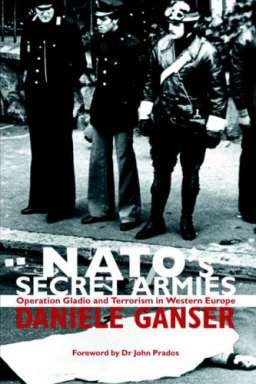
Daniele Ganser
London: Frank Cass, 2005, £22.99, p/b
Country by country the author has assembled what has been made public about the Gladio network since it was revealed in 1990. There are even 3 pages on the Gladio network in Luxembourg. Much of this is appearing in English for the first time and it would be hard to overstate its importance. An organisation set up by NATO to act as ‘stay behind’ groups in the event of the Soviet occupation of Western Europe, ended up murdering Franco’s critics in Spain; murdered the left, union leaders and Kurds by the thousand in Turkey; was part of the ‘strategy of tension’ in Italy; and killed 28 people in a series of random shootings in Belgium in the 1980s. And this is what we know of. Since none of the states involved have held really serious inquiries serious meaning subpoena powers and the threat of imprisonment into the secret organisation revealed to have been in their midst for 40 years, we will never know what was actually going on. What we do know is bad enough and it shows, once again, that in post-war Europe much of the ‘terrorism’ came from the right, directed by the state, in the name of anti-communism.
The big question Ganser cannot answer is: to what extent were these activities co-ordinated by NATO? Was the formal NATO control meetings and a NATO management structure real? Did the Turkish state get permission from this management to use Gladio to kill thousands of people? Were the killings taking place in Belgium only a few miles from NATO HQ being directed by NATO personnel? If they were, this would be startling confirmation that the left critics of NATO, who saw it as essentially the means of enforcing American power in Europe, were right. But we don’t know yet.
This is a tremendous piece of research, coping with the languages of NATO members’ countries, and it is terrible shame that Ganser’s publisher didn’t bother to have someone copy edit the book and rewrite the author’s occasionally clumsy English.