
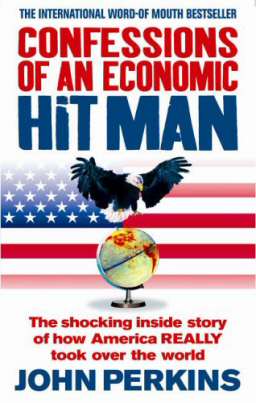
John Perkins
San Francisco: Berrett-Koehler, 2004, $25.95, h/b ( £14.50 from Amazon.co.uk in January 2005)
This is an interesting book, though it is not quite as interesting as it sounded in the interviews with the author which are on the Net. The key material is Perkins’ account of working as an economist for an American company, Main, which did research for the World Bank research which helped to determine the lending policies of the Bank. Perkins researched what he calls LDCs (less developed countries) and wrote development plans for them in the 1970s and 80s. These plans were, with one exception, wildly exaggerated, forecasting ridiculous levels of growth if here’s the point large amounts of (mostly) American money were lent to the LDCs. What he’s describing is an international version of the mafia ‘bust out’, where a business borrows from the mob shylock at ridiculous levels of interest, fails to make the payments, and falls into the hands of the mob, who then strip it of its assets. ([12])
‘But my real job was deal-making. It was giving loans to other countries, huge loans, much bigger than they could possibly repay. One of the conditions of the loan let’s say a $1 billion to a country like Indonesia or Ecuador was that the country would then have to give ninety percent of that loan back to US companies, to build the infrastructure companies like Halliburton or a Bechtel. Those companies would then go in and build an electrical system or ports or highways, and these would basically serve just a few of the very wealthiest families in those countries. The poor people in those countries would be stuck ultimately with this amazing debt that they couldn’t possibly repay. A country today like Ecuador owes over fifty percent of its national budget just to pay down its debt. And it really can’t do it. So we have them over a barrel. When we want more oil, we go to Ecuador and say, “Look, you’re not able to repay your debts, so give our oil companies your Amazon rain forests, which are filled with oil.” And today we’re going in and destroying Amazonian rain forests, forcing Ecuador to give them to us because they’ve accumulated all this debt. So we make this big loan, most of it comes back to the United States, the country is left with the debt plus lots of interest, and they basically become our servants, our slaves.'([13])
But was enslaving and asset-stripping say Ecuador the intention of these schemes? It has been clear since the early 1970s and the first wave of critiques of the IMF and World Bank ([14]) that enslaving LDCs was the outcome of the ‘aid’ process; but it was never clear to me that this wasn’t just dumb economic theories applied by the well-meaning. Perkins’ significance is that he says ‘Yes, it was the intention to enslave LDCs’ at least at the higher levels. Perkins claims that he did know, at the time, that this was the operation and puts in quotes comments to this effect made to him by the woman who recruited him to the job. (30 year-old quotes? Hell of a memory!) But he also adds:
‘….the vast majority had merely performed the tasks they had been taught in business, engineering, and law school schools, or had followed the lead of bosses in my mould, who demonstrated the system by their own greedy example through rewards and punishments calculated to perpetuate it.’ (p. 204)
Notes
[12] This was also a feature of the British empire. Scott Newton refers to this happening in Egypt. See his Historical Notes in Lobster 42, p. 27.
[13] http://dominionpaper.ca/labour/2004/12/19/confession.html
[14] See, for example, Cheryl Payer, The Debt Trap (Harmondsworth: Penguin, 1974)