
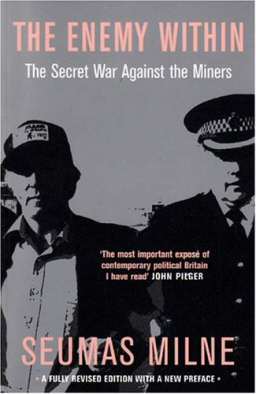
The Enemy Within: The Secret War Against the Miners
Seumas Milne
London: Verso, 2004, p/back, £8
GB84
David Peace
London: Faber & Faber, 2004, p/back, £12.99
On the 20th anniversary of the most significant power struggle in post war Britain, two very different books on the miners’ strike of 1984-85, read alongside each other, offer real insights into this epochal confrontation.
Seumas Milne’s updated account of this watershed moment in British history is investigative journalism at its very best. It is a stunning exposé of the strategy and tactics of right wing elements in the British state and their business allies, in their quest to fundamentally transform the UK political landscape.
This epic battle was the culmination of a long series of anti-trade union and anti-Labour actions, planned and executed by Nicholas Ridley and Margaret Thatcher. Their ambitious purpose was to weaken, or preferably confine to history, socialist or social democratic values of solidarity and collective action. They were intent upon the permanent establishment of a new market-driven, neo-liberal economic order based upon Thatcherite beliefs in individualism and the unquestioned merits of private and corporate capital enterprise.
An important section of Milne’s work tackles the still prevailing myths peddled, in the main, by those in the labour movement and in the ‘left’ press who failed to understand the world-historic importance of this strike. It is now clear that the NUM leadership were faced with a state-organised operation to shut down the coalfields and that a negotiated compromise was never an option available to them.
For those who argued that the NUM could never win this strike, there is now firm evidence, cited in this work, that the Tory government and the NCB came close to defeat around late October 1984. The offer of jobs, special pension deals and financial inducements to some officials of the pit deputies’ union (NACODS) may have been crucial in the decision to call off their strike on 24 October. A NACODS strike would have closed down all pits, and in this eventuality, Thatcher had plans to send in the Army. Furthermore, exactly at that dramatic moment, there is some evidence of a highly risky, secretive operation to sabotage the miners’ cause (see below). Since Thatcher and David Hart were absolutely determined to prevail, they would surely have prepared to play some desperate last card.
Another damaging myth was the mistaken assertion that the NUM were standing against cold economic logic, that most pits were uneconomic and that coal had no place in the future of energy supplies. In fact, the Ridley plan was to manipulate energy markets to both weaken trade union power and influence and permanently remove natural Labour constituencies in the coalfields, steel towns and docklands.
To his great credit, Milne is able to systematically demolish all the central accusations levelled by the government and the press, led by the Mirror, at the NUM and Arthur Scargill. It is salutary to realise that some of these charges, such as the mortgage repayments of NUM leaders from Libyan largesse, could have been dismissed at the time through elementary research. Milne’s determination to get to the truth results in some sections being arcane to all but the most patient, committed reader. This is not a criticism, but a warning to those who find that this real-life thriller occasionally turns into a dogged paper chase. This outstanding study makes an imperative case for a radical overhaul of the security services in a society professing to be a democracy.
 A complimentary ‘novel based upon a fact’, as the author, David Peace puts it, brilliantly adds to our understanding of this political drama. GB84 is a bold and disturbing mélange of an industrial diary and documentary, an insight into the sinister world of ‘deep politics’ and a quick moving crime thriller, all laced together with a passionate literary style described variously as ‘occult history’ and ‘Northern noire’.
Peace mixes three linked but continuous narratives cutting into each other: the angry and painful diaries, in dialect, of two striking Yorkshire miners; an account of the crucial role of the senior administrative officer of the NUM, based on the widely-held view that Roger Windsor was MI5 agent; and a brutal portrayal of the machinations and skulduggery which characterise the black underbelly of state politics.
Most of the leading actors in this drama are renamed or nicknamed. David Hart, Thatcher’s plutocratic ‘eyes and ears’, is Stephen Sweet or the Jew, as his secret agent chauffeur and co-conspirator calls him. Thatcher is always the PM or Her, and Scargill is simply the President. The Mechanic or David Johnson is clearly modelled on David Gricewith, who died in police custody from shotgun wounds in Stockton in February 1987. Within hours of his extraordinary and highly suspicious death, and without the necessity of proof, Gricewith was named as the killer of police officer, Sergeant John Speed, in Leeds on 31 October 1984.
To this day, there has been no believable explanation as to why this officer was clinically executed in broad daylight. Some circumstantial evidence exists that this could have been a bungled attempt to blame the death on a couple of NUM militants with military backgrounds. Whatever the explanation, this tragedy happened exactly when dwindling coal stocks was a major issue, and the crucial NACODS strike decision was in the balance.
Peace speculates that the Mechanic may have led an Army-trained group operating as agent provocateurs on picket lines and as a hit squad when required. He weaves in several fascinating strands from that period, including the murders of Hilda Murrell and WPC Fletcher. More importantly, there is a suggestion of a genesis in British Army-supported paramilitary activity in the north of Ireland in the 1970s. There is also a nod in the direction of the Gladio story of a European network of right wing military units with their hidden arms dumps.
This stimulating novel even hints at an interconnection between the ‘strategy of tension’ in Italy in the 1960s and 1970s, which was designed to create a political crisis from which an ‘authoritarian moment’ could be born, and the motives of the American neo-conservatives who have replaced ‘the Cold War’ with the new ‘security’ preoccupation, the almost completely phoney ‘war on terror’.
These two, very different, versions of this epic struggle are essential reading for students of ‘deep politics’. Together, Milne and Peace have contributed hugely to our comprehension of that year long, dark, brutal confrontation which destroyed the fabric of many British communities and heralded a tougher and more divided phase of capitalism.