
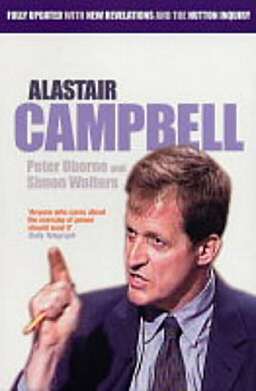
Peter Oborne and Simon Walters
London: Aurum Press, 2004
p/back, £8.99
If you were going to read only one book on New Labour, this account of the New Labour people and their relationships with the media, from the days of opposition through to Campbell’s resignation in the wake of the death of Dr David Kelly, would be my nomination. All the familiar events in the great saga of ‘spin’, the Blair group’s attempt to manage the British media, are here; and done in great detail. Almost incidentally, this is also the best study of the incompetent, lazy, craven British political journalist I am aware of.
Looked at closely like this, the little group round Blair were a strange bunch of terribly straight people, totally lacking in self-awareness, but with incredible egos. Vanity, jealousy, sulking, back-stabbing, arse-kissing and careerism are the dominant themes. (To the cynics who are thinking that those are always the dominant themes of politics, I would say: read the diarists of the Labour governments of the sixties and seventies; it wasn’t always this bad. This is politics played out by a dumbed-down, career-obsessed generation.)
Running through the book is a thesis that the new power in the land is a ‘Media Class’.
‘By the 1980s, however, the Media Class had established itself as the most powerful force in British national life……the power that had drained from parliament, from ministers, from the Cabinet and other traditional institutions of state has had to go somewhere. It has been amassed, instead, by the Media Class.’
‘Class’ is the wrong word, of course; and while the thesis is obviously correct to some extent, it is overstated. Compared to the power of the nation state, the power of the media, like the power of other corporations, is largely illusory. Having kissed Murdoch’s butt before the 1997 election and got The Sun’s endorsement, with a large parliamentary majority, Blair et al could have introduced a bill restricting ownership of newspapers published in the UK to UK or EU citizens (as the Americans do; which is why Murdoch became an American citizen); or set the Mergers and Monopolies Commission and/or the Inland Revenue onto News Corporation; or set up a large fund to enable ordinary citizens to sue newspapers; or introduced a Right of Reply Act. Etc etc. In the event they did nothing. The conservative nature of the British media became the cover story for their own conservative beliefs.
A member of the Labour Party for tribal rather than political reasons, Campbell is portrayed as a man with few political beliefs. Like Blair, he despised most of the Labour Party, the British state, democracy and journalists. The only people he and Blair don’t seem to have despised are the rich and the powerful, especially if they owned newspapers. Like Blair, Campbell seems to have wanted to be something, not do something. In the end he became co-Prime Minister, shepherding and bullying the ignorant, naive and uncertain Tony Blair through his first term. That this did not become widely known was due Blair’s virtual abolition of minuted cabinet meetings in favour of tête-à-têtes with individual ministers – and the willingness of the Cabinet members not to blow the gaff.