
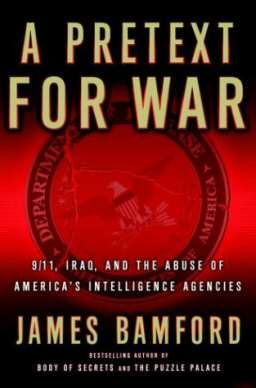
A Pretext for War: 9/11, Iraq, and the abuse of America’s intelligence agencies
James Bamford,
New York: Doubleday, 2004, h/back, $26.95
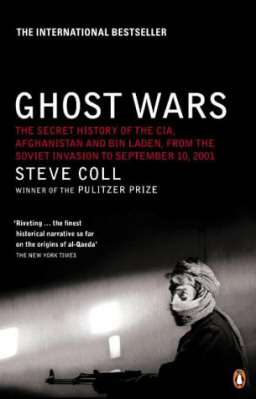
Ghost Wars: The Secret history of the CIA, Afghanistan and Bin Laden, from the Soviet invasion to September 10, 2001
Steve Coll
New York: Penguin, 2004, h/back, $29.95
These books cover some of the same ground but with different purposes. Coll’s enormously detailed account of the period from 1979 onwards, through the US funding of the assault on the Soviets in Afghanistan, and the consequences which flowed from those billions of dollars scattered so carelessly in Pakistan and Afghanistan – much of it ending up in the hands of Pakistan’s intelligence service – ends with the attack on the Twin Towers. Coll never quite says it, but his book is a 600 hundred page exposition of blowback.(1)
Relying chiefly on CIA sources, Coll does his best to present the CIA in as reasonable a light as the evidence will bear. He shows how the CIA tried to deal with bin Laden before 9-11, how they warned of bin Laden before 9-11 and how they were stymied in various ways by Washington inertia; reluctance to embarrass Arab customers and allies; inability to get bin Laden’s threat to the top of the crowded agenda; bureaucratic rivalries between the FBI and CIA; legal restrictions on killing non-US citizens; the difficulties of operating in Afghanistan, and so forth.
There are no heroes but the CIA’s bin Laden unit (which was correct but got ignored for years), CIA Director Tenet who eventually tried to get Washington to take bin Laden seriously and Richard Clarke, who did the same, get what little professional credit there is to be had from the killing of more than a million Afghanis.(2)
 Bamford spends much less time on the run-up to 9-11. With his NSA sources (he wrote The Puzzle Palace about the NSA), he emphasises the technical difficulties involved in tracking and intercepting people who are using digital communications, and criticises the CIA clandestine services as risk-averse and incompetent. Where Coll is ultimately putting the case for the CIA in the post 9-11 blame game, Bamford’s much less detailed account has a different political purpose. As the subtitle suggests, he uses the later sections of the book to run a critique of the Bush regime’s case for war and the activities of the neo-con, pro-Israel cabal at the heart of the Bush government: the whole sorry saga of Chalabi and the INC, the politicisation of intelligence, the Office of Special Plans and the production of fake ‘intelligence’.
The underlying lessons of these two books are two fold. The first is the extraordinary difficulties in funnelling information from the bottom to the top of a bureaucracy as large and as politicised as that of the United States national security structure. The second is that there is too much information; and there would be even more if the FBI/NSA/CIA had enough translators of the various languages being spoken to transcribe the mountains of intercepts. In short, you cannot police the entire world: it is technically impossible. And even if it were possible to intercept all the world’s communications, it would be impossible to analyse them. And even if you could, the US cannot act in the way it did in the 1950s when it could overturn governments it didn’t like and rely on a coopted American media not to even ask why and where. Largely thanks to the Net, the Bush mob’s Iraq adventure was being exposed before it took place and has been analysed since in unprecedented detail.
Notes
1 There is a very good, long review essay on this book – virtually a summary of it – by Chalmers Johnson in the London Review of Books, vol 26, no. 20, 21 October 2004.
2 There are other views of Tenet within the Beltway. Michael F. Scheuer, who led the CIA unit that tracked Osama bin Laden, commented in a letter to the 9-11 Commission: ‘you never mention that the D.C.I…. starved and is starving the bin Laden unit of officers while finding plenty of officers to staff his personal public relations office, as well as the staffs that handled diversity, multiculturalism, and employee newsletters.’ See Eric Lichtblau, ‘CIA Officer Denounces Agency and Sept. 11 Report’, The New York Times, 17 August 2004 <www.nytimes.com/2004/08/17/politics/17intel.html>