
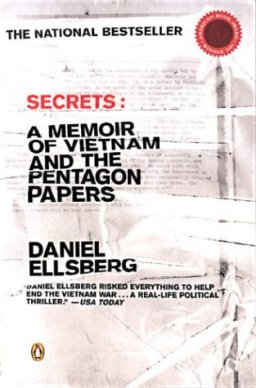
Daniel Ellsberg
New York: Viking, 2003
Colin Challen MP
The timely publication of Ellsberg’s memoir shows that from the 1964 Tonkin Gulf incident to the Arabian Gulf in 2003, little seems to have changed in the United States’ approach to starting war. Ellsberg’s account of secret White House activity in the wake of the Tonkin incident shows how initial ineptitude was turned into cynical manipulation to create the pretext for ramping up military activity in Vietnam. The key component in securing the future of any military campaign would be to convince Congress that this had to be done.
The first ‘torpedo attack’ by the North Vietnamese on the USS Maddox took place on 2 August 1964, with a second alleged attack two days later. But after reports came in to Washington of the second attack and as confirmation was sought, doubts were already evident that anything so warlike had actually happened. It almost certainly was just an over-reaction by the Maddox’s commander to an incorrect interpretation made by the ship’s sonar man of stormy conditions or the boat’s own propellers. Ellsberg records how he was eventually convinced no attack had occurred. But by 7 August, it was too late. President Johnson was able to secure Congress’s approval for a motion saying,
‘Congress approves and supports the determination of the President, as commander in chief, to take all necessary measures to repel any armed attack against the forces of the United States and to prevent any further aggression.’ (1)
Within barely 72 hours, Johnson had used a minor though probably non-existent ‘incident’ in which there was, in any case, no loss of life to win democratic legitimacy for a war which would eventually claim the loss of hundreds of thousands of lives. This was the crucial turning point, more important than the changing language of National Security Action Memoranda 263 and 273, which were issued before and after JFK’s assassination, and which allegedly show Johnson’s hawkish intent to reverse Kennedy’s timid plans for withdrawal from Vietnam. (2)
Then, as today, the hawks would win their arguments would by stretching the truth an understatement, since what constituted the factual basis of the Tonkin incident remains unproven. What happened clearly was much less than what Johnson was told or subsequently convinced himself of. In the 1970s, just before the Pentagon Papers were released, Ellsberg recalls:
‘General Maxwell Taylor was being interviewed [on TV] by Martin Agronsky, in a program that had been taped earlier. He was describing his recommendations to President Kennedy in November 1961. He was telling Agronsky and the American public ten years later: “I did not recommend combat forces. I stressed we would bring in engineer forces, logistic forces, that could work on logistics and help the very serious flood problem in 1961. So this was not a combat force …… I did not recommend anything other than three battalions of infantry. Pardon me, three battalions of engineers.” A decade had passed since his actual recommendations, and the president to whom he had given them was dead. I recall thinking two things as I listened to him: The president’s men think they have a license to lie that never expires, and watch what you say, General. Your cables are coming out any day now.’ (3)
In today’s context, we could do with a few more people who say ‘Watch what you’re saying’ to whomsoever obfuscates and lies in order to wage war. Note the General’s reference to humanitarian aims, the flood problem of 1961: are not all modern wars built on humanitarian presumptions? But it is Ellsberg’s comment about the ‘president’s men having a license to lie that never expires’ which tells the story. Ellsberg struggled to ensure that the truth would reach the president’s ears. He spent a considerable period in Vietnam, and, unlike his State Department contemporaries, actually got out of Saigon’s hotels to see for himself what conditions were like in the countryside, which is where the war would be won or lost. His accounts of this period are amongst the most compelling in the memoir, since it was this direct experience which led him to the conclusion that the war could not be won. Or at least, it could not be won on the basis of anything less than a massive deployment of troops well beyond what was politically acceptable.
This was Ellsberg’s human intelligence, as opposed to the ‘Humint’ variety of wishful thinking the president’s men were peddling. But presidents down the line were continually presented with wishful thinking from the military whose lies, being self-deceptions, they would not recognise as deliberate falsehoods.
Given the events of 2002/2003, it is clear that not much has been learnt from history. With the Cold War over, and with a far less capable opponent, it may have seemed today as if war on Iraq would be an open and shut case without all the attendant risks the US faced in 1964. But what has really changed? One of the lessons about Vietnam that Ellsberg himself learnt whilst reading the Pentagon papers was:
‘Since at least the late 1940s there had probably never been a year when political violence in Vietnam would have reached or stayed at the scale of a “war” had not the US president, Congress and citizens fuelled it with money, weapons and ultimately manpower: first through the French, then funnelled to wholly owned client regimes, and at last directly. Indeed there would have been no war after 1954 if the United States and its Vietnamese collaborators, wholly financed by the United States, had not been determined to frustrate and overturn the process of political resolution by election negotiated at Geneva.'(4)
It is plain that the same old approach was deemed suitable for Iraq. For all its military sophistication and certainly because of it the United States administration’s mindset remains locked into a globalised form of control freakery which seems unable to recognise that whilst Iraq does not present the challenges of a jungle topography, it does contain a human challenge more demanding. No amount of Agent Orange and puppet regime change will make the Islamic undergrowth disappear; it will merely help to propagate a diffuse but deeply rooted resistance which Bush’s tough-talking National Security Strategy and bigger Pentagon budgets cannot address.
Whilst Johnson had a gratuitous and timely pretext to escalate the Vietnam war, Bush has now got a gratuitous and timeless ‘fighting terrorism’ pretext to wage war wherever he chooses; but he is still faced with a reluctant need to give it a veneer of democratic legitimacy. In the absence of the bipolar context of cold war politics, this means having to pay lip service to the United Nations, to at least being seen to engage with world opinion. (5)
There have been no discoveries of Iraqi weapons of mass destruction and it is safe to conclude that they didn’t exist, certainly not after the end of the first Gulf war. In their absence, we were told that the war was not so much about WMD but because it was morally the right thing to do. The discovery of mass graves surely made the war justifiable, so the argument went. All of a sudden, the vast bulk of UN Security Council resolution 1441 which is devoted to the issue of WMD has been subordinated to the one paragraph which refers to resolution 688, passed in April 1991 and which talks of ending the repression of the civilian population and the need for humanitarian aid. How convenient that resolution 688 existed! How strange that at the time of 1441’s passing, more wasn’t made of it, if that was what this war was all about. Just as if in Ellsberg’s day General Taylor’s concerns about flooding in Vietnam weren’t his number one priority how could his good intentions have become so misunderstood?!
But it is important not to take Resolution 1441 at face value, because as the Foreign Office has said, it uses ‘diplomatic language’; that is diplomatic code as to how it should be interpreted any which way for later convenience. British MPs were advised that 1441 authorised without further ado, the use of military action the famous ‘serious consequences’. But it is hard to see how the resolution would have received unanimous support in the Security Council if that is what, for example, French diplomats thought it meant. As it was, it wasn’t what the Americans thought it meant either. On 25 October, 2002 the Deputy US Ambassador to the UN, James Cunningham said
‘We didn’t bring this issue in the Security Council to look for authorisation to use military force. We brought it into the Security Council to send a clear message to Iraq to strengthen and reinforce the Inspections regime so that it can have a chance of success.’ (emphasis added) (6)
Other accounts of the discussions that took place make it clear that 1441 did not authorise war, for that was a matter which would need further Security Council consideration and that did not happen because the so-called second resolution was not tabled, and the ‘coalition of the willing’ did not want to engage with the French proposals.
It is interesting that although Bush’s National Security Strategy itself barely manages to pay lip service to the United Nations he still felt obliged to seek UN approval for war on Iraq. 40 years previously, Johnson could at least have argued that his response to the Tonkin ‘incident’ was merely an act of self defence permitted under UN Charter Chapter Seven Article 51. Perhaps it was Blair who pointed out to Bush that his war may have been illegal without UN approval, and that a delay would be needed to create the impression that approval had been sought and actually given. Curiously, that was the spin placed on the failure to get the second resolution. But then why go for the second resolution anyway if 1441 did the job?
As with the escalation of the war in Vietnam, the public were hoodwinked by a huge deception. How many people over the coming years will be killed as a consequence of the deepening instability of Middle Eastern states and the growing Islamic backlash? Already more servicemen and women have been killed in Iraq since Bush declared the conflict over than died during it.
The publication of the Pentagon Papers did not lead to the end of civilisation as we know it. The days that Ellsberg and a handful of compatriots spent photocopying those papers must count as one of the greatest acts performed in the service of their country during the conduct of the Vietnam War. In contributing to U.S. disengagement from Vietnam, they helped save many more lives and helped debunk the domino theory, the dominating fallacy of post-war American foreign policy.
Notes
1 Ellsberg p.16
2 Peter Dale Scott, Deep Politics and the Death of JFK, (London: University of California Press, 1993) p.24. I have not found any mention of NSAM 263 or NSAM 273 in Ellsberg which is a shame; but then he confines himself to matters in which he was directly involved, and he did not arrive at the White House until August 1964.
3 Ellsberg p. 396
4 Ellsberg p. 255
5 According to a report in the Financial Times, May 27th 2003 the decision to go to the United Nations was a result of a ‘compromise presented by Mr [Colin] Powell, and thrashed out through the summer months…. When Tony Blair flew in for an informal summit at Camp David on September 7th, the battle for the president’s ear was as good as won. “By the time we got there, Mr Bush was predisposed to go the UN route,” according to a senior Downing Street official. It was only when Iraq presented its dossier on WMD in December that the president was convinced military action was inevitable. A White House ‘insider’ said “There was a feeling the White House was being mocked …. a tin pot dictator was mocking the president.”‘ The exact timing of the decision was probably earlier. Michael Heseltine wrote in the Guardian (1 September 2003): ‘In one of London’s most prestigious dining rooms on November 13th 2002 I listened, along with some 200 of the “great and the good” to a very senior American politician close to the Bush administration tell us that it did not matter what happened in the UN or what the weapons inspectors said. The decision to invade had already been taken.’
6. Chicago Tribune 26 October 2002