
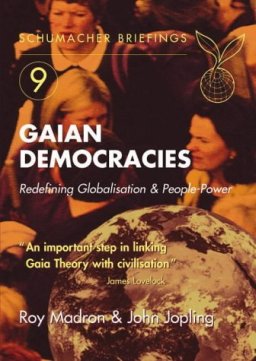
Roy Madron and John Jopling
Dartington (UK): Green Books, 2003, £8.00
The authors are eco-doomsters who believe the planet is on the verge of catrastrophe. I am also at heart though not in practice a deep green, for what it’s worth, and have been since the first ‘eco-politics’ wave of the 1969-71 period. (Remember Barry Commoner and Paul Ehrlich?) The authors think the only solution is for the world to move from the current dominance of the ‘Global Monetocracy’ to Gaian democracies.
For ‘Global Monetocracy’ read finance capital and for ‘Gaian democracy’ read socialism, syndicalism, anarchism or community self-management. The authors have redescribed the old arguments. When the left asked ‘How do we get to socialism?’, it divided over the one country/many countries debate between the Stalinists and the Trotskyists. The authors tell us that no single country can overcome the ‘Global monetocracy’ and they join the international socialists.
But the enemy remains the same.
‘The unjust and unsustainable aspects of globalisation stem from the purposes, principles and ideologies of a purposeful human system we have called the “Global Monetocracy” …… The elites of the Global Monetocracy use the power of property, personality, tradition, technology, myth, propaganda, the media, government, professional and technical expertise, the judiciary, and the police, patronage and, crucially, the power of ideology.’ (pp. 11 and 12)
Which is what the left has been saying since……
How to change this, how to rid us of this vast powerful, system? The authors assure us (p. 15)
‘With an accelerating accumulation of shared experiences, competences and people-power, there will eventually be a tipping-point at which “globalisation” will come to mean the global network of Gaian democracies, rather than the Global Monetocracy. By that point the vast varieties of power that the elites of the Global Monetocracy have at their command will have evaporated‘ (emphasis added).
Didn’t Marx envisage the state ‘wasting away?’
That the ‘Gobal monetocracy’ will evaporate seems profoundly unlikely to me, even if there is a vast blossoming of ‘Gaian democracies’; and that seems profoundly unlikely to me because the authors tell us that
‘Gaian democracies will only become increasingly just and sustainable if their citizens understand, are committed to, and share, a set of purposes and moral and ecological principles’ (p.111 ).
Since the majority of this (relatively) educated, sophisticated and wealthy country cannot be persuaded to use their cars less, what are the chances of them adopting ecological principles in the foreseeable future? (Perhaps as good as them discovering their true class consciousness, to continue the analogy with socialism.)
This is a romance; the authors are dreamers. (Which may be no bad thing.) Our likely future is more banal: slow degradation of the planet with periodic crises in this country flooding, energy shortages as the oil and gas begin to run out, unemployment, urban decay and racial conflict.
A Gaian democratic Britain? More likely the Gulf Stream shifts away, leaving us in a cold, populist, totalitarian nightmare, with the North Sea covering East Anglia.